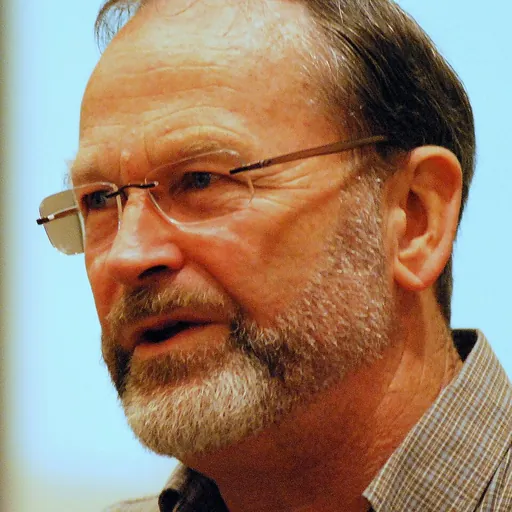
About William E. Rees
Born 1943. William E. Rees is a Canadian professor, ecologist and biologist, known for Ecological footprint.
William E. (Bill) Rees, PhD, FRSC, is a Canadian human ecologist, ecological economist and Professor Emeritus at the University of British Columbia in Vancouver, Canada, where he taught and conducted interdisciplinary research for more than four decades. He is perhaps best known for co-developing the ecological footprint concept and method of analysis with his graduate students. This quantitative tool estimates humanity's demand on nature, through measurable flows of energy and materials to and from ecosystems; it thus reinforces associated concepts such as ecological limits and biocapacity, and shows clearly that the human enterprise is in a state of advanced ecological overshoot.
Rees' work has long focused on the relationship between the human enterprise and the ecosphere, sustainability, human carrying capacity, over-exploitation, ecological overshoot, and urban systems and on cognitive barriers to understanding the depth of our eco-predicament. He has authored or co-authored hundreds of peer-reviewed papers and popular articles on these issues. His work is taken up by governments, nongovernmental organizations, educators, and scholars internationally. Rees has been a member of various sustainability-oriented organizations, including the Canadian Society for Ecological Economics (co-founder and past-president), OneEarth Living (co-founder), the Post Carbon Institute, and the Club of Rome.
Rees' contributions are widely recognized. He was elected a Fellow of the Royal Society of Canada and received a Pierre Elliott Trudeau Foundation Fellowship. Honours include the Blue Planet Prize (shared with his former student Mathis Wackernagel), the ISEE Kenneth Boulding Award for Ecological Economics, the Herman Daly Award, and an honorary doctorate from Université Laval.
He also held senior administrative roles at UBC, including Director of the School of Community and Regional Planning (SCARP).
Background Background / Youth
William E. (Bill) Rees was born on December 18, 1943, in Brandon, Manitoba, Canada, and spent his early childhood in Montreal, Quebec, and later in Toronto, Ontario. Many of his most formative experiences took place on his grandparents' farm in southern Ontario, where he began to experience and understand humans as a species within many ecosystems.
Since then, Rees has been concerned that few young people today have an opportunity to be "up close and personal" with the ecosystems that support them – and thus have never come to feel "in their bones" that they are part of nature.
Undergraduate studies
Rees first earned an undergraduate degree (B.Sc.) in Zoology from the University of Toronto. This foundational study of animal biology and ecosystems provided the groundwork for his later explorations of human ecology, carrying capacity and biophysical limits.
Ph.D in Population Ecology (University of Toronto)
Continuing his education with a scholarship to the University of Toronto, Rees earned his Ph.D. in population ecology. His fieldwork and academic courses equipped him with the conceptual and analytical tools to study population dynamics in relation to biocapacity, inter- and intra-specific competition, the interplay of positive and negative feedback, and how these factors ultimately impose limits on population and material growth. It also infused him with a lasting fascination with society's general ignorance of the biophysical foundations of its own existence. Thus equipped, Rees joined the University of British Columbia (UBC) in September 1969, initially with a joint appointment as assistant professor in the School of Community and Regional Planning (SCARP) and the (former) Institute of Animal Resource Ecology.
Early academic Experience
Rees was assigned the task of developing an "ecological planning" stream in SCARP, beginning with courses on the ecological basis for planning and on ecological land-use planning. His early research focused on the application of environmental impact assessment in Canada, but his background in ecology helped him maintain his broad interest in the biophysical requirements for human sustainability.
Shortly after joining UBC, Dr. Rees was appointed to an interdisciplinary committee tasked with establishing the parameters for a proposed new water-oriented research centre. He was asked to explain his research interests and potential contribution to the new centre. Rees presented a seminar to the committee on human carrying capacity and the relevance of the concept to water resource management. A senior colleague (one of Canada's foremost resource economists) later took him aside and warned him that, should he pursue this line of research, his career at UBC would be a Hobbesian "nasty, brutish and short." Apparently, economists had negated the concept of carrying capacity as applied to Homo sapiens.
This was Rees' introduction to the assumptions of neoliberal economics that the human enterprise operates separately from, and largely independent of, nature. His economist colleague told him that "human ingenuity (read 'technology') is the greatest resource" and that any residual local resource limits could be overcome through trade, at least until technology came to the rescue.
Ecological economics
Ecological economics attempts to restructure economics (resource extraction, allocation, and distribution) on a sound foundation of biophysical theory, particularly far-from-equilibrium thermodynamics. Rees argues that economic analysis must account for biophysical limits and ecological feedbacks, which would involve the implementation of degrowth dynamics when resource and waste constraints become binding. His 2020 article, "Ecological economics for humanity's plague phase," develops these arguments using ecological analogies of expansion and corrective feedback in complex systems. This perspective considers the question: "Is further population growth and urbanization advisable in an era of growing energy uncertainty?" In a 2023 paper with Mathis Wackernagel, Rees reviewed the foundational principles of ecological footprint accounting, its role in sustainability debates, and major critiques of the method.
Human carrying capacity
Conventionally, economists have dismissed the concept of human carrying capacity on the grounds that human inventiveness, techno-efficiency and international trade free regional populations from biophysical constraints. Rees argues that ecological footprint accounting dissolves this argument. Instead of asking the traditional carrying capacity question, "How many people can this area support?" ecological footprint accounting inverts the question and asks, "How much productive land/water area is needed to support this population, wherever that land/water is located?" The late biologist and naturalist E. O. Wilson called the ecological footprint "one of the most important environmental concepts today." The Post Carbon Institute describes it as the "world's best-known indicator of the (un)sustainability of techno industrial society."
Rees' legacy is closely tied to the ecological footprint concept; the Royal Society of Canada called it his "most influential contribution." Ecological footprint accounting has been acknowledged or used by governments at all levels, by major international organizations and agencies, and by dozens of private consulting firms to assess their or clients' demands on global biocapacity. The Global Footprint Network calls it "the world's premier measure of humanity's demand on nature." American environmentalist and entrepreneur Paul Hawken describes it as "the only standard by which we may calibrate our collective impact upon the planet." The World Wide Fund for Nature (WWF) adopted Ecological Footprint Analysis as a co-indicator of sustainability along with the WWF's own Living Planet Index. In short, the ecological footprint is an unusually successful example of an ecological concept crossing from the academic realm into public and policy language. Rees and other practitioners regret only that the method has not seriously constrained the ethic of perpetual growth.
Ecological economics Rees has had a significant impact on ecological economics, as ecological footprint accounting is firmly rooted in ecological economic theory. Ecological footprint accounts show graphically that the economy is a growing subsystem within the non-growing biosphere and, while in overshoot, is depleting the finite resources – even essential self-producing resources – of Earth.
In April 2011, Rees was the only ecological economist invited to present that year at George Soros' Institute for New Economic Thinking (INET) Annual Conference at Bretton Woods, a high-level meeting of financiers and finance economists. His renegade paper was titled "Toward a Sustainable Global Economy."
Carrying capacity Rees' work helped revive the debate about planetary limits and human carrying capacity. He had a major role in elevating discussions around ecological overshoot and the need to constrain consumption and reduce populations. Ecological footprint accounting shows unambiguously how much human demand on ecosystems has outpaced Earth's capacity to regenerate resources and absorb wastes. In short, by explaining sustainability in simple-to-understand terms, Rees has helped elevate the concepts of ecological limits and overshoot to the forefront in sustainability discussions.
Educator Rees has received praise from former students for his skill in teaching interdisciplinary science, describing his classes as "captivating," "compelling," and "exciting." Rees intended the ecological footprint concept to serve as a consciousness-raising tool to communicate biophysical reality to economists, other academics, and particularly the public. Even so, critics argue that Ecological Footprint Analysis is too static. They point out that it relies on agricultural yields per year (ignoring technological improvements in farming) and that it relies heavily on carbon land equivalence while ignoring ocean carbon sinks. Critics often label Rees' predictions of ecological overshoot as "neo-Malthusian" (referencing Thomas Malthus), arguing that his views on population contraction and degrowth are unnecessarily alarmist.
Additionally, in public climate discourse, the footprint has been criticized for emphasizing individual responsibility. This is in part because it has been used by the corporate sector in ways perceived to shift responsibility from corporations and governments onto individuals. For example, in 2005, fossil fuel company British Petroleum hired the advertising campaign Ogilvy to popularize the idea of a carbon footprint for individuals. The campaign instructed people to calculate their personal footprints and provided ways for people to "go on a low-carbon diet." This critique has occasionally contributed to broader skepticism toward footprint-based metrics, despite methodological differences between personal carbon footprinting and ecological footprint accounting, which compares demand on ecosystems with biocapacity.
Major Intellectual Contributions (Philosophy) Ecological overshoot
Rees describes ecological overshoot as the condition in which human demand on ecosystems exceeds Earth's capacity to regenerate bioregulators and absorb wastes. In this context, ecological footprint accounts enable us to estimate the extent to which humanity is living beyond available biocapacity. He calls these faux solutions "business-as-usual-by-alternative-means."
Biophysical limits to growth
Biophysical limits to growth refers to Rees' and others' argument that human economies are materially embedded within the ecosphere and therefore cannot expand indefinitely on a finite planet. This view places Rees' analyses within ecological economics and distinguishes his work from mainstream models that treat growth as potentially indefinite through efficiency or novel technological solutions.
Rees argues that human societies and economies are constrained by ecological limits, including finite biocapacity and thermodynamic realities. His ecological footprint method underscores that the economy is increasingly embedded within (and dependent on) the ecosphere and that material transformations are governed by physical laws.
Human behaviour and sustainability
Rees' later research focuses heavily on the neurobiological, cognitive, and cultural barriers to sustainability. He suggests that the human enterprise is constrained not just by biophysical limits, but by human nature itself. According to Rees, Homo sapiens is biologically predisposed, much like any other species, to expand geographically, reproduce exponentially, and consume all available resources (i.e., H. sapiens is potentially unsustainable by nature). Our paleolithic brains, which evolved to manage life in small, egalitarian bands within unchanging habitats, are cognitively obsolete to comprehend the sheer complexity and rapid changes characteristic of global-scale systems; we are unable to cope with the crises that emerge from excess exploitation and hostile interactions between human and natural systems.
To overcome the causative, deeply ingrained, and now maladaptive behavioural tendencies, Rees argues that modern humans could, in theory, use our capacity for logical thought to raise to consciousness the behavioural sources of our predicament.
Solution space
Rees outlines radical and specific opportunities for change to avert societal collapse. He argues, for example, that mainstream climate solutions under global capitalism (such as the "alleged" transition to renewable energy) fail because they do not address the proximate cause, ecological overshoot and its cause, excessive industrialization (mostly capitalist) on a finite planet. Rather, they increase overshoot by augmenting the already excessive scale of industrial civilization. Instead, Rees' solution space advocates for intentional compound degrowth, calling for a planned contraction of human economies and populations toward a steady-state. This is the system's ideal in which human material demands and impacts are kept within Earth's productive and assimilative capacities.
To restore alignment with the planet's regenerative limits, Rees emphasizes the necessity for non-coercive, voluntary population decline, helped by enhanced access to birth control methods, improved family planning education, and greater economic independence for women. He also challenges society to assert "collective reason over instinct" and socially constructed narratives, shifting the emphasis away from the modern fixation on competitive individualism toward mutual support and community cooperation.
Ecological footprint accounting has become one of the most widely recognized indicators used in sustainability and education, but it has also been the subject of ongoing scholarly debate. Some economists have argued that the ecological footprint is not a comprehensive or fully transparent planning tool, raising conceptual criticisms. Eco-modernist critics have further argued that the ecological footprint can be misleading and provides weak guidance for policy evaluation.
Rees and Wackernagel have acknowledged recurring critiques, such as that the footprint does not capture all environmental impacts and is primarily deductive rather than predictive; they defend the approach as a synthetic accounting metric intended to complement, not replace, other indicators.
Awards and honours Over the course of his career, Rees received a large range of scholarships, fellowships, academic honours, and international awards. These awards showcase his early scholarly achievements and his later contributions to ecological economics and sustainability science.
New College In-Course Scholarship, University of Toronto (1965–1966) National Research Council of Canada Postgraduate Scholarship (1966–1967) Ramsay Wright Scholarship, Department of Zoology, University of Toronto (1967–1968) National Research Council of Canada Postgraduate Scholarship (1967–1968) National Research Council of Canada Postgraduate Scholarship (1968–1969) Social Sciences and Humanities Research Council Study Leave Fellowship and Grant (1985–1986) Killam Senior Research Prize, University of British Columbia (1996) Named one of British Columbia's top / leading public intellectuals by the Vancouver Sun (2000) City of Barcelona 2004 Award (Multimedia Category), as a member of the winning team for the exhibition Inhabiting the World (awarded 10 February 2005) Elected Fellow of the Royal Society of Canada (FRSC) (2006) Pierre Elliott Trudeau Foundation Fellowship (2007–2010) Honorary Doctoral Degree, Laval University (2012) Kenneth Boulding Prize / Boulding Memorial Award in Ecological Economics (jointly with Mathis Wackernagel) (2012) Blue Planet Prize (jointly with Mathis Wackernagel) (2012) Herman Daly Award in Ecological Economics (2015) Dean's Medal of Distinction, UBC Faculty of Applied Science (2016)
Key Organization Affiliations Post Carbon Institute: Rees has been a Fellow since 2008/2009 at this think tank focused on helping the world transition away from fossil fuels and build resilient, sustainable communities.
Club of Rome: Rees served as a full member from 2014 to 2019. This international network of prominent scientists and economists is devoted to studying the complex interrelationships of global problems (the "world problematique"). The Club of Rome sponsored the (in)famous 1972 report The Limits to Growth.
Global Footprint Network: Rees helped institutionalize the footprint concept by serving as a founding adviser to GFN, an international nonprofit established in 2003 by his former PhD student and co-developer of Ecological Footprint Analysis, Mathis Wackernagel. GFN tracks the ecological footprints of all the world's countries, monitors global ecological overshoot, and manages the National Footprint Accounts (now located at York University).
OneEarth Living: In 2006, Rees was one of five co-founders of OneEarth Living, including sisters Vanessa and Dagmar Timmer, who continue to lead this organization. The Vancouver-based nonprofit "think-and-do tank" advances sustainable everyday living around the world.
Canadian Society for Ecological Economics (CANSEE): As a founding member and past-president, Rees helped establish this national chapter to bring together academics and policymakers to develop alternative economic models that operate within Earth's biophysical limits.
Royal Society of Canada (RSC): In 2006, Rees was elected a Fellow of the Royal Society of Canada (FRSC), the country's highest academic honour, recognizing his outstanding career contributions to ecological economics and sustainability science.
Great Transition Initiative: Rees serves as an associate fellow for this international network of scholars and activists, established under the aegis of the Global Scenario Group, analyzing the requirements for a transition to a sustainable global future.
Don’t just read it —
keep it.
Full-length biographies made to live with: read them, listen on the way to work, watch them tonight.
- E-book
- Audio
- Video
Instant download · yours to keep · every purchase keeps this site free
Important facts
People in William E. Rees's life
Named in this biography and alive at the same time



Related people
Same field, nearest in time



Contemporaries
People whose lives overlapped William E. Rees's


Frequently asked questions
Who is William E. Rees?
Canadian ecologist
When was William E. Rees born?
William E. Rees was born on 18 December 1943.
What is William E. Rees's occupation?
William E. Rees is a professor, ecologist and biologist.
What is William E. Rees known for?
William E. Rees is known for Ecological footprint.
What nationality is William E. Rees?
William E. Rees is Canadian.
Sources & further reading
Cite this page
APA: Biography.guide. (2026). William E. Rees. https://biography.guide/william-e-rees/
MLA: "William E. Rees." Biography.guide, https://biography.guide/william-e-rees/.
Chicago: "William E. Rees." Biography.guide. https://biography.guide/william-e-rees/.
Data last updated: 2026-09-22 · Spot an error? Report a correction.
Portrait: Wikimedia Commons · author & licence
Page generated 2026-09-27 05:02 UTC