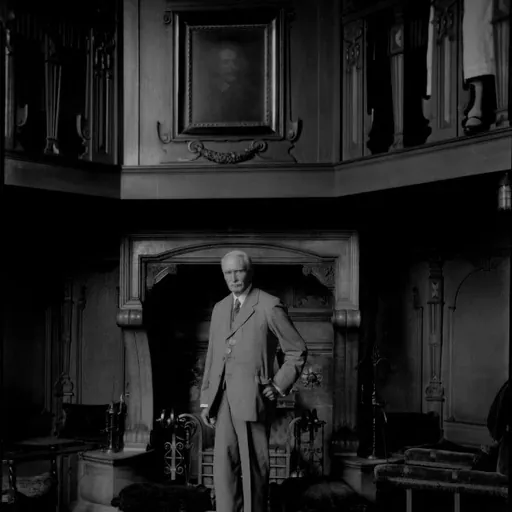
About William Douglas Caroe
Lived 1857 – 1938 (aged 80). William Douglas Caroe was a British architect.
William Douglas Caröe (1 September 1857 – 25 February 1938) was a British architect, particularly of churches.
Early life Caröe was born on 1 September 1857 in Holmsdale, Blundellsands, near Liverpool, the youngest son of the Danish Consul in Liverpool, Anders Kruuse Caröe (d. 1897) and Jane Kirkpatrick Green (d. 1877). He was educated at Ruabon Grammar School in Denbighshire, Wales, before entering Trinity College, Cambridge in 1875. and graduated with a BA in the same year. He was articled to John Loughborough Pearson and would later write the article on Pearson in the Encyclopædia Britannica (11th ed., 1911).
Career
Caröe was a major figure in the Arts and Crafts Movement and described as a "master of spatial painting". The firm he founded, Caroe & Partners, still specialises in ecclesiastical architecture, especially the restoration of historic churches.
Caröe was architect to numerous ecclesiastical buildings including St Davids and Durham cathedrals, and Tewkesbury and Romsey abbeys. Although he primarily made his name in church architecture, he was also the architect for the 1905–1909 Main Building of University College Cardiff (now Cardiff University), which was inspired by his alma mater Trinity College, Cambridge.
Caröe designed additions to his country house, Vann in Hambledon, Surrey; the house was featured in the TV series The Curious House Guest in 2006. No. 1 Millbank, London, was built for the Church Commissioners in 1903.
In later life, Caröe lived in Cyprus in the winter months. He designed his residence in Kyrenia, North Cyprus: called Villa Latomia, it was built in 1933. He also designed the colonial-style Catsellis Dome Hotel on the Kyrenia seafront.
Personal life He married Grace Desborough (d.1947), with whom he had two sons and a daughter. The couple's elder son was (Sir) Olaf Kirkpatric Kruuse Caröe (1892–1981), who became an Indian administrator; then came a daughter, Christian Desborough Caröe (1894–1973); and finally a second son, Alban Douglas Rendall Caröe (1904–1991), who followed his father's footsteps in architecture.
Caröe died in Cyprus on 25 February 1938.
Don’t just read it —
keep it.
Full-length biographies made to live with: read them, listen on the way to work, watch them tonight.
- E-book
- Audio
- Video
Instant download · yours to keep · every purchase keeps this site free
Important facts
People in William Douglas Caroe's life
Named in this biography and alive at the same time


Related people
Same field, nearest in time




Contemporaries
People whose lives overlapped William Douglas Caroe's




Frequently asked questions
Who was William Douglas Caroe?
English architect
When was William Douglas Caroe born?
William Douglas Caroe was born on 1 September 1857 in Blundellsands.
When did William Douglas Caroe die?
William Douglas Caroe died on 25 February 1938 in Kyrenia.
What was William Douglas Caroe's occupation?
William Douglas Caroe was an architect.
What nationality was William Douglas Caroe?
William Douglas Caroe was British.
Sources & further reading
· Wikipedia: William Douglas Caroe
Cite this page
APA: Biography.guide. (2026). William Douglas Caroe. https://biography.guide/william-douglas-caroe/
MLA: "William Douglas Caroe." Biography.guide, https://biography.guide/william-douglas-caroe/.
Chicago: "William Douglas Caroe." Biography.guide. https://biography.guide/william-douglas-caroe/.
Data last updated: 2026-09-20 · Spot an error? Report a correction.
Portrait: Wikimedia Commons · author & licence
Page generated 2026-09-27 04:58 UTC