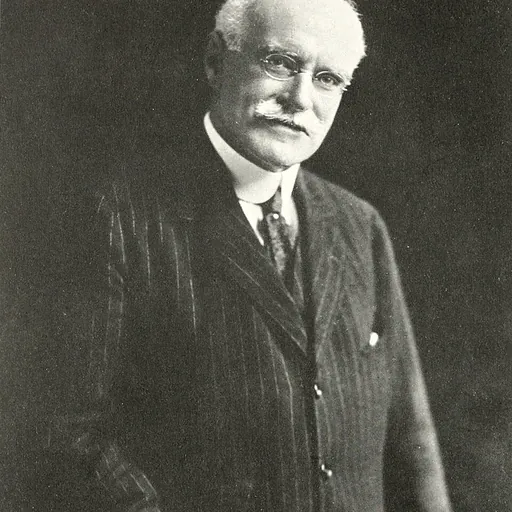
About William Brooks Close
Lived 1853 – 1923 (aged 70). William Brooks Close was a British rower and businessperson.
William Brooks Close (1853–1923) was a British businessman active in the Midwestern United States. He first arrived in the United States during the summer of 1876 to compete in a regatta in Philadelphia while he was the president of the Cambridge University Boat Club. Close and two brothers, Frederick and James, created a colony in Iowa called the Close Colony. They made a profit from buying public land and reselling it. He was the co-founder of the Close Brothers Group. Close helped finance the building of a railway from Skagway into the Yukon, named the White Pass and Yukon Route.
Early life Close was born in 1853 in Naples, Italy. He was one of eight children, all of whom grew up on the yacht Sibilla, which his British father, James Close, sailed on the Mediterranean and Adriatic Seas. Close lived on the yacht until he was five years old. His father was a banker and a business advisor to Ferdinand II of the Two Sicilies. After his father's death, his French mother Anne Brooks sent Close and his three brothers to school in Marlborough, Wiltshire. He rowed in The Boat Race during his time at Cambridge. He was runner-up to Alfred Dicker in the Diamond Challenge Sculls at Henley Royal Regatta in 1875.
First arrival in the United States Close first arrived in the United States in 1876 when he was the president of the Cambridge University Boat Club that was taking part in the Centennial Regatta in Philadelphia during the summer. Recovering from an injury sustained during the race, Close met Daniel Paullin, a landowner and land speculator from Quincy, Illinois, who told him that it was possible to earn a significant amount of money buying and selling land in northwest Iowa to settlers. The Close Colony was a community of British farmers.
In 1880, Close wrote Farming in North-western Iowa, United States of America: A Pamphlet for Emigrants and a Guide to North-western Iowa. The pamphlet contained information about the Close brothers and for those emigrating to Iowa. The Close brothers purchased Kingsley, Iowa, then known as Quorn, in 1880 along with parts of six Iowa counties: Woodbury, Plymouth, Cherokee, Lyon, Sioux, and Osceola. Englishmen founded the Prairie Club in Le Mars in 1881, which became a popular venue for gatherings and was renovated in 1882. The only club members were British emigrants until 1882, when Americans were allowed to join to replace its dwindling numbers. The Iowa Land Company was founded on May 28, 1855. They operated the Iowa Land Company to purchase acres of United States land, help investors manage farms, lease farms, offer mortgages, and look after stock feeding operations. The Close brothers were in the business of buying and selling acreage in Iowa, Minnesota, Kansas, Texas, and other states. At times they owned at almost of the best land in the United States. The Iowa Land Company operated under the Close brothers from 1881 to 1884, when C. W. Benson began running the company.
There were multiple benefits for the Close Colony settlers. The Close brothers showed settlers "the best and cheapest lands" for a farm. If a settler was inexperienced at farming, they could live at a farm requiring help and possibly receive a wage. The Close brothers obtained wholesale lumber and were able to buy necessities such as machinery and furniture at a wholesale price. They charged a $250 commission and a $125 deposit before the settler left England. The deposit would be returned if the settler was unhappy living in the United States.
The Close Colony had little to keep it together, with the exception being the British class system's social code, which the settlers wished to bring with them to the colony. Some British immigrants were unconvinced that they had found their new home. They were under the impression that they could easily try something else if farming the land did not suit them. A few of them adopted a normal American middle-class life, but most of them did not want to do so. While living in Sibley, Iowa, with his wife Margaret, Frederick wrote to his brother in London about part of the Antibes property being sold. Close was working in the London location of Close Brothers Group at the time. The colony eventually disappeared after Frederick Close died in 1890 following a polo accident in Sioux City. An economic depression gripped the country, land lost its value, and a fire destroyed the Prairie Club. Most of the British immigrants returned to their original homes.
Later life and death Three months after Frederick Close died in 1890, William's wife Mary gave birth to a son named Herbert. Mary became suspicious of Close due to him leaving often without telling her where he was going and what he was doing. Close later admitted to Mary that he was with another woman. In 1893, Mary divorced him on the legal grounds of adultery. The court hearing took place on 18 July 1893 in the New York Supreme Court. After the hearing, the divorce was final and Mary gained full custody of the child.
In November 1897, Close met entrepreneur Charles Wilkinson who had maps, pictures, and stories about Alaska and the Yukon. Wilkinson thought there was a need to build a railroad to develop Alaska and Canada and wanted Close to invest in it. Wilkinson was willing to accept practically any deal, so Close decided to accept his proposal. Despite having an interest in building the railroad, Close did not intend for the Close Brothers Group to pay for all of its costs. The Close Brothers Group gave Wilkinson a $20,000 short-term loan. In February 1898, Wilkinson said his company was ready to begin building the railroad. Close assumed that Wilkinson could not pay back the loan on time, so he negotiated with others, including associates he knew about taking control. Wilkinson attempted to raise more money in Canada, but accepted the inevitable and gave Close control of the construction. On 8 March 1898, Close and his team researched legal issues that could prevent the completion of the railroad, known as the White Pass and Yukon Route. This enterprise was started in 1898 and it became operational by 1899.
After the enterprise became operational, Close moved to a manor near Henley-on-Thames in order to be closer to the rowing competitions in that area. In 1922, Close bought the Shipley Collieries in Derbyshire to process coal. Towards the end of his life, Close continued these business ventures and also hired others to use metal in order to reinforce concrete and roads. Close died in 1923 at the home of actress Florence Desmond on the Isle of Wight.
Don’t just read it —
keep it.
Full-length biographies made to live with: read them, listen on the way to work, watch them tonight.
- E-book
- Audio
- Video
Instant download · yours to keep · every purchase keeps this site free
Important facts
People in William Brooks Close's life
Named in this biography and alive at the same time



Related people
Same field, nearest in time

Contemporaries
People whose lives overlapped William Brooks Close's



Frequently asked questions
Who was William Brooks Close?
British rower and businessman
When was William Brooks Close born?
William Brooks Close was born on 6 May 1853 in Naples.
When did William Brooks Close die?
William Brooks Close died on 25 September 1923 in Isle of Wight.
What was William Brooks Close's occupation?
William Brooks Close was a rower and businessperson.
What nationality was William Brooks Close?
William Brooks Close was British.
Sources & further reading
· Wikipedia: William Brooks Close
· DBpedia: William Brooks Close
Cite this page
APA: Biography.guide. (2026). William Brooks Close. https://biography.guide/william-brooks-close/
MLA: "William Brooks Close." Biography.guide, https://biography.guide/william-brooks-close/.
Chicago: "William Brooks Close." Biography.guide. https://biography.guide/william-brooks-close/.
Data last updated: 2026-09-23 · Spot an error? Report a correction.
Portrait: Wikimedia Commons · author & licence
Page generated 2026-09-27 05:06 UTC