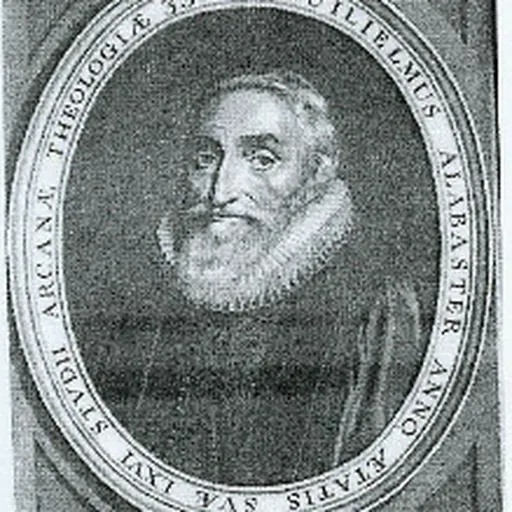
William Alabaster
English poet, playwright, and religious writer
About William Alabaster
Lived 1567 – 1640 (aged 73). William Alabaster was a British playwright, poet, theologian, writer and scholar.
William Alabaster (also Alablaster, Arblastier) (27 February 1567buried 28 April 1640) was an English Neo-Latin poet, playwright, and religious writer.
Alabaster became a Roman Catholic convert in Spain when on a diplomatic mission as chaplain. His religious beliefs led him to be imprisoned several times; eventually he gave up Catholicism, and was favoured by James I. He received a prebend in St Paul's Cathedral, London, and the living of Therfield, Hertfordshire. He died at Little Shelford, Cambridgeshire.
Biography
Alabaster was born at Hadleigh, Suffolk, the son of Roger Alabaster of the Puritan cloth merchant family long settled there, and Bridget Winthrop of Groton, Suffolk. (He was, so Fuller states, a nephew by marriage of Dr John Still, Bishop of Bath and Wells .) Bridget Winthrop was the sister of Adam Winthrop (1548–1623) whose first wife was Alice Still, sister of Bishop John Still. The marriage was short; she died three years later in childbirth. Through his mother, Alabaster was the first cousin of John Winthrop, the future Governor of Massachusetts Bay Colony.
According to Fr. John Gerard, an underground Roman Catholic priest of the Society of Jesus who briefly served as the former clergyman's spiritual director, Alabaster was, "raised in Calvin's bosom."
He was educated at Westminster School, and Trinity College, Cambridge from 1583. He became a fellow of Trinity, and in 1592 was incorporated of the university of Oxford.
In June 1596 Alabaster sailed with Robert Devereux, Earl of Essex, on the expedition to Cádiz in the capacity of Anglican military chaplain, and, while accompanying a subsequent diplomatic mission to Spain, Alabaster converted from Anglicanism to Roman Catholicism. An account of his conversion is given in an obscurely worded sonnet contained in a manuscript copy of Divine Meditations, by Mr Alabaster.
Louise Imogen Guiney, however, gives a different account of Alabaster's conversion. After returning from the diplomatic mission, the Earl of Essex had arranged for Alabaster to be assigned as Vicar of Landulph, in Cornwall. Alabaster had sought the parish because he was engaged to be married and the living was worth 400 crowns a year, which he first received on 8 September 1596.
It appears that Alabaster was imprisoned for his change of faith in the Tower of London and in The Clink in 1597 and 1598. According to historian Robert Caraman, during his incarceration, Alabaster adapted the sonnet form from love poetry into Christian poetry. Alabaster's 85-long sonnet sequence, which "portray some profound spiritual experiences", were mainly, "written in 1597 while he was in The Clink prison and was conscious (as he himself says) of unwonted inspiration."
After his escape from The Clink, which John Chamberlain reported to Sir Dudley Carleton on 4 May 1598, Fr. John Gerard concealed William Alabaster for two or three months in a London safe house and secret Catholic chapel overseen by Anne Line and Fr. Robert Drury.
According to Fr. John Gerard, "He was a learned man and spoke several languages. In order to become a Catholic he had declined many offers of high preferment in his church. Already he had had a taste of prison, and when he was offered the chance of escaping, I told him he could stay at my house."
During those months time, Fr. Gerard led Alabaster through a guided retreat based on The Spiritual Exercises of St. Ignatius Loyola and Alabaster expressed a desire to enter the Jesuit Order.
In 1607 Alabaster published at Antwerp Apparatus in Revelationem Jesu Christi, in which he used his study of the Kabbalah to give a mystical interpretation to the Christian Bible. The book was placed on the Vatican's Index Librorum Prohibitorum early in 1610. He went to Rome and was imprisoned for a time by the Roman Inquisition, but succeeded in returning to England and again conformed to the Established Church of the Realm.
After returning to England, Alabaster became a doctor of divinity at Cambridge University and chaplain to King James I. After his marriage in 1618 his life now became more settled and he devoted his later years to theological studies. He had an appreciable library, and books with his inscription can be found in numerous libraries today.
Personal life In 1618 Alabaster married Katherine Fludd, a widow, and was linked by marriage to the celebrated physician and alchemist Robert Fludd.
Death He died in 1640 after serving as Vicar of St. Dunstan's-in-the-West, at Little Shelford, Cambridgeshire.
Works Roxana is modelled on the tragedies of Seneca, and is a stiff and spiritless work. Fuller and Anthony à Wood bestowed exaggerated praise on it, while Samuel Johnson regarded it as the only Latin verse worthy of notice produced in England before Milton's elegies. Roxana is founded on the La Dalida (Venice, 1583) of Luigi Groto, known as Cieco di Hadria, and Hallam asserts that it is a plagiarism.
A surreptitious edition in 1632 was followed by an authorized version a plagiarii unguibus vindicata, aucta et agnita ab Aithore, Gulielmo, Alabastro. One book of an epic poem in Latin hexameters, in honour of Queen Elizabeth, is preserved in manuscript (MS) in the library of Emmanuel College, Cambridge. This poem, Elisaeis, Apotheosis poetica, Spenser highly esteemed. "Who lives that can match that heroick song?" he says in Colin Clout's come home againe, and begs "Cynthia" to withdraw the poet from his obscurity.
Alabaster's later cabalistic writings are Commentarius de Bestia Apocalyptica (1621) and Spiraculum tubarum (1633), a mystical interpretation of the Pentateuch. These theological writings won the praise of Robert Herrick, who calls him "the triumph of the day" and the "one only glory of a million".
List of works: Roxana – Latin drama. Elisaeis – Latin epic on Elizabeth I. Apparatus in Revelationem Jesu Christi (1607). De bestia Apocalypsis (1621) Ecce sponsus venit (1633) Spiraculum Tubarum (1633) Schindleri lexicon pentaglotton in epitomen redactum a G. A. Lexicon Pentaglotton, Hebraicum, Chaldaicum, Syriacum, Talmudico-Rabbinicon et Arabicum (1637)
Don’t just read it —
keep it.
Full-length biographies made to live with: read them, listen on the way to work, watch them tonight.
- E-book
- Audio
- Video
Instant download · yours to keep · every purchase keeps this site free
Important facts
People in William Alabaster's life
Named in this biography and alive at the same time




Related people
Same field, nearest in time



Contemporaries
People whose lives overlapped William Alabaster's



Frequently asked questions
Who was William Alabaster?
English poet, playwright, and religious writer
When was William Alabaster born?
William Alabaster was born on 27 January 1567 in Hadleigh.
When did William Alabaster die?
William Alabaster died on 28 April 1640 in Cambridgeshire.
What was William Alabaster's occupation?
William Alabaster was a playwright, poet, theologian, writer and scholar.
What nationality was William Alabaster?
William Alabaster was British.
Sources & further reading
· Wikipedia: William Alabaster
Cite this page
APA: Biography.guide. (2026). William Alabaster. https://biography.guide/william-alabaster/
MLA: "William Alabaster." Biography.guide, https://biography.guide/william-alabaster/.
Chicago: "William Alabaster." Biography.guide. https://biography.guide/william-alabaster/.
Data last updated: 2026-09-22 · Spot an error? Report a correction.
Portrait: Wikimedia Commons · author & licence
Page generated 2026-09-27 05:04 UTC