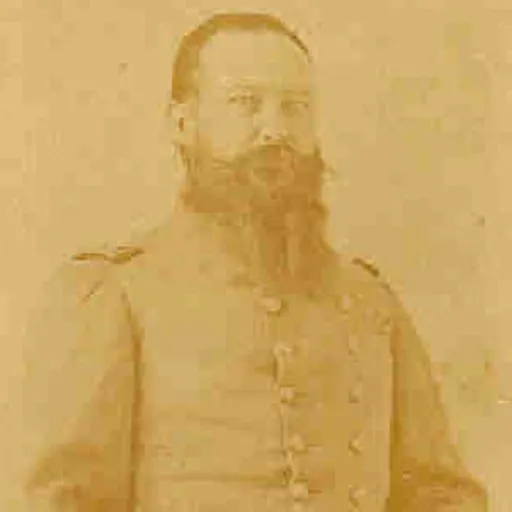
About William A. Webb
Lived 1824 – 1881 (aged 56–57). William A. Webb was an American military officer.
William Augustin Webb (1824-1881) was an American sailor and Mexican–American War veteran who resigned his United States Navy commission after more than 20 years of service to join the Confederate States Navy in the American Civil War. Webb was decorated for his service as Captain of the CSS Teaser, part of the James River Squadron, during the Battle of Hampton Roads.
In 1863, his orders sent him to Savannah, where he commanded a squadron that included the ironclad CSS Atlanta. He was captured in June 1863 and imprisoned in Boston. He was released as part of a prisoner exchange in October 1864 and returned to action on the CSS Richmond.
Early life and career William A. Webb grew up in Virginia. He joined the United States Navy at an early age and attained the rank of Midshipman on January 26, 1838. He was the brother-in-law to another naval officer John Randolph Tucker.
On July 2, 1845, Webb was promoted to Passed Midshipman. four months after the Secession, enrolling instead in the Confederate Navy as a First Lieutenant in June. Prior to the secession it was the property of the Virginia State Navy (then called the York River). The 64 ton, 80 by 18 foot tugboat was armed with a 32 and a 12-pounder rifled cannon. The CSS Teaser was part of the James River Squadron, operating on the homonymous river from Norfolk. The squadron's chieftain was Flag-Officer Franklin Buchanan, on the ironclad steamer CSS Virginia (ex-Merrimack). The squadron consisted of 3 steamers (24 guns in all) and 3 supporting gunboats, each with one gun.
On March 8–9, 1862, at the Battle of Hampton Roads, the Confederate flotilla tried to break a blockade maintained by two wooden Union frigates, the USS Cumberland and the USS Congress. The Union ships were escorted by some gunboats and backed by shore batteries. Buchanan wrote later: "The general order under which the gunboat squadron went into action required that, in the absence of all signals, each commanding officer was to exercise his own judgment and discretion in doing all the damage he could to the enemy and to sink before surrendering." To support the CSS Virginia in this action, Capt. John Randolph Tucker, commanding the rest of the James River Squadron, ran past the shore batteries to join the battle, with the CSS Teaser "puffing with all the energy of a short-winded tug." They arrived just as the CSS Virginia had managed to sink the USS Cumberland. The Confederate squadron now concentrated their fire on the USS Congress and forced its surrender. When the Confederate ships charged with accepting the surrender and escorting the captured officers were fired upon by Union shore batteries, Buchanan then ordered another boat to burn her, with Webb's Teaser as cover. When they were also fired upon, Buchanan then ordered his men to destroy the USS Congress using "hot shot and incendiary shell".
The arrival of the USS Monitor on the following day resulted in the "world's first battle between ironclads". Neither the CSS Virginia, nor the USS Monitor suffered major damage. However, the Monitor's arrival forced the Confederate ships eventually to retreat without having broken the blockade.
Webb was reported later as "slightly wounded" during the battle. Buchanan took pride in his gunboats: "Their judgment in selecting their positions for attacking the enemy was good; their constant fire was destructive, and contributed much to the success of the day." The Confederate Congress also "thanked" Webb. The squadron was stationed behind Fort Sumter in order to stop any Union ships that made it past the obstructions. What made this flotilla unusual, and hence its appellation of "special", was that the boats were armed with spar torpedoes, a highly controversial weapon of war that some considered "uncivilized". Webb assembled this squadron with a few cutters and a lot of canoes and skiffs, all armed with 20-foot long poles with a 60-pound torpedo.
quote|It was not at all uncommon to see a sailor rolling down to his boat, when they were called for exercise, with a quid of tobacco in his cheek and a torpedo slung over his back; and when it is recollected that each torpedo had seven sensitive fuses which a tap with a stick or blow with a stone was sufficient to explode and blow half the street down, it can readily be believed that we gave them a wide berth.
While present when Admiral Du Pont's fleet crossed the Charleston Bar on April 6, 1863, Webb's squadron was not called into action that day. Eager to make use of the torpedoes, Tucker, Gen. Beauregard and Webb hatched a plan on April 10 that would "shake Abolitiondom to [its] foundation." They decided to attack each of the seven Union ironclads by three torpedo boats, but in the several days it took to get the extra boats required, the Union ironclads had left Charleston. Webb proclaimed that "the whole abolition fleet" had "no terror" for him.
Considered by the citizens of Georgia to be the most powerful Confederate warship because of its fast speed of 7 knots, as well as its armament of four Brooke rifles, the Atlanta was difficult to maneuver. Special difficulties were caused by its 16-feet draft in the shallow waters surrounding Savannah. Another problem was the scarce airflow of its tight, armored roof, which caused profound heat and humidity. The Atlanta suffered profuse leaking. The ship's helm was already difficult to steer because it was simply unwieldy: the ship frequently stalled into sand banks along the side of the river. Webb marshaled the CSS Atlanta, though, removing the boat of unnecessary comfort - including sanitation and ventilation, as well as fully outfitting it with weaponry. Webb also had to deal with inexperienced sailors, most of whom were recruited from the Confederate Army around the mountainous regions of Georgia. For instance, his pilots arrived just two weeks before the ship engaged in the Battle of Wassaw Sound.
Although beset by problems, Webb was still excited about his prospects. He formulated ambitiously elaborate plans for the CSS Atlanta s first mission to clear the region of nearby Union forces. Webb was supposed to await reinforcement: the Confederate Congress voted to reinforce his squad with another ship still under construction: the CSS Savannah ironclad. Webb, however, waged action in Wassaw Sound against orders on June 17, 1863. He was escorted by two wooden steamers, the CSS Isondiga and the CSS Resolute. A percussion torpedo was attached to a large, projecting ram.
The Union expected Webb's move per intelligence reports and dispatched Captain John Rodgers in the USS Weehawken, escorted by the USS Nahant. The Atlanta suddenly ran aground and swayed at an angle which made it difficult to shoot. The USS Weehawken held fire until it was at 300 yards and then pounded the immobile ship, basically turning into target practice for the Union ship. After receiving five of the Weehawken s 350-pound shots, which knocked a hole in her casemate, crushed the pilot house and port shutter and severely wounded its pilots and several helmsmen, Webb was compelled to surrender immediately. From 136 to 165 men were taken captive Webb was in command of the Richmond, when the James River Squadron, of which Richmond was a member, during a routine patrol of the James River, were surprised on the morning of October 22, 1864, when the Union Army revealed their new battery at Boulware House, two miles from Chaffin's Bluff. To cover the retreat of the wooden vessels of the fleet, the flagship Virginia II approached the battery, followed by the Richmond and Fredericksburg, and effected the retreat upstream to Chaffin's Bluff.
He died at his home in Goochland County on December 1, 1881.
Don’t just read it —
keep it.
Full-length biographies made to live with: read them, listen on the way to work, watch them tonight.
- E-book
- Audio
- Video
Instant download · yours to keep · every purchase keeps this site free
Important facts
People in William A. Webb's life
Named in this biography and alive at the same time

Related people
Same field, nearest in time

Contemporaries
People whose lives overlapped William A. Webb's





Frequently asked questions
Who was William A. Webb?
United States Navy officer (1824–1881)
When was William A. Webb born?
William A. Webb was born in 1824 in Virginia.
When did William A. Webb die?
William A. Webb died on 1 December 1881 in Goochland County.
What was William A. Webb's occupation?
William A. Webb was a military officer.
What nationality was William A. Webb?
William A. Webb was American.
Sources & further reading
Cite this page
APA: Biography.guide. (2026). William A. Webb. https://biography.guide/william-a-webb/
MLA: "William A. Webb." Biography.guide, https://biography.guide/william-a-webb/.
Chicago: "William A. Webb." Biography.guide. https://biography.guide/william-a-webb/.
Data last updated: 2026-09-23 · Spot an error? Report a correction.
Portrait: Wikimedia Commons · author & licence
Page generated 2026-09-27 05:05 UTC