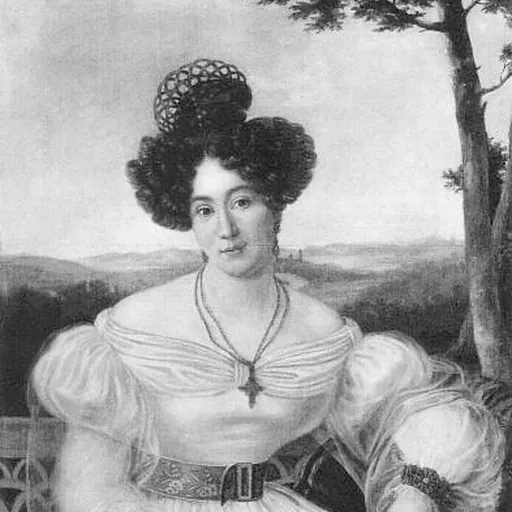
About Wilhelmine Halberstadt
Lived 1776 – 1841 (aged 65). Wilhelmine Halberstadt was a German writer and educator.
Wilhelmine Halberstadt (24 January 1776 – 11 March 1841) was a German educator and author.
Biography Elisabeth Friederike Wilhelmine Halberstadt was born in Corbach, a small town in the uplands west of Kassel. Carl Franz Halberstadt, her father, was a lawyer employed as a secretary by the Count Reuss. He had previously traveled extensively in Europe and later crossed the Atlantic, acquiring land in America. Upon his return, he married the childless widow Maria Christiane Speirmann (born Schmidt). After Maria's father was imprisoned for embezzlement of the family fortune, Carl Franz Halberstadt travelled back to America to sell his possessions there. During his journey, he was involved in a shipwreck after which he was never seen again. This led to austerity, which led to a growth in inter-denominational strife. In 1822 Halberstadt closed the school and began to work as a private tutor for families she knew and trusted. In 1822 she published "Gemälde häuslicher Glückseligkeit" (loosely,"Images of Domestic Happiness and Joy"), a substantial work on pedagogy, assembling her accumulated experience of teaching into just four volumes. Short of funds, she sent an unsolicited copy to the Russian emperor, who in return sent her a substantial payment "in recognition".
It was not only the Emperor of Russia who had been impressed by her contributions. Frederick William III of Prussia had also become an admirer of her educational achievements in his Rhine Province, and made arrangements to provide her with a pension. When Halberstadt became aware of the king's intentions, she quickly wrote to him, asking if he would instead be willing to fund her new project. Her plan was to select the most suitable girls from orphanages and train them to become elementary school teachers. Girls from higher social classes were not, she insisted, really suitable for work as elementary school teachers. Her project was timely, since the Prussian King had recently appointed the kingdom's first Minister for Education. Halberstadt's project met with approval and the Education Minister, Karl vom Stein zum Altenstein received instructions to look at her proposals sympathetically. Due to ongoing religious disputes in the Rhine Province it was still not possible to pursue the project in Trier.
In 1823, Halberstadt set up an educational institution for daughters of the wealthy in Kassel. She also published a second edition of her book "On the dignity and fate of women" and a new teaching book: "Schulbuch, als erste Uebung im Lesen und Denken, nach der Lautmethode. Ein Geschenk für fleißige Kinder." ("Textbook, as a first exercise in reading and thinking phonetically. A gift for industrious children"). These two books were both widely welcomed, and the first of them was translated into French. In October 1831, she opened the first "Halberstädtsche Free school" for poor girls, followed by the "Halberstädtsche Fräuleinstiftung für vaterlose Töchter" ("Halberstadt young ladies' foundation for fatherless daughters") in 1833. The schools enjoyed great success for decades, and was taken over by the municipal schools board in 1876. To fund these two schools, she launched the "Ehrentempel europäischer Classiker" ("Honoured temple of European classics") monthly journal in 1835, which appeared in German, French and English. Through her foundation thousands of children were educated, clothed, fed and trained for life.
Don’t just read it —
keep it.
Full-length biographies made to live with: read them, listen on the way to work, watch them tonight.
- E-book
- Audio
- Video
Instant download · yours to keep · every purchase keeps this site free
Important facts
Related people
Same field, nearest in time




Contemporaries
People whose lives overlapped Wilhelmine Halberstadt's


Frequently asked questions
Who was Wilhelmine Halberstadt?
German author (1776-1841)
When was Wilhelmine Halberstadt born?
Wilhelmine Halberstadt was born on 24 January 1776 in Korbach.
When did Wilhelmine Halberstadt die?
Wilhelmine Halberstadt died on 11 March 1841 in Kassel.
What was Wilhelmine Halberstadt's occupation?
Wilhelmine Halberstadt was a writer and educator.
What nationality was Wilhelmine Halberstadt?
Wilhelmine Halberstadt was German.
Sources & further reading
· Wikipedia: Wilhelmine Halberstadt
· DBpedia: Wilhelmine Halberstadt
Cite this page
APA: Biography.guide. (2026). Wilhelmine Halberstadt. https://biography.guide/wilhelmine-halberstadt/
MLA: "Wilhelmine Halberstadt." Biography.guide, https://biography.guide/wilhelmine-halberstadt/.
Chicago: "Wilhelmine Halberstadt." Biography.guide. https://biography.guide/wilhelmine-halberstadt/.
Data last updated: 2026-09-22 · Spot an error? Report a correction.
Portrait: Wikimedia Commons · author & licence
Page generated 2026-09-27 05:01 UTC