
About Wilhelm Schallmayer
Lived 1857 – 1919 (aged 62). Wilhelm Schallmayer was a German physician, pacifist and independent scholar, known for Eugenics.
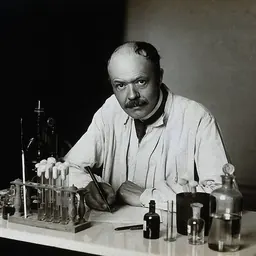
Friedrich Wilhelm Schallmayer (February 10, 1857 – October 4, 1919) was Germany's first advocate of eugenics who, along with Alfred Ploetz, founded the German eugenics movement. Schallmayer made a lasting impact on the eugenics movement.
Early life and academics After graduation from secondary school in 1876, Schallmayer joined the army as a one-year volunteer. However, due to a "loss of fitness for military duty", caused by overexertion from a military exercise, Schallmayer was discharged from the military, and the potential of a military career ended for him. Sheila Weiss wrote that his brief and unhappy experience in the army likely led to his life-long anti-militarism. In 1881, Schallmayer enrolled in the Faculty of Medicine at the Ludwig-Maximilians-Universität München, and in 1883, he passed the state medical examination, becoming a licensed physician. The early German eugenics movement was ideologically divided along Schallmayer and Ploetz lines, but with the rise of Nazi Germany, Ploetz's views became national policy. In 1939, Leonard Darwin wrote, in the Eugenics Review, that both Schallmayer and Ploetz are the pioneers of German eugenics, but it is up to Germany to decide who had the greater influence in bringing Germany in the right direction.
Diane Paul wrote in the journal of Medical History, that finding out Schallmayer and some other important eugenicists were non-racist is an unexpected and important finding, but more research needs to be done to determine if their views represented Wilhelmine eugenics as a whole. Weiss wrote that the motivation behind Wilhelmine eugenics was to boost national efficiency through the management of the reproductive capacities of the population.
Political views Schallmayer believed the state had the duty to protect and develop the biological capacity of its people. He praised the Social Democratic Party for their support of science education and collective ownership but criticized the Marxist for their preoccupation and belief in economic equality for all.
Don’t just read it —
keep it.
Full-length biographies made to live with: read them, listen on the way to work, watch them tonight.
- E-book
- Audio
- Video
Instant download · yours to keep · every purchase keeps this site free
Important facts
People in Wilhelm Schallmayer's life
Named in this biography and alive at the same time


Related people
Same field, nearest in time




Contemporaries
People whose lives overlapped Wilhelm Schallmayer's



Frequently asked questions
Who was Wilhelm Schallmayer?
German physician (1857–1919)
When was Wilhelm Schallmayer born?
Wilhelm Schallmayer was born on 10 February 1857 in Mindelheim.
When did Wilhelm Schallmayer die?
Wilhelm Schallmayer died on 4 October 1919 in Krailling.
What was Wilhelm Schallmayer's occupation?
Wilhelm Schallmayer was a physician, pacifist and independent scholar.
What was Wilhelm Schallmayer known for?
Wilhelm Schallmayer was known for Eugenics.
What nationality was Wilhelm Schallmayer?
Wilhelm Schallmayer was German.
Sources & further reading
· Wikipedia: Wilhelm Schallmayer
· DBpedia: Wilhelm Schallmayer
Cite this page
APA: Biography.guide. (2026). Wilhelm Schallmayer. https://biography.guide/wilhelm-schallmayer/
MLA: "Wilhelm Schallmayer." Biography.guide, https://biography.guide/wilhelm-schallmayer/.
Chicago: "Wilhelm Schallmayer." Biography.guide. https://biography.guide/wilhelm-schallmayer/.
Data last updated: 2026-09-20 · Spot an error? Report a correction.
Page generated 2026-09-27 05:19 UTC