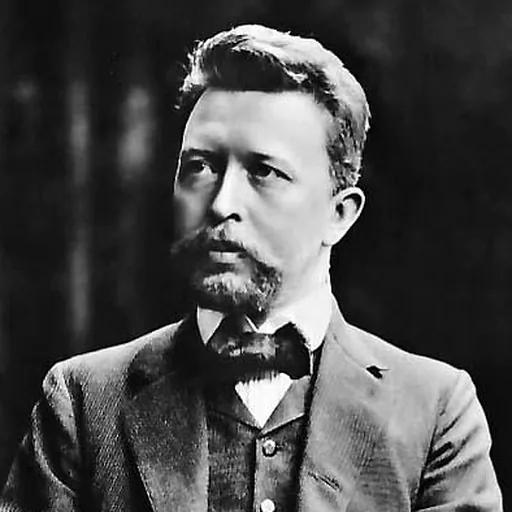
About Wilhelm Peterson-Berger
Lived 1867 – 1942 (aged 75). Wilhelm Peterson-Berger was a Swedish composer, musicologist, music critic, music teacher and philosopher of culture.
Olof Wilhelm Peterson-Berger ( 27 February 1867 – 3 December 1942) was a Swedish composer and music critic. As a composer, his main musical influences were Grieg, August Söderman and Wagner as well as Swedish folk idiom.
The composer Peterson-Berger was born in Ullånger. He studied at the Stockholm Conservatory from 1886 to 1889 and then in Dresden for a year.
He is best known for three albums of national romantic piano pieces entitled Frösöblomster I, II and III (Flowers of Frösö), which include the often performed Vid Frösö kyrka (At Frösö Church) and Sommarsång (Summer Song). The sets, which were composed over a period of 18 years (1896–1914) and brought together afterwards as a collection have gained a reputation of representing a quintessential "Swedishness" in the romantic, nationalistic vein of their time. The most famous of the pieces, Sommarsång (Summer Song) recalls the warm, calm, harmonious and bright pre-summer evenings where the sun in the north almost never goes down; they were the great breakthrough for Wilhelm. Sommarsång is still known to most Swedes, even to people generally uninterested in music: the majority of young piano students in the Nordic countries have been taught this piece. His songs for vocal ensemble are also still regularly performed, and are part of the core repertoire of Swedish choirs.
His other works include the five symphonies – among them are no.2 Sunnanfärd and no.3 Same-Ätnam generally considered the best – as well as the operas Ran, Arnljot, Domedagsprofeterna ("The Doomsday Prophets") and Adils och Elisiv ("Adils and Elisiv"). His command of the larger forms, in both architecture and instrumentation, is disputed.
He was stage manager at the Stockholm Opera from 1908 to 1910. The opera Arnljot has nevertheless become something of a symbol for the province of Jämtland and is regularly performed there, as a "musical drama", at Arnljotlägden on Frösön, close to Peterson-Berger's former home, Sommarhagen. Domedagsprofeterna is the antithesis of Arnljot – a light festive musical comedy set in 17th-century Uppsala, while the saga Adils och Elisiv where Swedish ‘talsång’ (speechsong) attained its purest expression is a work extolling Peterson-Berger's belief in humanism and the goodness of man. He was conservative and fought the increasing influence of modernism in music, especially from Arnold Schoenberg and his followers. His progress was hindered by many enemies whom he made through his writings; he attacked showy virtuosity and dry academicism with satire but also with strict conscientiousness.
The man One acquaintance later recalled his surprise when, on a journey by train from Stockholm to Östersund and Frösön, the big man and notorious critic suddenly burst into tears and felt soft like a child as the bucolic landscape of his beloved Jämtland began to unfold outside the window. Even this writer, however, noted that even Peterson-Berger's threatening and miserable physical appearance and demeanour conformed to the stereotype of the dour Scandinavian.
His home on the island of Frösön near Östersund (where he spent his summers from 1914 and then lived permanently from 1930) is open to the public in the summer months and is much as the composer left it. The downstairs music hall has his grand piano (he was a competent pianist), a work room (with a ‘picture window’ looking out over Storsjön) and library (with his collection of books and scores), while upstairs the bedrooms may be viewed. He lived alone there with a butler and his cats. There is also a small café where books and CDs are sold.
Don’t just read it —
keep it.
Full-length biographies made to live with: read them, listen on the way to work, watch them tonight.
- E-book
- Audio
- Video
Instant download · yours to keep · every purchase keeps this site free
Important facts
People in Wilhelm Peterson-Berger's life
Named in this biography and alive at the same time

Related people
Same field, nearest in time



Contemporaries
People whose lives overlapped Wilhelm Peterson-Berger's




Frequently asked questions
Who was Wilhelm Peterson-Berger?
Swedish composer (1867-1942)
When was Wilhelm Peterson-Berger born?
Wilhelm Peterson-Berger was born on 27 February 1867 in Kramfors Municipality.
When did Wilhelm Peterson-Berger die?
Wilhelm Peterson-Berger died on 3 December 1942 in Östersund.
What was Wilhelm Peterson-Berger's occupation?
Wilhelm Peterson-Berger was a composer, musicologist, music critic, music teacher and philosopher of culture.
What nationality was Wilhelm Peterson-Berger?
Wilhelm Peterson-Berger was Swedish.
Sources & further reading
· Wikipedia: Wilhelm Peterson-Berger
· DBpedia: Wilhelm Peterson-Berger
Cite this page
APA: Biography.guide. (2026). Wilhelm Peterson-Berger. https://biography.guide/wilhelm-peterson-berger/
MLA: "Wilhelm Peterson-Berger." Biography.guide, https://biography.guide/wilhelm-peterson-berger/.
Chicago: "Wilhelm Peterson-Berger." Biography.guide. https://biography.guide/wilhelm-peterson-berger/.
Data last updated: 2026-09-22 · Spot an error? Report a correction.
Portrait: Wikimedia Commons · author & licence
Page generated 2026-09-27 04:59 UTC