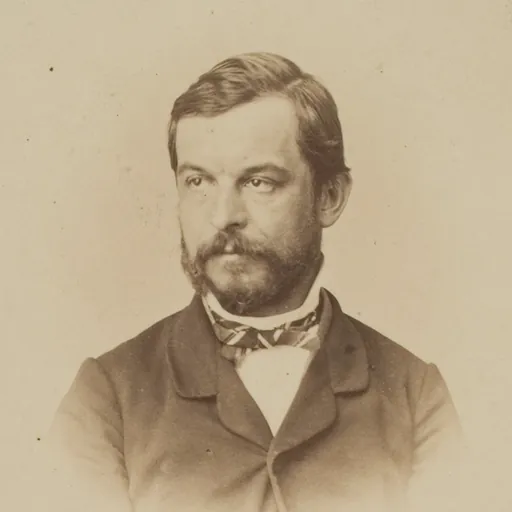
About Wilhelm Hofmeister
Lived 1824 – 1877 (aged 52). Wilhelm Hofmeister was a German biologist, botanist and university teacher, known for Alternation of generations.
Wilhelm Friedrich Benedikt Hofmeister (18 May 1824 – 12 January 1877) was a German biologist and botanist. He "stands as one of the true giants in the history of biology and belongs in the same pantheon as Darwin and Mendel." Largely self-taught he was the first to study and establish alternation of generations and the details of sexual reproduction in the bryophytes.
Biography Hofmeister and his sister Clementine were the children of Friederich and Frederike (née Seidenschnur) Hofmeister. She (died 28 March 1870) and seven children pre-deceased him. Nevertheless, he was only 27 when he published his ground-breaking monograph on the alternation of generations in plants. He was awarded an honorary doctorate by the University of Rostock in 1851.
Hofmeister is widely credited with discovery of alternation of generations as a general principle in plant life. His proposal that alternation between a spore-bearing generation (sporophyte) and a gamete-bearing generation (gametophyte) constituted a unifying theory of plant evolution that was published in 1851. This was crucial in demonstrating that sexual reproduction occurred in plants, which was under extensive debate in the mid-1800s. He showed that products from both the pollen tube and egg were required. After this book was published, Hofmeister became a leading proponent of Darwinism.
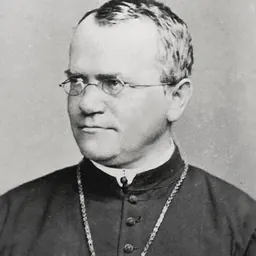
Hofmeister was also an early student of the genetics in plants. He is cited for the first studies of plant embryology. According to C. D. Darlington, Hofmeister had observed what would later be called chromosomes in a dividing cell nucleus as early as 1848. He left detailed sketches which are reproduced in Darlington's The Facts of Life, though he was not the first to observe them. There is good evidence that Gregor Mendel was aware of Hofmeister's work and this was part of his motivation to study plant hybridisation. He also carried out experiments to measure the forces and tensions involved as plant stems bend. Charles Darwin referred to Hofmeister's studies extensively in his own book The Power of Movement in Plants (1880).
In 1869, he was elected a foreign member of the Royal Swedish Academy of Sciences.
Hofmeister's contribution to biology is still far from widely acknowledged. This may partly be attributed to the fact that only one of his works was translated at the time from German to English. However, Kaplan & Cooke conclude that "his reputation became eclipsed because he was so far ahead of his contemporaries that no one could understand or appreciate his work".
Selected works "Untersuchungen des Vorgangs bei der Befruchtung der Oenothereen." In: Botanische Zeitung, vol. 5, 1847, cols. 785–792 (= in: No. 45, 5 November 1847). Die Entstehung des Embryo der Phanerogamen. Eine Reihe mikroskopischer Untersuchungen. Verlag F. Hofmeister, Leipzig 1849. Vergleichende Untersuchungen der Keimung, Entfaltung und Fruchtbildung höherer Kryptogamen (Moose, Farrn, Equisetaceen, Rhizocarpeen und Lycopodiaceen) und der Samenbildung der Coniferen. 179 pp., 1851, (Reprint: Historiae Naturalis Classica 105. Cramer, Vaduz 1979). English translation (by F. Currey): On the germination, development and fructification of the higher Cryptogamia and on the fructification of the Coniferae. Ray Society, London, 1862. Neue Beiträge zur Kenntniss der Embryobildung der Phanerogamen. 1. Dikotyledonen mit ursprünglich einzelligem, nur durch Zellentheilung wachsendem Endosperm. S. Hirzel, Leipzig, pp. 536–672. 1859. Neue Beiträge zur Kenntniss der Embryobildung der Phanerogamen. 2. Monokotyledonen. S. Hirzel, Leipzig, pp. 632–760. 1861. "Die Lehre von der Pflanzenzelle". In: W. Hofmeister (ed.): Handbuch der Physiologischen Botanik I-1. W. Engelmann, Leipzig 1867. "Allgemeine Morphologie der Gewächse." In: W. Hofmeister (ed.): Handbuch der Physiologischen Botanik I-2. W. Engelmann, Leipzig 1868.
Don’t just read it —
keep it.
Full-length biographies made to live with: read them, listen on the way to work, watch them tonight.
- E-book
- Audio
- Video
Instant download · yours to keep · every purchase keeps this site free
Important facts
People in Wilhelm Hofmeister's life
Named in this biography and alive at the same time
Related people
Same field, nearest in time


Contemporaries
People whose lives overlapped Wilhelm Hofmeister's




Frequently asked questions
Who was Wilhelm Hofmeister?
German botanist (1824-1877)
When was Wilhelm Hofmeister born?
Wilhelm Hofmeister was born on 18 May 1824 in Leipzig.
When did Wilhelm Hofmeister die?
Wilhelm Hofmeister died on 12 January 1877 in Lindenau.
What was Wilhelm Hofmeister's occupation?
Wilhelm Hofmeister was a biologist, botanist and university teacher.
What was Wilhelm Hofmeister known for?
Wilhelm Hofmeister was known for Alternation of generations.
What nationality was Wilhelm Hofmeister?
Wilhelm Hofmeister was German.
Sources & further reading
· Wikipedia: Wilhelm Hofmeister
Cite this page
APA: Biography.guide. (2026). Wilhelm Hofmeister. https://biography.guide/wilhelm-hofmeister/
MLA: "Wilhelm Hofmeister." Biography.guide, https://biography.guide/wilhelm-hofmeister/.
Chicago: "Wilhelm Hofmeister." Biography.guide. https://biography.guide/wilhelm-hofmeister/.
Data last updated: 2026-09-22 · Spot an error? Report a correction.
Portrait: Wikimedia Commons · author & licence
Page generated 2026-09-27 05:01 UTC