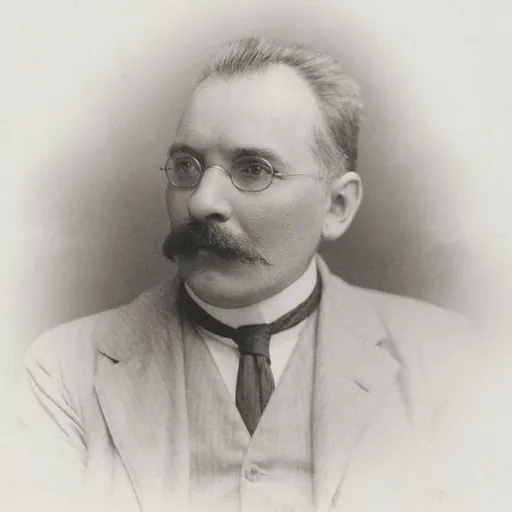
About Wilfrid Voynich
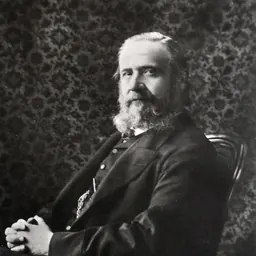
Lived 1865 – 1930 (aged 64). Wilfrid Voynich was an American, Polish and British antiquarian seller, historian, chemist, pharmacist, political activist and bookseller, known for Voynich manuscript.
Wilfrid Voynich (, ; born Michał Habdank-Wojnicz; – 19 March 1930) was a Polish revolutionary, antiquarian and bibliophile. Voynich operated one of the largest rare book businesses in the world. He is remembered as the eponym of the Voynich manuscript.
Life Michał Habdank-Wojnicz was born in the town of Telšiai in present-day Lithuania, then part of the Russian Empire, into a Polish noble family. The "Habdank" part of his surname is the name of a Polish heraldic clan. He was the son of a Polish petty official (titular counsellor).
In June 1890 he escaped from Siberia and travelling west by train got to Hamburg, eventually arriving in London in October 1890. Under the assumed name of Ivan Kel'chevskii at first, he worked with Sergius Stepniak, a fellow revolutionary, under the banner of the anti-tsarist Society of Friends of Russian Freedom in London. After Stepniak's death in a railway crossing accident in 1895, Voynich ceased revolutionary activity.
Voynich became an antiquarian bookseller from around 1897, acting on the advice of Richard Garnett, a curator at the British Museum. Voynich opened a bookshop at Soho Square in London in 1898. He was remarkably lucky in finding rare books, including a Malermi Bible in Italy in 1902. He became deeply involved in the antiquarian book trade, and wrote a number of catalogues and other texts on the subject.
Voynich relocated his London bookshop to 175 Piccadilly in 1917. Also in 1917, based on rumours, Voynich was investigated by the FBI, in relation to his possession of Bacon's cipher. The report also noted that he dealt with manuscripts from the 13th, 12th, and 11th centuries, and that the value of his books at the time was half a million dollars. However, the investigation did not reveal anything significant beyond the fact that he possessed a secret code nearly a millennium old.
Voynich manuscript
The most famous of Voynich's possessions was a mysterious manuscript he said he acquired in 1912 at the Villa Mondragone in Italy, but first presented in public in 1915. The book has been carbon-dated, which revealed that the materials were manufactured sometime between 1404 and 1438. He owned the manuscript until his death.
Don’t just read it —
keep it.
Full-length biographies made to live with: read them, listen on the way to work, watch them tonight.
- E-book
- Audio
- Video
Instant download · yours to keep · every purchase keeps this site free
Important facts
Family & relationships
People in Wilfrid Voynich's life
Named in this biography and alive at the same time

Related people
Same field, nearest in time





Contemporaries
People whose lives overlapped Wilfrid Voynich's



Frequently asked questions
Who was Wilfrid Voynich?
Polish revolutionary, antiquarian, bibliophile, historian and eponym of Voynich manuscript (1865-1930)
When was Wilfrid Voynich born?
Wilfrid Voynich was born on 31 October 1865 in Telšiai.
When did Wilfrid Voynich die?
Wilfrid Voynich died on 19 March 1930 in New York City.
What was Wilfrid Voynich's occupation?
Wilfrid Voynich was an antiquarian seller, historian, chemist, pharmacist, political activist and bookseller.
What was Wilfrid Voynich known for?
Wilfrid Voynich was known for Voynich manuscript.
What nationality was Wilfrid Voynich?
Wilfrid Voynich was American, Polish and British.
Sources & further reading
Cite this page
APA: Biography.guide. (2026). Wilfrid Voynich. https://biography.guide/wilfrid-voynich/
MLA: "Wilfrid Voynich." Biography.guide, https://biography.guide/wilfrid-voynich/.
Chicago: "Wilfrid Voynich." Biography.guide. https://biography.guide/wilfrid-voynich/.
Data last updated: 2026-09-24 · Spot an error? Report a correction.
Portrait: Wikimedia Commons · author & licence
Page generated 2026-09-27 05:09 UTC