
About Wild Bill Hickok
Lived 1837 – 1876 (aged 39). Wild Bill Hickok was an American poker player, gunfighter, gold miner, hunter, soldier and actor.
James Butler Hickok (May 27, 1837 – August 2, 1876), better known as "Wild Bill" Hickok, was a folk hero of the American Old West known for his life on the frontier as a soldier, scout, lawman, cattle rustler, gunslinger, gambler, showman, and actor, and for his involvement in many famous gunfights. He earned a great deal of fame in his own time, much of it bolstered by the many outlandish and often fabricated tales told and printed about him, occasionally by himself. Some contemporaneous reports of his exploits are known to be fictitious, but they remain the basis of much of his fame and reputation.
Hickok was born and raised on a farm in Northern Illinois at a time when lawlessness and vigilante activity were rampant because of the influence of the "Banditti of the Prairie". Drawn to this criminal lifestyle, he headed west at age 18 as a fugitive from justice, working as a stagecoach driver and later as a lawman in the frontier territories of Kansas and Nebraska. He served in and spied for the Union army during the American Civil War and gained publicity after the war as a scout, marksman, actor, and professional gambler. He was involved in several notable shootouts during the course of his life.
In 1876, Hickok was shot and killed while playing poker in a saloon in Deadwood, Dakota Territory (present-day South Dakota) by Jack McCall, an unsuccessful gambler. The hand of cards that he supposedly held at the time of his death has become known as the dead man's hand: two pairs; black aces and eights, and another unknown card, therefore having five cards in his hand at his death.
Hickok remains a popular figure of frontier history. Many historic sites and monuments commemorate his life, and he has been depicted numerous times in literature, film, and television. He is chiefly portrayed as a protagonist, although historical accounts of his actions are often controversial, and much of his career is known to have been exaggerated both by himself and by contemporary mythmakers. Hickok claimed to have shot numerous gunmen in his lifetime, and he killed six or seven, all between 1861 and 1871 according to Joseph G. Rosa, Hickok's biographer and the foremost authority on him.
Early life James Butler Hickok was born May 27, 1837, in Homer, Illinois, (present-day Troy Grove, Illinois) to William Alonzo Hickok (1801–1852), a farmer and abolitionist, and his wife, Pamelia Hickok (née Butler, 1804–1878). Hickok was of English ancestry. James was the fourth of six children. His father was said to have used the family house, now demolished, as a station on the Underground Railroad. William Hickok died in 1852, when James was 15.
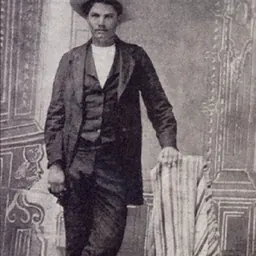
Hickok was a good shot from a young age, and was recognized locally as an outstanding marksman with a pistol. Photographs of Hickok appear to depict dark hair, but all contemporaneous descriptions affirm that he had red hair.
In 1855, at age 18, James Hickok fled Illinois following a fight with Charles Hudson, during which both fell into a canal; each thought, mistakenly, that he had killed the other. Hickok moved to Leavenworth in the Kansas Territory, where he joined Jim Lane's Free State Army (also known as the Jayhawkers), an antislavery vigilante group active in the new territory during the Bleeding Kansas era. While there he met 12-year-old William Cody (later known as "Buffalo Bill"), who, despite his youth, served as a scout just two years later for the U.S. Army during the Utah War.
Nicknames James B. Hickok in the 1860s, during his pre-gunfighter days Hickok used his late father's name, William Hickok, from 1858, and the name William Haycock during the American Civil War. Most newspapers referred to him as William Haycock until 1869. He was arrested while using the name Haycock in 1865. He afterward resumed using his given name, James Hickok. Military records after 1865 list him as Hickok, but he was also known as Haycock. In an 1867 article about his shootout with Davis Tutt, his surname was misspelled as Hitchcock.
While in Nebraska, Hickok was derisively referred to by one man as "Duck Bill" for his long nose and protruding lips. He grew a moustache following the McCanles incident, and in 1861 began calling himself "Wild Bill". On March 22, 1858, he was elected one of the first four constables of Monticello Township. In 1859, he joined the Russell, Majors and Waddell freight company, the parent company of the Pony Express.
In 1860, Hickok was badly injured by a bear, while driving a freight team from Independence, Missouri, to Santa Fe, New Mexico. According to Hickok's account, he found the road blocked by a cinnamon bear and its two cubs. Dismounting, he approached the bear and fired a shot into its head, but the bullet ricocheted off its skull, infuriating it. The bear attacked, crushing Hickok with its body. Hickok managed to fire another shot, wounding the bear's paw. The bear then grabbed his arm in its mouth, but Hickok was able to grab his knife and slash its throat, killing it.
Hickok was severely injured, with a crushed chest, shoulder, and arm. He was bedridden for four months before being sent to Rock Creek Station in the Nebraska Territory to work as a stable hand while he recovered. There, the freight company had built a stagecoach stop along the Oregon Trail near Fairbury, Nebraska, on land purchased from David McCanles. Two men with McCanles (James Wood and James Gordon) were also killed. Hickok, Wellman, and another employee, J.W. Brink, were tried for killing McCanles, but were found to have acted in self-defense. McCanles may have been the first man Hickok killed. Personal account of the foreman of the Overland Stage Company stations, as given to The DeWitt Times News: At the time of this affair I was at a station farther west and reached this station just as Wild Bill was getting ready to go to Beatrice for his trial. He wanted me to go with him, and as we started on our way, imagine my surprise and uncomfortable feeling when he announced his intention of stopping at the McCanles home. I would have rather been somewhere else, but Bill stopped. He told Mrs. McCanles he was sorry he had to kill her man then took out $35 and gave it to her saying: "This is all I have, sorry I do not have more to give you." We drove on to Beatrice and at the trial, his plea was self-defense; no one appeared against him, and he was cleared. The trial did not last more than fifteen minutes.
Buffalo Bill claimed that he encountered Hickok disguised as a Confederate States Army officer in Missouri in 1864. Hickok had not been paid for some time, and was hired as a scout by General John B. Sanborn by early 1865. In June, Hickok mustered out and went to Springfield, where he gambled. Tutt's shot missed, but Hickok's struck Tutt through the heart from about away. Tutt called out, "Boys, I'm killed" before he collapsed and died.
Hickok was arrested for murder two days later, but the charge was reduced to manslaughter. He was released on $2,000 bail and stood trial on August 3, 1865. At the end of the trial, Judge Sempronius H. Boyd told the jury that they could not find that Hickok acted in self-defense if he could have reasonably avoided the fight. However, if they felt that the threat of danger was real and imminent, he instructed that they could apply the unwritten law of the "fair fight" and acquit. The jury voted to clear Hickok, resulting in public backlash and criticism of the verdict.
Deputy U.S. marshal in Kansas In September 1865, Hickok came in second in the election for city marshal of Springfield, but he was recommended for the position of deputy federal marshal at Fort Riley, Kansas. This was during the Indian Wars, in which Hickok sometimes served as a scout for General George A. Custer's 7th Cavalry. Witnesses confirm that Hickok was attacked by a large group of Indians on May 11, 1867 while working as a scout at Fort Harker, Kansas. The Indians fled after he shot and killed two. In July, Hickok told a newspaper reporter that he had led several soldiers in pursuit of Indians who had killed four men near the fort on July 2. He reported returning with five prisoners after killing 10. Witnesses confirm that the story was true to the extent that the party had set out to find whoever had killed the four men, but the group returned to the fort "without nary a dead Indian" and without "even seeing a live one".
On September 1, 1868, Hickok was in Lincoln County, Kansas where he was hired as a scout by the 10th Cavalry Regiment, a segregated black unit. On September 4, Hickok was wounded in the foot while rescuing several cattlemen in the Bijou Creek basin who had been surrounded by Indians. The 10th Regiment arrived at Fort Lyon in Colorado in October and remained there for the rest of 1868. Three sheriffs had quit during the previous 18 months. Hickok may have been acting sheriff before he was elected; a newspaper reported that he arrested offenders on August 18, and the commander of Fort Hays wrote a letter to the assistant adjutant general on August 21 in which he praised Hickok for his work in apprehending deserters.
The regular county election was held on November 2, 1869. Hickok ran as an Independent; but lost to his deputy, Peter Lanihan, who ran as a Democrat. Hickok and Lanihan, however, remained sheriff and deputy, respectively. Hickok accused a J.V. Macintosh of irregularities and misconduct during the election. On December 9, Hickok and Lanihan both served legal papers on Macintosh, and local newspapers acknowledged that Hickok had guardianship of Hays City.
Killings as sheriff Hickok killed two men in September 1869 during his first month as sheriff. The first was Bill Mulvey, who was galloping through town on a rampage, drunk, shooting out mirrors and whisky bottles behind bars. Citizens warned Mulvey to behave because Hickok was sheriff, but Mulvey angrily declared that he had come to town to kill Hickok. When he saw Hickok, he leveled his cocked rifle at him. Hickok waved his hand past Mulvey at some supposed onlookers and yelled, "Don't shoot him in the back; he is drunk." Mulvey wheeled his horse around to face those who might shoot him from behind, and Hickok shot him through the temple before he realized that he had been fooled.
The second man killed by Hickok was Samuel Strawhun, a cowboy who was causing a disturbance in a saloon at 1:00 a.m. on September 27 when Hickok and Lanihan went to the scene.
Marshal of Abilene, Kansas John Wesley Hardin, a well-known gunfighter, claimed to have killed at least 27 men. In his autobiography, Hardin made the unlikely claim that he had once disarmed Town Marshal "Wild Bill" Hickok with the use of the "road agent's spin" while surrendering his guns to the lawman due to a local ordinance.
On April 15, 1871, Hickok became marshal of Abilene, Kansas after being hired by mayor Joseph McCoy, who had won the mayoral election that same month. He replaced Tom "Bear River" Smith, who had been killed while serving an arrest warrant on November 2, 1870. Outlaw John Wesley Hardin arrived in Abilene at the end of a cattle drive in early 1871. Hardin was a well-known gunfighter, and is known to have killed more than 27 men. Hardin claimed in his 1895 autobiography that he was befriended by Hickok, the newly elected town marshal, after he had disarmed the marshal using the road agent's spin, but Hardin was known to exaggerate. In any case, Hardin appeared to have thought highly of Hickok.
In August 1871, Hickok sought to arrest Hardin for killing Charles Couger in an Abilene hotel "for snoring too loud", but Hardin left Kansas before Hickok could arrest him. A newspaper reported, "A man was killed in his bed at a hotel in Abilene, Monday night, by a desperado called Arkansas. The murderer escaped. This was his sixth murder."
Shootout with Phil Coe Hickok had a dispute with saloon owner Phil Coe that resulted in a shootout. Coe had established the Bull's Head Saloon in Abilene in partnership with gambler Ben Thompson. The two men had painted a picture of a bull with a large erect penis on the side of their establishment as an advertisement. Citizens of the town complained to Hickok, who requested that Thompson and Coe remove the image. They refused, so Hickok altered it himself. Infuriated, Thompson tried to incite John Wesley Hardin to kill Hickok by exclaiming to Hardin that "he's a damn Yankee. Picks on rebels, especially Texans, to kill." Hardin was in town under his assumed name Wesley Clemmons, but was better known to the townspeople by the alias "Little Arkansas". He seemed to have respect for Hickok's abilities and replied, "If Bill needs killing, why don't you kill him yourself?"
Hickok was relieved of his duties as marshal less than two months after the accidental shooting, this incident being only one of a series of questionable shootings and claims of misconduct during his career. The show featured six buffalo, a bear, and a monkey, and one show ended in disaster when a buffalo refused to act, prompting Hickok to fire a bullet into the sky. This angered the buffalo and panicked audience members, causing the animals to break free of their wire fencing and chase audience members, some of whom were trampled. The incident helped contribute to the overall failure of the show.
Eye trouble From 1871 until his death in 1876, Hickok had vision problems. A former cavalryman, J. W. "Doc" Howard, who had known Hickok, stated that Hickok had left Buffalo Bill's Scouts of the Plains exhibition "because the lights affected his eyes, so he had to give it up".
Charles Snyder, the Lucien Howe Librarian of Ophthalmology at Harvard Medical School, said "Granular conjunctivitis, ophthalmia, trachoma—call it what you will—was common on the Western Frontier. Jesse James suffered from it."
In 1876, Hickok sought treatment from an eye specialist in Kansas City, Missouri. No definitive diagnosis has survived, but speculation ranges from secondary syphilis to glaucoma. Although he was just 39, his marksmanship and health were apparently in decline, and he had been arrested several times for vagrancy.
Marriage Hickok met Agnes Thatcher Lake, at the time 45 years old, on July 31, 1871. Lake, a widow and the proprietor of Lake's Hippo-Olympiad circus, arrived in Abilene and went to the office of the town marshal to pay the performance fee. She and the circus departed the next day, but Lake and Hickok continued to correspond. On March 5, 1876, Hickok married Lake in Cheyenne, Wyoming Territory. Hickok left his new bride a few months later, joining Charlie Utter's wagon train to seek his fortune in the gold fields of South Dakota.
Martha Jane Cannary, known popularly as Calamity Jane, claimed in her autobiography that she was married to Hickok and had divorced him so he could be free to marry Agnes Lake, but no records that support her account have been found.
Death On August 1, 1876, Hickok was playing poker at Nuttal & Mann's Saloon No. 10 in Deadwood, Dakota Territory. A seat opened up at the table and a drunk man named Jack McCall sat down to play. McCall lost heavily. Hickok encouraged him to quit the game until he could cover his losses, and offered to give him money for breakfast. McCall accepted the money, but he was apparently insulted.
The next day, Hickok was playing poker again. He usually sat with his back to a wall so that he could see the entrance, but the only seat available when he joined the game was a chair facing away from the door. He twice asked Charles Rich to change seats with him, but Rich refused. McCall then entered the saloon, walked up behind Hickok, drew his Colt Single Action Army .45-caliber revolver serial #2079, and shouted, "Take that!" as he shot Hickok in the back of the head at point-blank range.
Hickok died instantly. The bullet emerged through his right cheek and struck Captain William Massie in the left wrist. Hickok had told his friend Charlie Utter that he thought that he would be killed while in Deadwood.
Hickok was playing five-card stud or five-card draw when he was shot. He was holding two pairs: black aces and black eights as his "up cards", which has since become widely known as the "dead man's hand". The identity of the fifth card is the subject of debate.
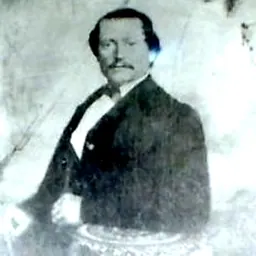
Jack McCall's two trials Jack McCall shot Hickok in the back of the head; the photo has been claimed to be of McCall, but is unsubstantiated.
McCall's motive for killing Hickok is the subject of speculation, largely concerning McCall's anger at Hickok's giving him money for breakfast the day McCall had lost heavily.
McCall was summoned before an informal "miners' jury", an ad hoc local group of miners and businessmen. He claimed that he was avenging Hickok's slaying of his brother, which may have been true; a man named Lew McCall had indeed been killed by an unknown lawman in Abilene, Kansas, but whether the two McCall men were related is unknown.
As I write the closing lines of this brief sketch, word reaches me that the slayer of Wild Bill has been rearrested by the United States authorities, and after trial has been sentenced to death for willful murder. He is now at Yankton, D.T. awaiting execution. At the trial it was suggested that he was hired to do his work by gamblers who feared the time when better citizens should appoint Bill the champion of law and order – a post which he formerly sustained in Kansas border life, with credit to his manhood and his courage.
Burial
Charlie Utter claimed Hickok's body and placed a notice in the Black Hills Pioneer:
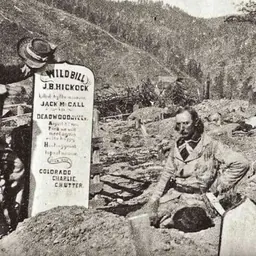
Utter had Hickok buried with a wooden grave marker reading:
Hickok is known to have fatally shot six men and is suspected of having killed a seventh. Despite his reputation, The flag never goes down on Mt. Moriah Cemetery, as Deadwood was granted permission by the U.S. Congress during World War I to fly the flag 24 hours a day to honor all veterans who have served their country.
Calamity Jane was reported to have been buried next to Hickok according to her dying wish. Albert Malter, Frank Ankeney, Jim Carson, and Anson Higby were on Calamity Jane's burial committee, and they later stated that Hickok had "absolutely no use" for Jane in this life, so they decided to play a posthumous joke on him by laying her to rest by his side.
At the time of his death, Hickok was wearing a Smith & Wesson Model No. 2 Army revolver, a five-shot, single-action.32-caliber weapon, innovative as one of the first metallic cartridge firearms and favored by many Union officers during the Civil War. Bonhams auction company offered this pistol at auction on November 18, 2013, in San Francisco, California, described as Hickok's Smith & Wesson No. 2, serial number 29963, a .32 rimfire with a six-inch barrel, blued finish, and varnished rosewood grips. The gun did not sell because the highest bid of $220,000 was less than the reserve set by the gun's owners.
In popular culture
Hickok has remained one of the most popular and iconic figures of the American Old West, and is still frequently depicted in popular culture, including literature, film, and television. Actors who have played Bill are as follows:
1923 - Paramount Pictures' Western silent film Wild Bill Hickok (released on November 18, 1923) was directed by Clifford Smith and stars William S. Hart as Hickok. A print of the film is maintained in the Museum of Modern Art film archive. 1936 - Gary Cooper starred as Hickok in the movie The Plainsman (1936), which features the alleged romance between Calamity Jane and him as its main plot line. It is a loose adaptation of Hickok's life, ending with his famous aces-and-eights card hand. 1940 - Prairie Schooners is an American Western film directed by Sam Nelson, which stars Wild Bill Elliott as Hickok. 1951-1958 - Guy Madison and Andy Devine starred in the 1950s TV seriesThe Adventures of Wild Bill Hickok. 1953 -A later film (1953) and subsequent stage musical, both titled Calamity Jane, also portray a romance between Calamity Jane and Hickok. In the film version, Howard Keel co-stars as Hickok to Doris Day's Calamity Jane. 1954 - An episode of Gunsmoke on CBS radio featured John Dehner as Hickok. Hickok was sent from Abilene to arrest Matt Dillon (William Conrad) for the murder of a man he had thrown out of Dodge earlier that month. In the episode Dillon and Hickok are old friends. 1964 - Lloyd Bridges played Hickok in an episode of The Great Adventure. 1970 - revisionist Western film Little Big Man (1970), directed by Arthur Penn and starring Dustin Hoffman, Wild Bill Hickok is portrayed by Jeff Corey. The film presents Hickok as a larger-than-life but increasingly weary frontier legend, seen through the eyes of the film's fictional protagonist, Jack Crabb. Hickok's depiction emphasizes his declining eyesight and mythic reputation, blending historical detail with satire as part of the film's broader deconstruction of Old West heroism. 1977 - Charles Bronson starred as Hickok in The White Buffalo (1977), tells a tale of Hickok's hunt for a murderous white buffalo that follows him in his nightmares. 1989-1992 - ABC television series Young Riders, a fictional account of Pony Express riders, Hickok is portrayed by Josh Brolin. 2018 - In the anthology movie The Ballad of Buster Scruggs, Scruggs refuses to play the dead man's hand upon entering a game of poker.
Memorials and honorable distinctions Hickok's birthplace is now the Wild Bill Hickok Memorial and is a listed historic site under the supervision of the Illinois Historic Preservation Agency. The town of Deadwood, South Dakota, re-enacts Hickok's murder and McCall's capture every summer evening.
Abilene, Kansas hosts the Wild Bill Hickok rodeo every summer during the Central Kansas Free Fair.
Don’t just read it —
keep it.
Full-length biographies made to live with: read them, listen on the way to work, watch them tonight.
- E-book
- Audio
- Video
Instant download · yours to keep · every purchase keeps this site free
Important facts
People in Wild Bill Hickok's life
Named in this biography and alive at the same time



Related people
Same field, nearest in time



Contemporaries
People whose lives overlapped Wild Bill Hickok's

Frequently asked questions
Who was Wild Bill Hickok?
American folk hero and lawman (1837–1876)
When was Wild Bill Hickok born?
Wild Bill Hickok was born on 27 May 1837 in Troy Grove.
When did Wild Bill Hickok die?
Wild Bill Hickok died on 2 August 1876 in Deadwood.
What was Wild Bill Hickok's occupation?
Wild Bill Hickok was a poker player, gunfighter, gold miner, hunter, soldier and actor.
What nationality was Wild Bill Hickok?
Wild Bill Hickok was American.
Sources & further reading
Cite this page
APA: Biography.guide. (2026). Wild Bill Hickok. https://biography.guide/wild-bill-hickok/
MLA: "Wild Bill Hickok." Biography.guide, https://biography.guide/wild-bill-hickok/.
Chicago: "Wild Bill Hickok." Biography.guide. https://biography.guide/wild-bill-hickok/.
Data last updated: 2026-09-26 · Spot an error? Report a correction.
Page generated 2026-09-27 05:13 UTC