
About Wilbur Hobby
Lived 1925 – 1992 (aged 66). Wilbur Hobby was a trade unionist.
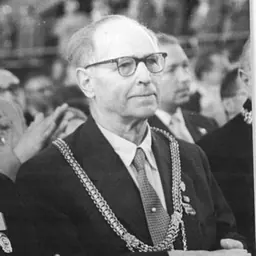
Wilbur Hobby (November 8, 1925 – May 9, 1992) was an American labor unionist. He was the president of the North Carolina chapter of the American Federation of Labor – Congress of Industrial Organizations (AFL-CIO) from 1969 to 1981. Hobby also was active in North Carolina politics, running unsuccessfully for the Democratic nomination for Governor in 1972.
Hobby strove to provide security and stability to the working lives of ordinary people, something he never had as a child. He used politics as a means to this end, but he entered the field at a time when segregationist forces were still very strong in the South. Hobby attempted to counter this by promoting a populist message that crossed racial lines that he hoped would become part of mainstream political conversation in North Carolina. However, his career ended in scandal with a conviction on felony corruption charges in 1981.
Early life, education, and service Wilbur Hobby was born in Durham in 1925, the son of a bricklayer and a cleaning lady who divorced when he was eight years old. The family struggled to make ends meet throughout most of his childhood. Sometimes, he had to skip school to pick up free groceries for the family, which included four brothers. Hobby moved more than twenty times, usually within the blue-collar Edgemont section of Durham. His father abandoned the family when he was seven or eight years old.
Hobby dropped out of school in the ninth grade. He then worked various odd jobs, including as the Durham Bulls first uniformed batboy. In fact, Hobby had developed some anti-labor sentiments during the war, viewing workers who went on strike as selfish while soldiers risked their lives defending the right to strike.
Hobby credits a specific instance during a night shift as changing his attitude towards unions. His tasks suddenly were split onto two floors instead of just one, making it extremely difficult to get everything required done in the allotted time. When he asked a friend what to do about the situation, Hobby was referred to their union representative. A day later, all was back to normal, and Hobby had discovered how a union could provide security and stability in the workplace. He went to the next meeting simply to express his gratitude, and he guessed that he ended up going to every successive one for the next fifteen years.
This aided Hobby's rise in the labor movement. Already well-versed in the North Carolina political scene, Hobby was appointed Southern political director of the Textile Workers Union of America in 1958, and became director of the AFL-CIO Committee on Political Education (COPE) for the seven southern states of Alabama, Florida, Georgia, Kentucky, North Carolina, South Carolina, and West Virginia (comprising Area 3) only one year later. Hobby spent the 1960s organizing the spread of unions in the South and promoting AFL-CIO-endorsed candidates for public office. He also strove to become president of the North Carolina chapter of the AFL-CIO, and was successful on his fourth attempt in 1969. Hobby considered the previous president, Milton Barbee, too timid to lead the organization into the future.
Political career
The overarching theme of Hobby's career in politics was to advance populist causes and the position of labor. He served in a variety of roles to make this possible, with his interest in politics becoming evident by the late 1940s.
Early years at Voters for a Better Government (VBG) Hobby's first union leadership position at the American Tobacco Company's local plant was his stepping stone into politics. He was elected president of Voters for a Better Government (VBG), an officially non-partisan, but Democratic-leaning, Durham-based organization in 1949. Uniting liberal academics from Duke University and North Carolina Central University with laborers of all races, VBG helped elect the progressive Dan Edwards as Mayor of Durham. Hobby became part of the Durham County Democratic Party power structure, and he soon involved VBG in the 1950 Senate race, which pitted conservative Democratic candidate Willis Smith against Frank Graham, the former president of the University of North Carolina, who had been appointed to the position. Smith won with a campaign that characterized Graham as pro-integration and as likely pro-communist. He felt that the purpose of the education system was to produce well-rounded individuals and capable citizens. He also wished to help more of North Carolina's students obtain at least some college training by having the state of North Carolina match pre-existing federal funds for community colleges, a plan that was not popular at a time when more than half of the state's high school graduates went on to no further schooling.
Housing North Carolina provided one of the lowest qualities of life for its citizens of any state in the early 1970s. Twenty percent of residences were classified as having inadequate plumbing or being overcrowded, with far more substandard by other measures.
Decline and felony conviction
What ultimately brought down Wilbur Hobby was not electoral defeat; it was the criminal justice system. There were some early warning signs that Hobby did not always play by the rules: during the first day of his gubernatorial campaign he pledged to not accept donations of more than $200 from any group, but he took in $10,000 from the AFL-CIO the next day. Hobby's opponents also accused him of spending too much on himself as AFL-CIO President, leading a lavish lifestyle while not truly representing the workers.
Hobby's executive career came to a sudden end in 1981. Using connections with new, union-friendly governor Jim Hunt, Hobby secured $1,000,000 in funding for job training programs under the federal Comprehensive Employment and Training Act (CETA) between 1977 and 1979. Hobby initially got funds awarded to Precision Graphics, a printing company he headed. Hobby and his business partner, Mort Levi, recognized the need for computers at the union and hoped to cut out the middleman by founding Precision Data together in early 1979. Precision Data proceeded to purchase several expensive computers with multi-year payment plans. Despite having no substantive capital, employees, or history as a company, Precision Data, under Hobby's direction, applied for a CETA contract to help train women to gain data skills. The board in charge of approving such contracts met the application with skepticism, and instead decided to award it to Precision Graphics, who they felt were better equipped to use the funds. Suddenly in financial trouble, Precision Data began leasing its computers to Precision Graphics for hefty fees. Over the course of the next few months, it became apparent that funds were being intentionally diverted from Precision Graphics to Precision Data, most notably a $28,000 payment for "transportation of students" that never occurred.
A year later, state and federal audits that found substantial funds unaccounted for (around $34,000). This led to indictments for Hobby and Levi for defrauding the federal government.
Though his personal political endeavors were unsuccessful and his career ended ignominiously, Hobby was an important figure in North Carolina's post-World War II era. He was a champion of the underprivileged, be they laborers or Blacks, and he tried to bring their struggles to the public's attention.
Don’t just read it —
keep it.
Full-length biographies made to live with: read them, listen on the way to work, watch them tonight.
- E-book
- Audio
- Video
Instant download · yours to keep · every purchase keeps this site free
Important facts
People in Wilbur Hobby's life
Named in this biography and alive at the same time



Related people
Same field, nearest in time



Contemporaries
People whose lives overlapped Wilbur Hobby's



Frequently asked questions
Who was Wilbur Hobby?
American labor unionist
When was Wilbur Hobby born?
Wilbur Hobby was born on 8 November 1925.
When did Wilbur Hobby die?
Wilbur Hobby died on 9 May 1992.
What was Wilbur Hobby's occupation?
Wilbur Hobby was a trade unionist.
Sources & further reading
Cite this page
APA: Biography.guide. (2026). Wilbur Hobby. https://biography.guide/wilbur-hobby/
MLA: "Wilbur Hobby." Biography.guide, https://biography.guide/wilbur-hobby/.
Chicago: "Wilbur Hobby." Biography.guide. https://biography.guide/wilbur-hobby/.
Data last updated: 2026-09-20 · Spot an error? Report a correction.
Page generated 2026-09-27 05:18 UTC