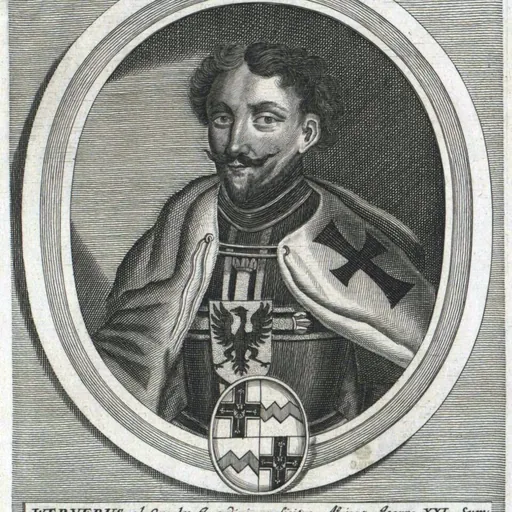
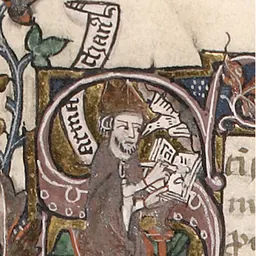
Werner von Orseln
Grand Master of the Teutonic Knights (died 1330)
About Werner von Orseln
Lived 1280 – 1330 (aged 49–50).
Life of Werner von Orslen Werner von Orseln (18 November 1330) was the 14th Grand Master of the Teutonic Order from 1324 until his murder in 1328.
Von Orseln hailed from a noble family of vogts (reeves) of the Counts of Falkenstein in Oberursel near Frankfurt. It is not known when he joined the Teutonic Order. He is first mentioned in 1312 holding the office of a Komtur at the Ordensburg of Ragnit (present-day Neman) near the border of the Order State with the Grand Duchy of Lithuania. In 1314, Grand Master Karl von Trier appointed von Orseln Grand Komtur at Malbork Castle. During a coup d'etat in the Monastic State, he supported the Grand Master and was exiled along with him. However, he returned in 1319 and he held the position of von Trier's resident in Prussia. He negotiated discussion and restored hierarchic discipline within the Order.
Upon the death of Karl von Trier, the Order's capitulum on 6 July 1324 chose von Orseln as the next Grand Master. Immediately after being elected, von Orseln was forced to start negotiations with King Władysław I the Elbow-high of Poland over the contested lands of Pomerelia, which the Knights had annexed after the takeover of Gdańsk in 1308. The discussions did not produce any results, however, and the Teutonic Order started preparations for war with Poland. In 1326 the Grand Master formed an anti-Polish coalition at Brodnica, consisting of the Masovian dukes Siemowit II, Trojden I and Wenceslaus of Płock as well as of several Silesian Piasts and King John of Bohemia. The pretext to start the Polish–Teutonic War gave King Władysław I by the invasion of Płock in 1327. In retaliation, the Grand Master ordered the conquest of Polish Kujavia and Dobrzyń Land.
Castles and Colonization In 1325, according to Nicolaus von Jeroschine and his book The Chronicle of Prussia, Werner von Orslen would get his subordinates to build the castles of Gerdauen, Wartenburg, Guttstadt, and Plut, and two years later, in 1327, Werner von Orslen would also command Hermann von Oppin, who was the leader of the Teutonic hospital at Elbing, to found a town on the lake of Maurin that would end up being called Mohrungen. This Europeanisation that von Orslen was certainly a part of would help create the Europe we know today. Historian Robert Bartlett helps to expand on why castles like this were important in his book The Making of Europe. In this book, Bartlett mostly focuses on the Norman castles and Knights that were present in the wars in Ireland; however, the blueprint is nearly identical to the Teutonic Order in terms of how castles and knights were used in order to bring people to the newly conquered lands and help hold them. On this topic, Bartlett says that “Homage and the fief came in the wake of conquest, the successful conquerors or warrior immigrants of the High Middle Ages expected a reward, and that reward was typically what they called a fief”. Here, though, it is noted by Urban that they mainly specialized in warfare. This, according to Pluskowski, occurred because the Teutonic knights “needed to find their place in a crusading world dominated by the Templars and Hospitallers”. While these wars between the Teutonic Knights and Cumans could not be called a Baltic crusade, they do seemingly help lay out a basic blueprint for the methods of the Teutonic Knights that can be seen nearly identically in the conquest that would later occur on the Baltic frontier and the actions of von Orslen in his mass building of German Castles and towns.
Circumstances of death In 1328, Headmaster Werner Von Orslen would be stabbed to death by Lord Johann of Endorf, who was also a brother of the Teutonic order, while Von Orslen was leaving the church of Marienburg in a procession. Because of this support from the Pope and the Emperor the situation for the Knights in the Baltic would be significantly different from both the Teutonic knights' actions in the Levant and in Hungary because, instead of being under the power of a king, they would actually own the lands themselves and would be given a free hand to take control of any lands in this general area that were controlled by non-Christians. Because of this, the Teutonic knights were able to legally expand their small holdings indefinitely. This legal expansion, coupled with the pope's decree of absolution, would allow the order to attract soldiers, knights, and colonists from all over Christendom and eventually create what was essentially their own powerful autonomous state in the Baltic region.
Lead up to the Polish wars of von Orslen's age The next piece of context that is necessary in understanding the world Werner von Orslen lived in is, of course, how the Teutonic knights went from protecting the Polish border and battling pagan tribes to fighting in full-blown wars against a Polish Lithuanian alliance. To understand this, one must realize that these wars against the Baltic people were generally not quick, outright conquests. For example, Pluskowski illuminates on this topic by showing that the area of what is roughly today the Kaliningrad Oblast took a staggering 50 years for the Teutonic order to conquer and fully pacify. This type of warfare was not limited to the Prussians, however, but would, according to von Jeroschin in 1283, expand into a war against the Lithuanians. This would eventually lead to the multiple wars between the Teutonic knights and the Polish Lithuanian alliance, which Werner von Orslen would both lead and fight in.
Historiography In Pluskowski's work, he covers the topic of what exactly the goals of Crusading orders (mainly in the Levant) that had come before were, and what exactly, in Pluskowski's view, the goals of the Baltic crusades were, and how this was achieved. Firstly, Pluskowski dives into how the creation of crusader states in the Levant was generally an almost accidental consequence of the first crusade. Another reason that Jenson is hesitant to call the Baltic Crusades true Crusades is stated best by Jenson himself when he says, “Many Scandinavian historians have simply rejected all mentions of crusades in medieval sources as mere rhetoric and a pretext for political expansion and economic exploitation”. This quote indeed looks very similar to the ideas that are provided in Pluskowski's monograph. These ideas paint the Baltic Crusades (manned by groups like the Teutonic Knights and other Catholic nations of the time period, such as Bohemia) as not simply forcible attempts to expand the faith but rather deliberate seizures of land. These seizures of land, as stated by Jenson, would undoubtedly have (at least on paper) major economic benefits. Also, these seizures of land would very likely entail political benefits for the theoretical converter of the Baltic pagans in the way that the conquest would bring papal favor and paint the leader of these efforts as a righteous conqueror.
Don’t just read it —
keep it.
Full-length biographies made to live with: read them, listen on the way to work, watch them tonight.
- E-book
- Audio
- Video
Instant download · yours to keep · every purchase keeps this site free
Important facts
People in Werner von Orseln's life
Named in this biography and alive at the same time


Contemporaries
People whose lives overlapped Werner von Orseln's


Frequently asked questions
Who was Werner von Orseln?
Grand Master of the Teutonic Knights (died 1330)
When was Werner von Orseln born?
Werner von Orseln was born in 1280.
When did Werner von Orseln die?
Werner von Orseln died on 18 November 1330 in Malbork.
Sources & further reading
· Wikipedia: Werner von Orseln
Cite this page
APA: Biography.guide. (2026). Werner von Orseln. https://biography.guide/werner-von-orseln/
MLA: "Werner von Orseln." Biography.guide, https://biography.guide/werner-von-orseln/.
Chicago: "Werner von Orseln." Biography.guide. https://biography.guide/werner-von-orseln/.
Data last updated: 2026-09-23 · Spot an error? Report a correction.
Portrait: Wikimedia Commons · author & licence
Page generated 2026-09-27 05:05 UTC