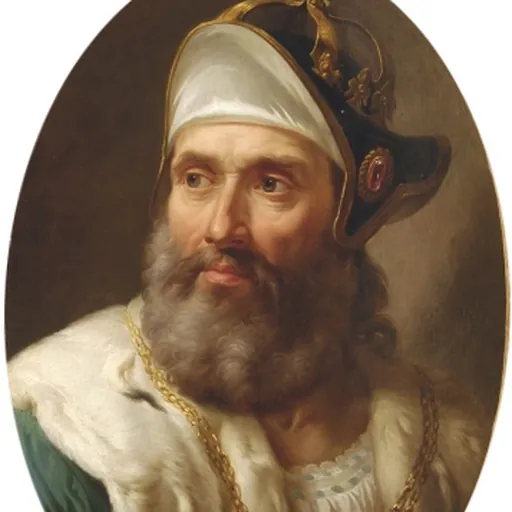
About Wenceslaus II of Bohemia
Lived 1271 – 1305 (aged 33). Wenceslaus II of Bohemia was a writer, composer, poet and monarch.
Wenceslaus II of Bohemia (; ; 27 September 1271 – 21 June 1305) was King of Bohemia (1278–1305), Duke of Cracow (1291–1305), and King of Poland (1296–1305).
He was the only surviving son of King Ottokar II of Bohemia and Ottokar's second wife Kunigunda. He was born in 1271, ten years after the marriage of his parents. Kunigunda was the daughter of Rostislav Mikhailovich, lord of Slavonia, son of a Grand Prince of Kiev, and Anna of Hungary, daughter of Béla IV of Hungary. His great-grandfather was the German king Philip of Swabia. Wenceslaus II was the grandfather of the Holy Roman Emperor, Charles IV. He was a member of the Přemyslid dynasty.
Early years Weneclaus was one of three sons of Ottokar II and Kunigunda, and the only one to survive to adulthood. At some point between 1283 and 9 September 1285, when the Dowager Queen died, Záviš and Kunigunda married after gaining the young King's consent, though there is speculation they had already held a wedding in the early 1280s without his approval. Despite his mother's death, Weneclaus remained under his stepfather's influence for the next few years.
On 24 January 1285, Wenceslaus married Judith of Habsburg, daughter of Rudolf I, to whom he had been betrothed since 1276. In 1290, Wenceslaus had Záviš beheaded for alleged treason and began ruling independently.
Polish kingship
In 1291, High Duke Przemysł II of Poland ceded the sovereign Duchy of Kraków to Wenceslaus. Kraków was associated with the overlordship of Poland, but Przemysł held the other duchies and in 1295 was crowned king. After Przemysł's death in 1296, Wenceslaus became overlord of Poland and, in 1300, had himself crowned its king.
Silver in Kutná Hora In 1298, silver was discovered at Kuttenberg (now Kutná Hora) in Central Bohemia. Wenceslaus took control of the mine by making silver production a royal monopoly and issued the Prague groschen, which became the most popular of the early Groschen-type coins. Kutná Hora was one of the richest European silver strikes ever: between 1300 and 1340, the mine may have produced as much as 20 tons of silver a year.
In 1300, Wenceslaus issued the new royal mining code Ius regale montanorum. This was a legal document that specified all administrative as well as technical terms and conditions necessary for the operation of mines.
The Crown of Hungary and death Queen Judith died in 1297. Wenceslaus' second wife was Elisabeth Richeza, daughter of King Przemysl II of Poland (1295–1296).
In 1301, Wenceslaus' kinsman Andrew III of Hungary died and the Árpád dynasty became extinct in the male line. Wenceslaus was one of the relatives who claimed the throne, and he accepted it from a party of Hungarians on behalf of his young son, betrothed to Andrew's only child, Elizabeth. On 27 August 1301, his son was crowned in Székesfehérvár as king of Hungary.
At that time the Kingdom of Hungary was split into several de facto principalities, and young Wenceslaus was only accepted as the King of Hungary by the rulers in Upper Hungary (Matthew III Csák), West-Transdanubia in modern-day Burgenland and West-Transdanubia, (where the Güssings Kőszegi (Croatian: Gisingovci) family were their strongest supporters, and on territory around the capital, Buda. But the Abas and Matthew Csák switched sides in 1303 and started to support Wenceslaus' rival Charles Robert of Anjou. Consequently, the young Wenceslaus, in Ofen (Buda), became afraid and wrote to his father in Prague for help. His father took a large army and invaded Buda, but having considered the situation, he took his son and the Hungarian crown and returned to Bohemia (1304). Ivan Kőszegi was named to represent Wenceslaus III in Hungary.
Wenceslaus II died on 21 June 1305, at the age of 33, probably of tuberculosis. He was succeeded by his son, Wenceslaus III, the last of the Přemyslid kings.
Review of the government of Wenceslaus II Wenceslaus II is considered one of the most important Czech kings. He built a great empire stretching from the Baltic Sea to the Danube river and established numerous cities, such as Plzeň in 1295. He won for his family three royal crowns (Bohemia, Hungary and Poland). The Kingdom of Bohemia was the largest producer of silver in Europe in his time. He created the Prague Groschen, which was an important European currency for centuries.
During his reign, there was great urban development. He planned to build the first university in Central Europe. The power and wealth of the Kingdom of Bohemia gave rise to great respect, but also to the hostility of European royal families. His son King Wenceslaus III was unable to maintain a mighty empire, and soon after the untimely death of Wenceslaus II, his empire began to crumble.
Family In 1285 in Eger (Cheb), he married the German Princess Judith of Habsburg (1271–1297), daughter of King Rudolf I of Germany and his wife Gertrude of Hohenberg. She died shortly after their 10th child was born: Přemysl Otakar (6 May 1288 – 19 November 1288); Wenceslaus III (6 October 1289 – 4 August 1306); King of Bohemia, King of Hungary and King of Poland; Agnes (6 October 1289 – soon after 6 August 1296), twin of Wenceslaus; married in 1296 to Rupert, eldest surviving son of German King Adolf, King of the Romans;
Gallery
Don’t just read it —
keep it.
Full-length biographies made to live with: read them, listen on the way to work, watch them tonight.
- E-book
- Audio
- Video
Instant download · yours to keep · every purchase keeps this site free
Important facts
Family & relationships
People in Wenceslaus II of Bohemia's life
Named in this biography and alive at the same time

Related people
Same field, nearest in time



Contemporaries
People whose lives overlapped Wenceslaus II of Bohemia's

Frequently asked questions
Who was Wenceslaus II of Bohemia?
King of Bohemia and Poland
When was Wenceslaus II of Bohemia born?
Wenceslaus II of Bohemia was born on 27 September 1271 in Prague.
When did Wenceslaus II of Bohemia die?
Wenceslaus II of Bohemia died on 21 June 1305 in Old Town.
What was Wenceslaus II of Bohemia's occupation?
Wenceslaus II of Bohemia was a writer, composer, poet and monarch.
Sources & further reading
· Wikipedia: Wenceslaus II of Bohemia
· DBpedia: Wenceslaus II of Bohemia
Cite this page
APA: Biography.guide. (2026). Wenceslaus II of Bohemia. https://biography.guide/wenceslaus-ii-of-bohemia/
MLA: "Wenceslaus II of Bohemia." Biography.guide, https://biography.guide/wenceslaus-ii-of-bohemia/.
Chicago: "Wenceslaus II of Bohemia." Biography.guide. https://biography.guide/wenceslaus-ii-of-bohemia/.
Data last updated: 2026-09-23 · Spot an error? Report a correction.
Portrait: Wikimedia Commons · author & licence
Page generated 2026-09-27 05:06 UTC