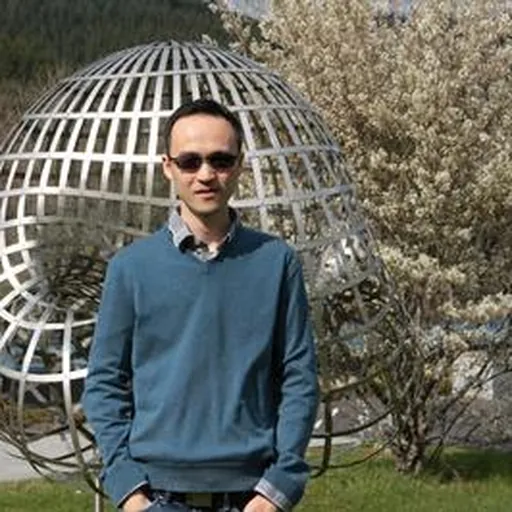
About Wei Zhang
Born 1981. Wei Zhang is a Chinese mathematician and university teacher.
Wei Zhang (; born 1981) is a Chinese mathematician specializing in number theory. He is a professor of mathematics at the Massachusetts Institute of Technology.
Early life and education Zhang grew up in Sichuan province and attended Chengdu No.7 High School. He graduated from Peking University with a Bachelor of Science in mathematics in 2004 and earned his Ph.D. from Columbia University in 2009 under the supervision of Shou-Wu Zhang.
Work His collaborations with Zhiwei Yun, Xinyi Yuan and Xinwen Zhu have received attention in publications such as Quanta Magazine and Business Insider. In particular, his work with Zhiwei Yun on the Taylor expansion of L-functions is "already being hailed as one of the most exciting breakthroughs in an important area of number theory in the last 30 years." In 2013, Zhang received a Sloan Research Fellowship; in 2016 Zhang was awarded the Morningside Gold Medal of Mathematics. In December 2017 he was awarded 2018 New Horizons In Mathematics Prize together with Zhiwei Yun, Aaron Naber and Maryna Viazovska. In 2019 he received the Clay Research Award.
He was included in the 2019 class of fellows of the American Mathematical Society "for contributions to number theory, algebraic geometry and geometric representation theory". He was elected to the American Academy of Arts and Sciences in 2023.
Publications (selected) "Automorphic period and the central value of Rankin-Selberg L-function", J. Amer. Math. Soc. 27 (2014), 541–612. "On arithmetic fundamental lemmas", Invent. Math., 188 (2012), No. 1, 197–252. "Fourier transform and the global Gan–Gross–Prasad conjecture for unitary groups", Annals of Mathematics 180 (2014), No. 3, 971–1049. "Selmer groups and the indivisibility of Heegner points" , Cambridge Journal of Mathematics 2 (2014), no. 2, 191–253. (with Michael Rapoport, Ulrich Terstiege) "On the Arithmetic Fundamental Lemma in the minuscule case", Compositio Mathematica 149 (2013), no. 10, 1631–1666. (with Xinyi Yuan, Shou-Wu Zhang) "The Gross–Kohnen–Zagier theorem over totally real fields", Compositio Mathematica 145 (2009), no. 5, 1147–1162. (with Xinyi Yuan, Shou-Wu Zhang) "The Gross–Zagier formula on Shimura curves", Annals of Mathematics Studies vol. 184, Princeton University Press, 2012. (with Manjul Bhargava, Christopher Skinner) "A majority of elliptic curves over Q satisfy the Birch and Swinnerton-Dyer conjecture", preprint. (with Zhiwei Yun) "Shtukas and the Taylor expansion of L-functions", Annals of Mathematics 186 (2017), No. 3, 767–911. (with Xinyi Yuan, Shou-Wu Zhang) "Triple product L-series and Gross–Kudla–Schoen cycles" , preprint. (with Yifeng Liu, Shou-Wu Zhang) "On p-adic Waldspurger formula", preprint.
Don’t just read it —
keep it.
Full-length biographies made to live with: read them, listen on the way to work, watch them tonight.
- E-book
- Audio
- Video
Instant download · yours to keep · every purchase keeps this site free
Important facts
People in Wei Zhang's life
Named in this biography and alive at the same time





Related people
Same field, nearest in time



Contemporaries
People whose lives overlapped Wei Zhang's





Frequently asked questions
Who is Wei Zhang?
Chinese mathematician
When was Wei Zhang born?
Wei Zhang was born on 18 July 1981 in Dachuan District.
What is Wei Zhang's occupation?
Wei Zhang is a mathematician and university teacher.
What nationality is Wei Zhang?
Wei Zhang is Chinese.
Sources & further reading
· DBpedia: Wei Zhang (mathematician)
Cite this page
APA: Biography.guide. (2026). Wei Zhang. https://biography.guide/wei-zhang/
MLA: "Wei Zhang." Biography.guide, https://biography.guide/wei-zhang/.
Chicago: "Wei Zhang." Biography.guide. https://biography.guide/wei-zhang/.
Data last updated: 2026-09-22 · Spot an error? Report a correction.
Portrait: Wikimedia Commons · author & licence
Page generated 2026-09-27 05:02 UTC