
About Wang Xianzhi
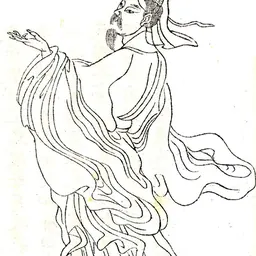
Lived 344 – 386 (aged 41–42). Wang Xianzhi was a Chinese painter and calligrapher.
Wang Xianzhi (, 344–386), courtesy name Zijing (子敬), was a famous Chinese calligrapher of the Eastern Jin dynasty.
Xianzhi was born to the Wang clan of Langya, an influential kin group descended from the Qin dynasty general Wang Jian. He was the seventh and youngest son of the famed calligrapher Wang Xizhi. Wang inherited his father's talent for the arts, and although several of his siblings were notable calligraphers, only Xianzhi was able to eventually equal his father in status, with the pair later attaining the appellation, "The Two Wangs (二王 èr wáng)." Wang Xianzhi's (also referred to as "Wang Junior" 小王) style is substantially more fluid and stylistic than that of his father ("Wang Senior" 大王), whose structural firmness nonetheless remains unrivaled. Xianzhi's most celebrated accomplishment is his refinement of the "running-cursive" script (行草), a writing style which, as the name implies, combines features of both the cursive and running scripts. The Duck-Head Pills Letter is an outstanding example of this technique. Another of Xianzhi's accomplishments is the extensive application of the "one-stroke writing" technique for (cursive script), historically (though perhaps incorrectly) attributed to Zhang Zhi (張芝) of the Late Han, which strings together several characters (typically three to four) into a single stroke or renders a complex character in a rather convoluted single stroke. Until the Tang dynasty, Wang Xianzhi's influence and reputation largely surpassed that of his father.
Wang Xizhi noticed Xianzhi's talent early on and started training him in calligraphy at around the age of seven. According to one popular anecdote, Wang Xizhi once unsuccessfully tried to snatch Xianzhi's brush from behind while the latter was writing. Being amazed at Xianzhi's strong grip, Wang Xizhi remarked, "This son of mine is destined for fame!" Wang Xianzhi continued to practice diligently into adulthood until finally becoming as skilled as his father. Xianzhi died at age 42 while still in his prime. By comparison, his father did not produce many of the works he is most known for until his late forties and fifties, including the work he is most well known for (though this attribution remains controversial), Lantingji Xu . Along with his father Wang Xizhi, Zhang Zhi and Zhong Yao, Wang Xianzhi is recognized as one of the "Four Worthies of Calligraphy (書中四賢 shūzhōng sìxián)."
Representative works
Family Wang Xianzhi's ex-wife Lady Xi was a daughter of Xi Tan (郗昙), son of Xi Jian. At his deathbed, Wang was once asked if he had any regrets; his reply was that his only regret was divorcing Lady Xi.
Don’t just read it —
keep it.
Full-length biographies made to live with: read them, listen on the way to work, watch them tonight.
- E-book
- Audio
- Video
Instant download · yours to keep · every purchase keeps this site free
Important facts
People in Wang Xianzhi's life
Named in this biography and alive at the same time

Related people
Same field, nearest in time




Contemporaries
People whose lives overlapped Wang Xianzhi's



Frequently asked questions
Who was Wang Xianzhi?
Chinese calligrapher
When was Wang Xianzhi born?
Wang Xianzhi was born in 344 in Linyi.
When did Wang Xianzhi die?
Wang Xianzhi died in 386.
What was Wang Xianzhi's occupation?
Wang Xianzhi was a painter and calligrapher.
What nationality was Wang Xianzhi?
Wang Xianzhi was Chinese.
Sources & further reading
· DBpedia: Wang Xianzhi (calligrapher)
Cite this page
APA: Biography.guide. (2026). Wang Xianzhi. https://biography.guide/wang-xianzhi/
MLA: "Wang Xianzhi." Biography.guide, https://biography.guide/wang-xianzhi/.
Chicago: "Wang Xianzhi." Biography.guide. https://biography.guide/wang-xianzhi/.
Data last updated: 2026-09-26 · Spot an error? Report a correction.
Page generated 2026-09-27 05:14 UTC