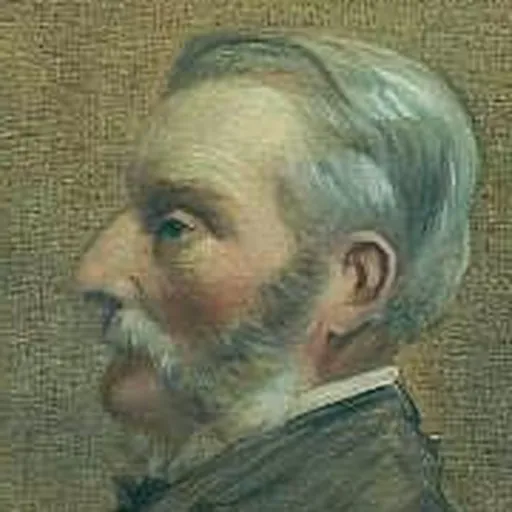
Walter Potter
British taxidermist
About Walter Potter
Lived 1835 – 1918 (aged 82). Walter Potter was a British taxidermist, known for Anthropomorphic.
Walter Potter (2 July 1835 – 21 May 1918) was an English taxidermist noted for his anthropomorphic dioramas featuring mounted animals mimicking human life, which he displayed at his museum in Bramber, Sussex, England. The exhibition was a well-known and popular example of "Victorian whimsy" for many years, even after Potter's death; however, enthusiasm for such entertainments waned in the twentieth century, and his collection was finally dispersed in 2003.
Early life and popularity Walter Potter's family ran The White Lion pub in Bramber. Potter left school at the age of fourteen and began creating taxidermy pieces as a way to encourage people to visit the family's establishment. His first attempt at taxidermy was to preserve the body of his own pet canary when he was a teenager. At the age of 19, inspired by his sister, Jane, who showed him an illustrated book of nursery rhymes,
Amongst Potter's scenes were "a rats' den being raided by the local police rats ... village school ... featuring 48 little rabbits busy writing on tiny slates, while the Kittens' Tea Party displayed feline etiquette and a game of croquet. A guinea pigs' cricket match was in progress, and 20 kittens attended a wedding, wearing little morning suits or brocade dresses, with a feline vicar in white surplice." and the village and Potter's museum were so popular that an extension was built to the platform at Bramber railway station. was shown at the Victoria and Albert Museum in 2001 as part of "The Victorian Vision" exhibition. Potter's Museum in Bramber The exhibits form the inspiration for the gothic thriller The Taxidermist's Daughter by Kate Mosse.
Sale of the collection The museum closed in the 1970s, and, after having been moved to Brighton and then to Arundel, was sold in 1984 to the owners of Jamaica Inn, Bolventor, Cornwall, The death of their taxidermist and economic considerations sapped the venture of its viability, and, when a buyer to maintain the collection intact did not come forward, it was auctioned by Bonhams in 2003, realizing over £500,000. "The Kittens' Wedding" was sold for £21,150, and "The Death and Burial of Cock Robin" was the highest-selling item of the sale, raising £23,500. Present at the auction were Peter Blake, Harry Hill and David Bailey. He also showed appreciation for the displays: "My own favourites are these tableaux: there's a kittens' wedding party, with all these kittens dressed up in costumes, even wearing jewellery. The kittens don't look much like kittens, but that's not the point. There's a rats' drinking party, too which puts a different construction on Wind in the Willows. And a group of hamsters playing cricket."
Don’t just read it —
keep it.
Full-length biographies made to live with: read them, listen on the way to work, watch them tonight.
- E-book
- Audio
- Video
Instant download · yours to keep · every purchase keeps this site free
Important facts
People in Walter Potter's life
Named in this biography and alive at the same time



Related people
Same field, nearest in time



Contemporaries
People whose lives overlapped Walter Potter's




Frequently asked questions
Who was Walter Potter?
British taxidermist (1835–1918)
When was Walter Potter born?
Walter Potter was born on 2 July 1835 in Bramber.
When did Walter Potter die?
Walter Potter died on 21 May 1918.
What was Walter Potter's occupation?
Walter Potter was a taxidermist.
What was Walter Potter known for?
Walter Potter was known for Anthropomorphic.
What nationality was Walter Potter?
Walter Potter was British.
Sources & further reading
Cite this page
APA: Biography.guide. (2026). Walter Potter. https://biography.guide/walter-potter/
MLA: "Walter Potter." Biography.guide, https://biography.guide/walter-potter/.
Chicago: "Walter Potter." Biography.guide. https://biography.guide/walter-potter/.
Data last updated: 2026-09-22 · Spot an error? Report a correction.
Portrait: Wikimedia Commons · author & licence
Page generated 2026-09-27 05:01 UTC