
About Walter Mildmay
Lived 1523 – 1589 (aged 65–66). Walter Mildmay was a politician.
Sir Walter Mildmay (bef. 1523 – 31 May 1589) was an English politician who served as Chancellor of the Exchequer to Queen Elizabeth I, and founded Emmanuel College, Cambridge.
Origins He was born at Moulsham in Essex, the fourth and youngest son of Thomas Mildmay, later auditor of the Court of Augmentations under Henry VIII, by his wife Agnes Read. As the Commissioner for receiving the surrender of the monasteries at the Dissolution, his father Thomas made a large fortune and in 1540 acquired the manor of Moulsham, near Chelmsford in Essex, where he built a fine mansion.
Collateral line Walter's elder brother Sir Thomas Mildmay (d. 1566) of Moulsham, was auditor of the Court of Augmentations, established in 1537 for allocating the property taken by the Crown from the monasteries. He was buried in Chelmsford Church, where his monument survived in 1878. Sir Thomas Mildmay was the grandfather of Sir Thomas Mildmay, 1st Baronet (d. 1626), created a baronet in 1611, and of Sir Henry Mildmay (d. 1654), a knight. Henry claimed, in right of his mother Frances Radcliffe, a daughter of Henry Radclyffe, 2nd Earl of Sussex, 3rd Baron FitzWalter (1507–1557), the barony of FitzWalter, and on 10 February 1670 his grandson Benjamin Mildmay, 17th Baron FitzWalter (c. 1646–1679), was summoned to the House of Lords by that title. Benjamin's two sons were Charles Mildmay, 18th Baron FitzWalter (1670–1728) and Benjamin Mildmay, 1st Earl FitzWalter, 1st Viscount Harwich, 19th Baron FitzWalter (1672–1756), the latter being further created Viscount Harwich and Earl FitzWalter in 1730. On Earl FitzWalter's death in 1756, the earldom became extinct and the barony fell into abeyance.
Career
Mildmay was educated at Christ's College, Cambridge, but as was common at the time, especially for those not intending to enter the church, did not take a degree. He later became a student of law at Gray's Inn (1546), and there obtained some employment under his father in the Court of Augmentations. When the Court of Augmentation was reconstituted, about 1545, Mildmay was made one of its two surveyors-general. During Edward VI's reign, Mildmay extended his official connection.
On 22 February 1546/47 he was knighted, and on 14 September prepared, along with three others, an inventory of the late King's wardrobe. Sixteen days later he was appointed a commissioner to report upon the Crown revenues. In 1548 he acted on commissions for the sale of lands (March) and for the maintenance of such grammar schools as had belonged to the dissolved chantries. After the Duke of Somerset's arrest he was ordered by the Privy Council on 12 November 1549, to examine the Palace of Westminster, which had been in the Duke's custody, and, on 8 March 1550/51, to take charge of the Duke's property at Syon House.
Mildmay soon proved himself a skillful financier. In 1550 he was directed, together with the Earl of Warwick and Sir William Herbert, to examine the accounts of the King's mints, and in 1551 superintended the establishment of a new mint at York. In December 1551 he was a commissioner to inspect the Courts which controlled the Crown lands. On 2 January 1552 he was commissioned to levy the King's debts; On 21 November to settle with the Crown accountants the effect of a fall in the value of money; In December to audit the funds belonging to the king's officers; and In that and the next year he superintended the receipt by the crown of plate, jewels, bells, and the like surrendered by dissolved monasteries or chantries. In his speeches in Parliament he argued that a liberal grant of subsidies placed the government under an obligation to redress grievances, and thus identified himself with the popular party in the commons.
In 1572 he helped to prepare evidence against Thomas Howard, 4th Duke of Norfolk, who, nevertheless, after his condemnation gave him some rich jewels. His nephew Sir Christopher Peyton was appointed Auditor General of Ireland in 1584.
The affairs of Mary, Queen of Scots, also occasionally occupied his attention. When she arrived in England in 1567 he strongly advised her detention. In October 1577 he and Cecil visited her at Chatsworth, after she had announced that she had important secrets to reveal to Elizabeth.
In 1586, he went to Fotheringhay Castle and informed her of her forthcoming trial, in which he took part as one of the special commissioners. In March 1587 he urged the condemnation of William Davison in the Star Chamber. Although four times nominated an ambassador to Scotland, in 1565, 1580, 1582, and 1583, he was on each occasion detained at home, but when his name was suggested for the office in 1589, James VI expressed great readiness to receive him. Mildmay's illness, however, brought the suggestion to nothing.
Epitaphs on Mildmay and Sir John Calthrop were licensed by the Stationers' Company on 29 July 1589. They are not known to be extant.
Mildmay otherwise showed his interest in education by acting as an original governor of Chelmsford Chantry School, now King Edward VI Grammar School, founded in 1550–1; by giving an annuity of 52s. to Christ's Hospital (10 April 1556); and by bestowing £20 a year on Christ's College, Cambridge (10 March 1568 – 1569), to be expended on a Greek lectureship, six scholarships and a preachership to be filled by a fellow of the college. He also contributed stone for completing the tower of Great St Mary's Church, Cambridge, and he helped to found the free-school at Middleton, Lancashire.
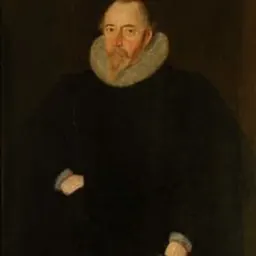
There are three portraits of Mildmay at Emmanuel College; one with his wife. A fourth painting was at Moulsham Hall, demolished in 1809, near Chelmsford, and a fifth at Knole, Sevenoaks. There are also engravings by J. Faber and E. Harding, and an unsigned plate is known.
Character and publications Sidney Lee wrote that Mildmay was a man of cultivation and of great piety, with some popular reputation as a believer in second sight. Henry Caesar, dean of Ely, was directed by the Star Chamber to retract a report that he had circulated to the effect that Mildmay had endeavoured to see by conjuration the person of Cardinal Pole after his death.
Henry Roberts, in his Fames Trumpet Soundinge (1589), mentions a book by Mildmay, and describes it as "in print now extant". It was entitled A Note to know a Good Man. Sir John Harington, in his Orlando Furioso, bk. xxii, p. 175, gives a stanza in Latin with an English translation; the former he says he derived from Mildmay's Latin poems, which are not otherwise known. A "memorial" by Mildmay, written for his son Anthony in 1570, consisting of sensible moral precepts, was printed from a manuscript at Apethorpe by the Rev. Arundell St John-Mildmay in 1893. Many of his official letters and papers are at Hatfield or in the state paper office.
Marriage and issue Mildmay married Mary Walsingham (died 16 March 1576), a daughter of William Walsingham by his wife Joyce (or Joice), a daughter of Edmund Denny, a Baron of the Exchequer, and a sister of Sir Francis Walsingham. By his wife he had issue including: Sir Anthony Mildmay (d.1617), of Apethorpe, eldest son and heir, an ambassador to France, who married Grace Sharington by whom he had one daughter Mary Mildmay. Humphrey Mildmay of Danbury Place, Essex, father of Sir Henry Mildmay; Winifred Mildmay, wife of Sir William Fitzwilliam of Gains Park, Essex; Martha Mildmay, wife of Sir William Brouncker; Christiana Mildmay, wife successively of Charles Barrett of Aveley in Essex, and Sir John Leveson of Kent, Knight.
Don’t just read it —
keep it.
Full-length biographies made to live with: read them, listen on the way to work, watch them tonight.
- E-book
- Audio
- Video
Instant download · yours to keep · every purchase keeps this site free
Important facts
People in Walter Mildmay's life
Named in this biography and alive at the same time







Related people
Same field, nearest in time

Contemporaries
People whose lives overlapped Walter Mildmay's

Frequently asked questions
Who was Walter Mildmay?
English politician; (1523-1589)
When was Walter Mildmay born?
Walter Mildmay was born in 1523.
When did Walter Mildmay die?
Walter Mildmay died in 1589.
What was Walter Mildmay's occupation?
Walter Mildmay was a politician.
Sources & further reading
Cite this page
APA: Biography.guide. (2026). Walter Mildmay. https://biography.guide/walter-mildmay/
MLA: "Walter Mildmay." Biography.guide, https://biography.guide/walter-mildmay/.
Chicago: "Walter Mildmay." Biography.guide. https://biography.guide/walter-mildmay/.
Data last updated: 2026-09-20 · Spot an error? Report a correction.
Page generated 2026-09-27 05:17 UTC