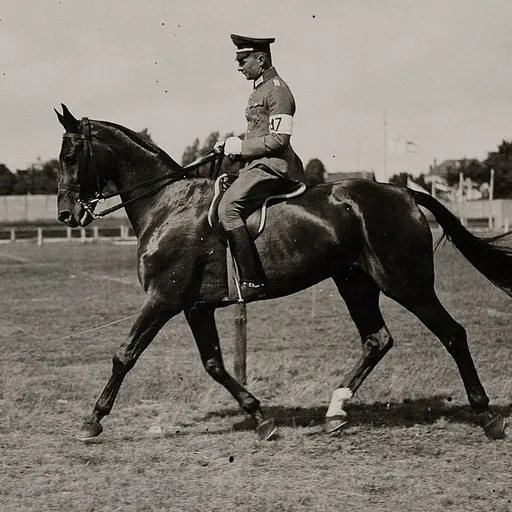
About Walter Feyerabend
Lived 1891 – 1962 (aged 70). Walter Feyerabend was a German military officer.
Walter Franz Georg Feyerabend (3 December 1891 – 17 April 1962) was a German career officer and equestrian. He competed in two events at the 1928 Summer Olympics.
Life
Walter Feyerabend was born in 1891 on the family estate (Gut Warthen) where his father was lord of the manor. Having graduated with honors from the cadet corps, was transferred to the 1st East Prussian Field Artillery Regiment No. 16 as a commissioned 2nd Lieutenant on 1 March 1910. The Feldartillerie (field artillery) was equipped with the lighter cannons to guarantee speed in the field, whereas the Fußartillerie (foot artillery) was equipped with the larger (heavier) calibers.
From 1 March to 30 April 1914, he was seconded to the artillery school in Jüterbog. At the outbreak of the First World War, he initially served as a platoon leader in his regiment. From 18 August 1914, he was the regimental adjutant. On 5 January 1916, he was transferred as adjutant to the staff of Army Group Prince Leopold of Bavaria. From 1 June to 14 July 1917, he was seconded to an anti-aircraft training course in Lille, followed by another course in Valenciennes. On 1 August 1917, he returned to the front as battery commander of Heavy Anti-Aircraft Battery 149. From 1 April 1918, he served in Brussels, before being transferred to the replacement detachment of his parent regiment on 15 December 1918.
From 15 January 1919, he was battery commander in the 1st East Prussian Field Artillery Regiment No. 16 (presumably with the Grenzschutz Ost). On 1 October 1919, he was transferred to the Preliminary Reichswehr and became battery commander in the 1st Artillery Regiment. From 1 April 1920 to 30 September 1922, Feyerabend served at the Cavalry School in Hanover. As a captain, he then briefly joined the staff of the 1st (Prussian) Artillery Regiment in Königsberg, before heading the training battalion of his regiment from 1 November 1922 to 31 March 1927. From 1 April 1927, he was again seconded to the Cavalry School to prepare intensively for the Olympic Games.
From 1 February 1929, he was a riding instructor and squadron commander at the Infantry School in Dresden. On 1 July 1933, he took command of the disguised motorized transport battalion (Fahrabteilung) in Königsberg. On 1 April 1935, he was transferred from the Heer to the Luftwaffe with a rank of Major. His battalion was now reclassified as I. Battalion/Flak-Regiment 1. On 1 October 1936, he was appointed commander of the new Flak-Regiment 25 in Ludwigsburg. On 1 November 1937, he was appointed Higher Flak Artillery Leader 1 in Königsberg.
From 26 September 1938, he was commander of the Leipzig Air Defense Area, renamed Air Defense Area 2 on 1 July 1939. On 20 April 1939, he had been promoted to the rank of Generalmajor. On 10 April 1940, he was appointed commander of the German air defense forces in Norway. On 24 July 1941, he again took command of Air Defense Area 2. From 1 September 1941, he was commander of the 2nd Flak Division in Leipzig.
When the 2nd Flak Division was sent to the Eastern Front and replaced in its garrison of Leipzig by the creation of the 14th Flak Division on 3 February 1942, Feyerabend took command of that division and remained in charge until 30 November 1942 when he was honorably discharged from the Wehrmacht, Rudolf Schulze took over the division on 1 December 1942.
On 1 February 1945, Generalleutnant Feyerabend was partially reactivated and held the deputy command of the 27th Flak Division, which had retreated from Königsberg to West Prussia and then to Stettin. It is presumed he represented Generalleutnant Walter von Hippel who had officially been appointed commander, but remained Flak Leader of the 10th Army in Italy. On 2 May 1945, Generalmajor Oskar Vorbrugg took over command of the division which capitulated in Schwerin on 4 May 1945.
Promotions 1 March 1910 Leutnant (2nd Lieutenant) without Patent 1 June 1910 received Patent 18 December 1915 Oberleutnant (1st Lieutenant) 1 February 1922 Hauptmann (Captain) 1 September 1932 Major 1 April 1935 Major (Luftwaffe) 1 June 1935 Oberstleutnant (Lieutenant Colonel) 1 August 1937 Oberst (Colonel) 20 April 1939 Generalmajor (Major General) with effect and Rank Seniority (RDA) from 1 April 1939 1 April 1941 Generalleutnant (Lieutenant General)
Awards and decorations (excerpt)
Iron Cross (1914), 2nd and 1st Class Military Merit Cross (Austria-Hungary), 3rd Class with the War Decoration (ÖM3K) Wound Badge (1918) in Black Honour Cross of the World War 1914/1918 with Swords Wehrmacht Long Service Award, 4th to 1st Class Repetition Clasp 1939 to the Iron Cross 1914, 2nd Class
Don’t just read it —
keep it.
Full-length biographies made to live with: read them, listen on the way to work, watch them tonight.
- E-book
- Audio
- Video
Instant download · yours to keep · every purchase keeps this site free
Important facts
People in Walter Feyerabend's life
Named in this biography and alive at the same time



Related people
Same field, nearest in time



Contemporaries
People whose lives overlapped Walter Feyerabend's

Frequently asked questions
Who was Walter Feyerabend?
German officer
When was Walter Feyerabend born?
Walter Feyerabend was born on 3 December 1891 in East Prussia.
When did Walter Feyerabend die?
Walter Feyerabend died on 15 April 1962 in Detmold.
What was Walter Feyerabend's occupation?
Walter Feyerabend was a military officer.
What nationality was Walter Feyerabend?
Walter Feyerabend was German.
Sources & further reading
· Wikipedia: Walter Feyerabend
Cite this page
APA: Biography.guide. (2026). Walter Feyerabend. https://biography.guide/walter-feyerabend/
MLA: "Walter Feyerabend." Biography.guide, https://biography.guide/walter-feyerabend/.
Chicago: "Walter Feyerabend." Biography.guide. https://biography.guide/walter-feyerabend/.
Data last updated: 2026-09-23 · Spot an error? Report a correction.
Portrait: Wikimedia Commons · author & licence
Page generated 2026-09-27 05:06 UTC