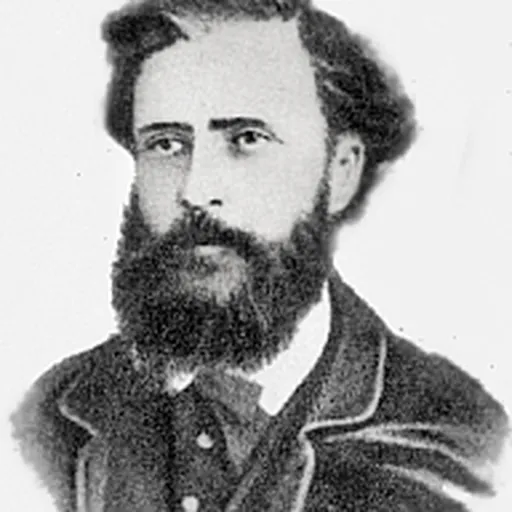
Walery Antoni Wróblewski
Polish politician, general of Paris Commune and commander of January Uprising
About Walery Antoni Wróblewski
Lived 1836 – 1908 (aged 71). Walery Antoni Wróblewski was a Polish and Russian revolutionary, politician, military personnel, communard, lamplighter and printer.
Walery Antoni Wróblewski (; 27 December 1836 – 5 August 1908) was a Polish-Belarusian and French revolutionary, politician and soldier. He was one of the leaders of the Reds during the January Uprising of 1863; exiled in France, he became a general of the Paris Commune.
Early life Walery Antoni Wróblewski was born in Żołudek (present day Zhaludok, Belarus) to an impoverished szlachta family. His father Antoni worked as a forester.
During his studies, he participated in the student movement, was a member of an illegal revolutionary circle led by Polish revolutionary democrats such as Zygmunt Sierakowski and Jarosław Dąbrowski.
He was sent to work for the position of the deputy head of the forestry school in Sokółka, and in 1861 he became the head of the school and was appointed a second lieutenant. He actively participated in the creation of an illegal revolutionary organization in the Grodno region and carried on propaganda among school students.
January Uprising
After the outbreak of the January Uprising, from April 1863 he became a deputy general and head of the armed forces of the Augustów and Grodno as a supporter of the Reds.
He had the rank of brigadier general and was the commander-in-chief of all the insurgent formations of the Grodno province. His skillful leadership of the rebels in the area entrusted to him made it possible to maintain an active partisan war against the Russian troops for much longer than in many other regions of the North-Western Territory covered by the uprising. However, after the final defeat of the rebellion in the Grodno region, he fled to Warsaw.
In Warsaw, the recently inaugurated dictator Romuald Traugutt appointed Wróblewski as commissar of the Lublin and Podlaskie and set him the task of reviving the insurgent movement that was fading there. However, in December 1863, when crossing with a horse detachment next to a river in the Kotsk region near the village of Ustinov, the group was attacked by a Cossack detachment. In a fierce battle, Wróblewski was seriously wounded in the head and shoulder, but survived. The Cossacks, who considered him dead, left him on the battlefield. Wróblewski was soon found there in a half-dead state by local peasants sympathizing with the rebels, and hidden in the barn of one of them.
After receiving medical treatment, and disguised as a woman, Wróblewski in July 1864 managed to escape to Galicia, which was under the control of the Austrian Empire. Since the authorities of the Russian Empire issued a warrant for his arrest, sentencing him to death in absentia, all of his property in the Russian Empire was confiscated.
France and the Paris Commune During his settlement in France, Wróblewski was a member of the Union of Polish Emigrants and at first worked as a teacher but later joined the National Guard.
During the Franco-Prussian War, he defended Paris in a battalion of the National Guard. After the revolution in Paris and the establishment of the Paris Commune, on 18 March 1871, he actively supported the revolutionary aspirations of the Parisian workers.
Wróblewski offered the Communards his services and was soon promoted to the rank of general and led one of the three revolutionary armies that defended the southern part of Paris.
During the semaine sanglante, he defended in vain the Butte-aux-Cailles and the district of the Bastille at the head of the 101st battalion trained workers of 13th and 5th arrondissements of Paris.
After these two failures and the death or injuries of many other senior officers of the Commune, he was offered the chief command of what remained of the army of the Communards.
After the defeat of the Communards he fled Paris and reached London in mid-August 1871. On May 28, 1872, a French tribunal sentenced him to death in absentia.
Later life
While in London, he became secretary of the General Council of the International Workingmen's Association, and was among the so-called Of the First International and Poland's delegate at its congresses. He was a member of the Polish People's Union committee in London. He actively supported Karl Marx and Friedrich Engels against Mikhail Bakunin and his supporters.
After the collapse of the First International and the organization and Polish People's Union, Wróblewski moved to Geneva. In 1878, he illegally settled in Russia. When the French government announced an amnesty to the participants of the Paris Commune, in 1885 he moved to France and settled in the city of Nice. In 1901, the French government even awarded him a pension. He spent the last years of his life in Ouarville.
On his gravestone there is an inscription: "to the heroic son of Poland - the people of Paris".
Streets in Katowice, Brest and Grodno are named after the general.
Don’t just read it —
keep it.
Full-length biographies made to live with: read them, listen on the way to work, watch them tonight.
- E-book
- Audio
- Video
Instant download · yours to keep · every purchase keeps this site free
Important facts
People in Walery Antoni Wróblewski's life
Named in this biography and alive at the same time



Related people
Same field, nearest in time


Contemporaries
People whose lives overlapped Walery Antoni Wróblewski's




Frequently asked questions
Who was Walery Antoni Wróblewski?
Polish politician, general of Paris Commune and commander of January Uprising (1836-1908)
When was Walery Antoni Wróblewski born?
Walery Antoni Wróblewski was born on 27 December 1836 in Zhaludok.
When did Walery Antoni Wróblewski die?
Walery Antoni Wróblewski died on 5 August 1908 in Ouarville.
What was Walery Antoni Wróblewski's occupation?
Walery Antoni Wróblewski was a revolutionary, politician, military personnel, communard, lamplighter and printer.
What nationality was Walery Antoni Wróblewski?
Walery Antoni Wróblewski was Polish and Russian.
Sources & further reading
· Wikipedia: Walery Antoni Wróblewski
· DBpedia: Walery Antoni Wróblewski
Cite this page
APA: Biography.guide. (2026). Walery Antoni Wróblewski. https://biography.guide/walery-antoni-wroblewski/
MLA: "Walery Antoni Wróblewski." Biography.guide, https://biography.guide/walery-antoni-wroblewski/.
Chicago: "Walery Antoni Wróblewski." Biography.guide. https://biography.guide/walery-antoni-wroblewski/.
Data last updated: 2026-09-23 · Spot an error? Report a correction.
Portrait: Wikimedia Commons · author & licence
Page generated 2026-09-27 05:06 UTC