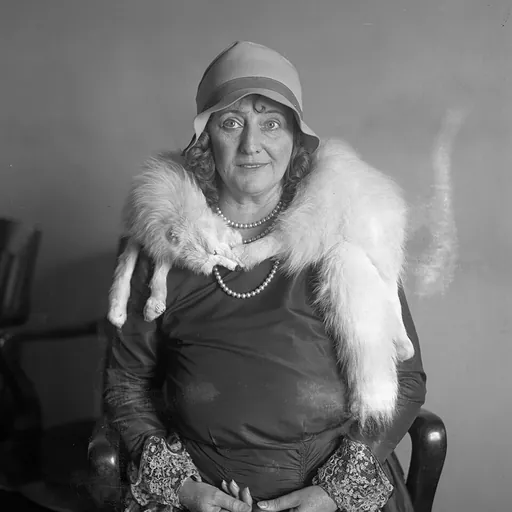
Walburga Oesterreich
American housewife
About Walburga Oesterreich
Lived 1900 – 1961. Walburga Oesterreich was an American housewife.
Walburga Oesterreich ( Korschel; 1880 – April 8, 1961), nicknamed "Dolly" and "Queen of Los Angeles", was an American housewife who gained notoriety for the shooting death of her husband, textile manufacturer Fred William Oesterreich (December 8, 1877 – August 22, 1922), and the subsequent bizarre revelation that she had kept her lover, Otto Sanhuber, hidden in the attic of the home she shared with her husband for ten years.
Background Oesterreich was born Walburga Korschel in 1880 to German immigrant parents. It is unclear if she was born in Imperial Germany or shortly after her parents arrived in the U.S.A. She grew up in the Milwaukee, Wisconsin area among a community of fellow German immigrants. At age 12, Walburga worked at the textile mill of Fred William Oesterreich, another German immigrant who had become successful and frequently hired fellow immigrants in his factories. Walburga was by all accounts an attractive and charismatic girl, with many friends among the factory workers. She quickly attracted Fred's notice and the two married when she was 17. As Fred's wife, Walburga remained popular among her husband's workers, often peacefully resolving labor disputes by acting as intermediary to the more distant and unlikeable Fred.
From the beginning of the marriage, Walburga was rumored to have invited many lovers into her home during the day while Fred worked at the mills. In 1913, when she was 33, Walburga was introduced to Otto Sanhuber, a 17-year-old sewing-machine repairman who worked for her husband. She invited Sanhuber to her home to fix her sewing machine, beginning an intense affair. To avoid suspicion from the neighbors, Walburga explained that Sanhuber was her "vagabond half-brother".
Gradually, the need to conceal the relationship from both Fred and the neighbors led to Sanhuber's moving into the Oesterreichs' attic, which was accessible through a panel in the ceiling of the closet of the bedroom Walburga shared with her husband. Sanhuber was supplied with a cot, food, a lamp, books, and writing materials. During the day he would perform housework in the residence; at night he would live in total silence in the attic, reading and writing science fiction stories, which Walburga would mail to potential publishers for him. Sanhuber would later describe himself as Walburga's "sex slave" and claimed they made love up to eight times a day. Fred remained unaware of Sanhuber's presence in the house. another of Walburga's lovers, soon discovered that she was having an affair with Shapiro. He went to police and informed them that Walburga had given him a pistol shortly after the murder, asking him to dispose of it in the La Brea Tar Pits. A neighbor also told police that Walburga had given him yet another pistol shortly after the murder, asking him to dispose of it because it too closely resembled the gun that killed her husband and she "did not want to get into trouble." The neighbor buried the pistol under a rosebush in his garden. Police were able to recover the pistols from both locations. Although badly decayed, both weapons were determined to be of the same caliber that killed Walburga's husband. She was arrested under suspicion of murder.
While in jail, Walburga confided to Shapiro that her "vagabond half-brother" was living in the attic of her home and requested he check on his well-being. Upon knocking on the trapdoor leading to the attic, he was greeted by a thin, pale, but cordial Sanhuber, who explained his true relationship with Walburga and eventually confessed to his role in the murder. Sanhuber was arrested and tried for manslaughter. The unusual circumstances of the case soon reached the press, where Sanhuber was dubbed "The Bat Man."
Sanhuber was convicted of manslaughter, but later released because the statute of limitations had expired. and 2018's Lover in the Attic, starring Molly Burnett and directed by Melora Walters.
The story was featured in the August 18, 2016 episode of The Dollop podcast.
Walburga was also the subject of a 2017 episode of the Investigation Discovery documentary series A Crime to Remember.
Don’t just read it —
keep it.
Full-length biographies made to live with: read them, listen on the way to work, watch them tonight.
- E-book
- Audio
- Video
Instant download · yours to keep · every purchase keeps this site free
Important facts
People in Walburga Oesterreich's life
Named in this biography and alive at the same time

Related people
Same field, nearest in time




Contemporaries
People whose lives overlapped Walburga Oesterreich's




Frequently asked questions
Who was Walburga Oesterreich?
American housewife (1880–1961)
When was Walburga Oesterreich born?
Walburga Oesterreich was born in 1900 in Chicago.
When did Walburga Oesterreich die?
Walburga Oesterreich died on 8 April 1961 in Los Angeles.
What was Walburga Oesterreich's occupation?
Walburga Oesterreich was a housewife.
What nationality was Walburga Oesterreich?
Walburga Oesterreich was American.
Sources & further reading
· Wikipedia: Walburga Oesterreich
· DBpedia: Walburga Oesterreich
Cite this page
APA: Biography.guide. (2026). Walburga Oesterreich. https://biography.guide/walburga-oesterreich/
MLA: "Walburga Oesterreich." Biography.guide, https://biography.guide/walburga-oesterreich/.
Chicago: "Walburga Oesterreich." Biography.guide. https://biography.guide/walburga-oesterreich/.
Data last updated: 2026-09-21 · Spot an error? Report a correction.
Portrait: Wikimedia Commons · author & licence
Page generated 2026-09-27 05:01 UTC