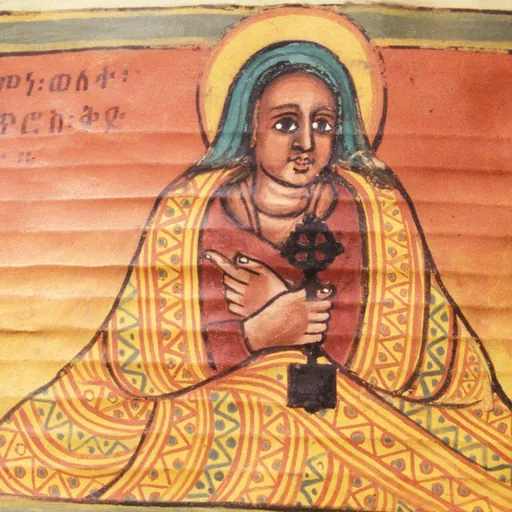
Walatta Petros
Saint of the Ethiopian Orthodox Tewahedo Church
About Walatta Petros
Lived 1592 – 1642 (aged 49–50).
Walatta Petros (; 1592 – 23 November 1642) was an Ethiopian saint. Her hagiography, The Life-Struggles of Walatta Petros (Gädlä Wälättä P̣eṭros) was written in 1672. She is known for resisting conversion to Roman Catholicism, forming many religious communities, and performing miracles for those seeking asylum from kings.
Names Walatta Petros's name in the Ge'ez script is written as ወለተ ጴጥሮስ. It is transliterated into the Latin alphabet in many ways online and scholarship, including the Library of Congress spelling Walata Péṭros and Walatta Pēṭros. Her name is a compound name, meaning "Daughter of [St] Peter," and should not be improperly shortened from "Walatta Petros" to "Petros." Other spellings are Walata Petros, Wallatta Petros, Wallata Petros, Waleta Petros, Waletta Petros, Walete Petros, Walleta Petros, Welete Petros, Wolata Petros plus Walatta Pétros, Walatta Pietros, Walatta Petrus, and Wälätä P'ét'ros.
Life
Early life Walatta Petros was born in 1592 into a noble family with hereditary rights to lands in southern Ethiopian Empire. Before her birth, it is said that her parents were told that she was fated to become an important and influential religious figure. Her father and brothers were officials at court. Walatta Petros was married at a young age to Malka Krestos, one of Susenyos's counselors. She gave birth to three children who all died in infancy and she decided to become a nun. and Sälamta Wälättä Peṭros ). Later, in 1769, others added more miracles, including those about the following kings: Bäkaffa, Iyasu II, Iyoˀas I, Ras Mikaˀel Səḥul, Yoḥannəs II, Täklä Giyorgis I and Tewodros II.
Over a dozen manuscript copies were made in Ethiopia. The first print edition was published in 1912, based on one manuscript. The first translation into another language, Italian, was published in 1970, In 2015, the first English translation was published, which included color plates from the parchment manuscript illuminations of her life, and in 2018 a short student edition was published.
Scholarship Little was published on Walatta Petros in Western scholarship before the 21st century. Written before the corrected, full edition based on 12 manuscripts was published in 2015, encyclopedia entries, histories, and journal articles: one published in 1902 in Russian and another in 1943 in Italian.
More has been published in the twenty-first century, almost entirely in English. The first was written by the French art historian Claire Bosc-Tiessé, who conducted field research at monasteries on Lake Ṭana about the creation of a royal illuminated manuscript of Gädlä Wälättä P̣eṭros. The Russian historian Sevir Chernetsov published an article arguing that Walatta Petros was a non-gender-conforming saint. The American literary scholar Wendy Laura Belcher argued that Walatta Petros was one of the noble Ethiopian women responsible for the defeat of Roman Catholicism in Ethiopia in the 1600s. Some journalism has been published about the saint as well.
Controversy has attended the English translation of the Gädlä Wälättä P̣eṭros, starting in October 2014 after one of the co-translators, Belcher, started giving talks about the saint's relationship with Eheta Kristos and due to news coverage of the translation. Members of the Ethiopian Orthodox Täwaḥədo Church have stated online that “this book claims Walatta Petros is a lesbian” and have written many comments about sexuality on a Guardian article about the translation. and published a scholarly article on the topic of same-sex sexuality in the hagiography.
In a September 2020 academic article, Dr. Yirga Gelaw Woldeyes argued that Belcher and Kleiner lacked an understanding of the Ge'ez language and pushed an orientalist and racist narrative of a queer, sex-driven, violent African woman in their translation. In October 2020, scholars and members of the Ethiopian Orthodox Church submitted an open letter to Princeton University, Princeton University Press, and Princeton University President Christopher L. Eisgruber protesting the treatment of their religious texts and urging the university to cease support to this translation and forthcoming works by Professor Belcher. Princeton University Press and the Princeton University President both responded with statements that they unequivocally supported Belcher and Kleiner's "award-winning work." Kleiner wrote a philological response article, rebutting the charges of misunderstanding and mistranslating the Ge'ez, thereby undermining the basis for the charges of racism raised by Yirga. Kleiner argued that the disputed translations, a dozen or so words out of tens of thousands of words, were a result of choosing the contextually best term from the lexically legitimate ones, although he admits that all translations will have some mistakes. However, Belcher’s argues the mistranslations were not mistakes. Rather, the mistranslations were deliberate choice a “stretch” of critical words that change the meaning-making of her hagiography and at times contradictory interventions. He added that Ethiopian church members understand the second meaning ይትማርዓ/ይትማርሐ (yətmarrəˁa, yətmarrəha, [feminine] guide/lead each other) as is common in monastery life. In this context,ይትማርዓ means ይትማርሐ(guide each other). Yirga agrees that one of the meanings is sexual but insists that the word is interchangeable with ይትማርሐ and should be understood contextually which means helping each other in a communal life.
Don’t just read it —
keep it.
Full-length biographies made to live with: read them, listen on the way to work, watch them tonight.
- E-book
- Audio
- Video
Instant download · yours to keep · every purchase keeps this site free
Important facts
Contemporaries
People whose lives overlapped Walatta Petros's



Frequently asked questions
Who was Walatta Petros?
saint of the Ethiopian Orthodox Tewahedo Church
When was Walatta Petros born?
Walatta Petros was born in 1592 in Ethiopian Empire.
When did Walatta Petros die?
Walatta Petros died on 23 November 1642.
Sources & further reading
Cite this page
APA: Biography.guide. (2026). Walatta Petros. https://biography.guide/walatta-petros/
MLA: "Walatta Petros." Biography.guide, https://biography.guide/walatta-petros/.
Chicago: "Walatta Petros." Biography.guide. https://biography.guide/walatta-petros/.
Data last updated: 2026-09-23 · Spot an error? Report a correction.
Portrait: Wikimedia Commons · author & licence
Page generated 2026-09-27 05:08 UTC