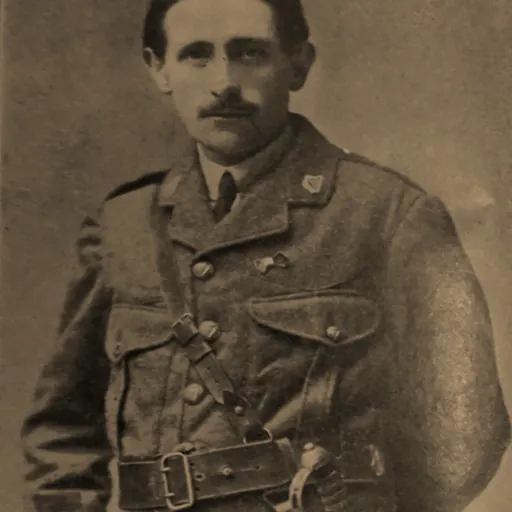
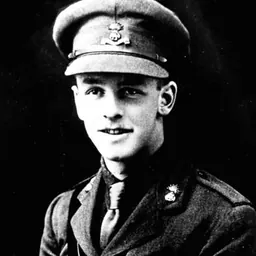
W.J. Brennan-Whitmore
Irish revolutionary and journalist
About W.J. Brennan-Whitmore
Lived 1886 – 1977 (aged 91).
William James Brennan-Whitmore (21 October 1886 – 27 December 1977) was an Irish revolutionary, journalist and soldier. Joining the Irish Volunteers during the Home Rule Crisis, Brennan-Whitmore took part in the Easter Rising, Irish War of Independence and Irish Civil War, before becoming in later years an advocate of corporatism and fascism.
Early life William James Brennan-Whitmore was born in Wexford, Ireland on 21 October 1886 to Thomas Whitmore, a journalist and painter, and his wife Mary Brennan. His parents died when he was a child, leaving him in the custody of his maternal uncle John Brennan from Ferns, a supporter of Fenianism, and his wife Elizabeth. Brennan-Whitmore would later combine the names of his guardian families together in appreciation of his foster parents. Following his schooling, Brennan-Whitmore briefly took a job as a grocer's apprentice in Dublin before enlisting in the Royal Irish Regiment.
Serving in the Royal Irish Rifles, Brennan-Whitmore was deployed to the British Raj in the medical corps and at one point received a promotion to the rank of sergeant. He first began to develop Irish nationalist convictions from his conversations with an Irish missionary priest named Father John Mullan while on duty in the hills of The Himalayas. Brennan-Whitmore left the army in 1907 and returned to his home in County Wexford, becoming a journalist and a prominent member of local branches of the Gaelic League and Sinn Féin.
In the latter stages of the rising, Brennan-Whitmore was accorded the military rank of commandant among the Irish Volunteers, having been promoted to the position by a wounded Connolly. He considered the rebel leadership's defensive plan a wasted opportunity, believing instead that the seized buildings should have been lightly garrisoned so as to free up manpower to push British patrols out of the city, and that the organisation of a planned retreat into the countryside was feasible as an alternative to surrender. Retreating under heavy British bombardment as his command post and other buildings in the vicinity were set ablaze by shelling, Brennan-Whitmore and the group under his leadership became lost due to his lack of knowledge of the city of Dublin's layout.
Irish Republican Army Brennan-Whitmore, alongside others who had taken part in the rebellion, was imprisoned in Frongoch internment camp in North Wales, where he was appointed camp adjutant to JJ O'Connell.
In 1940, Brennan-Whitmore founded a pro-German fascist party named Clann na Saoirse, which called for the military reclamation of Northern Ireland, pro-natalist policies, a ban on emigration, the elimination of the "pernicious influence of aliens" on Irish economic life, the establishment of a "sovereign federation" of the Celtic nations, and the prohibition of the English language under an eight-point planned drafted by the party's director Gearóid Ó Cuinneagáin, but this party proved short-lived as it was banned by the Irish government and its members arrested following the discovery of Plan Kathleen.
Despite his far-right views, Brennan-Whitmore became an active member of the left-leaning Clann na Poblachta, hoping that in government the new party would introduce financial reforms and break the de facto parity between Irish pound and the Sterling. He was also rumoured to have been a member of the National Socialist Irish Workers Party.
Later life
Brennan-Whitmore completed his memoir of his experiences during the Easter Rising, Dublin burning: the Easter rising from behind the barricades, in 1961. In a letter written to the Evening Herald in 1968, Brennan-Whitmore disputed the accepted story of Collins' assassination, alleging that Michael Collins had been assassinated by a British intelligence agent and implied Emmet Dalton was the supposed agent responsible. He endorsed the Provisional Irish Republican Army during The Troubles, arguing that he could not "see any difference, moral or legal, between the fight now being waged by the present generation I.R.A., and that waged by the I.R.A. of my generation. The objective of both is precisely the same - the liberation of our beloved country from foreign domination."
Death On 27 December 1977 Brennan-Whitmore died aged 91 at the Meath Hospital in Dublin.
Don’t just read it —
keep it.
Full-length biographies made to live with: read them, listen on the way to work, watch them tonight.
- E-book
- Audio
- Video
Instant download · yours to keep · every purchase keeps this site free
Important facts
People in W.J. Brennan-Whitmore's life
Named in this biography and alive at the same time



Contemporaries
People whose lives overlapped W.J. Brennan-Whitmore's





Frequently asked questions
Who was W.J. Brennan-Whitmore?
Irish revolutionary and journalist (1886–1977)
When was W.J. Brennan-Whitmore born?
W.J. Brennan-Whitmore was born on 21 October 1886.
When did W.J. Brennan-Whitmore die?
W.J. Brennan-Whitmore died on 27 December 1977.
Sources & further reading
· Wikipedia: W.J. Brennan-Whitmore
· DBpedia: W.J. Brennan-Whitmore
Cite this page
APA: Biography.guide. (2026). W.J. Brennan-Whitmore. https://biography.guide/w-j-brennan-whitmore/
MLA: "W.J. Brennan-Whitmore." Biography.guide, https://biography.guide/w-j-brennan-whitmore/.
Chicago: "W.J. Brennan-Whitmore." Biography.guide. https://biography.guide/w-j-brennan-whitmore/.
Data last updated: 2026-09-23 · Spot an error? Report a correction.
Portrait: Wikimedia Commons · author & licence
Page generated 2026-09-27 05:07 UTC