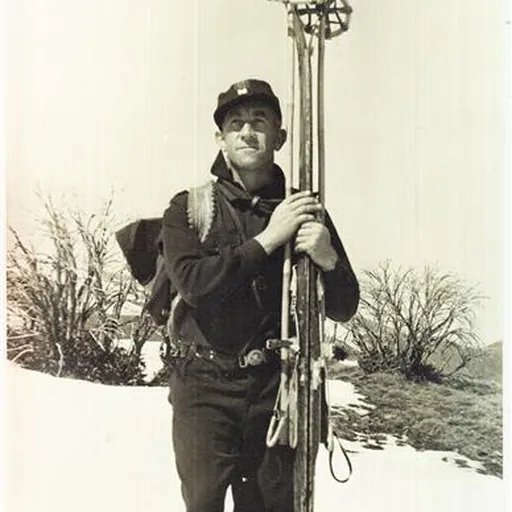
About W. F. Waters
Lived 1897 – 1968 (aged 71). W. F. Waters was an Australian civil servant.
William Francis "Bill" Waters ( – ) was Scouts Victoria's Headquarters Commissioner for Rover Scouts between 1930 and 1965. He began to take groups of Rover Scouts on week-long treks to explore the Bogong High Plains in 1932. The success of these treks led to the construction of the Bogong Rover Chalet before winter 1940.
Waters was presented with the Silver Acorn by Lord Baden-Powell himself in 1934, and received a Bar to the Silver Acorn 20 years later. Waters was presented with the highest award of The UK Scout Association, the Silver Wolf, at Surfmoot 1961, following the Seventh World Rover Moot.
Personal life Waters was an only child, born on 22 August 1897 in Traralgon, Victoria to Eva and Francis Waters. The family later relocated to Melbourne, where Waters attended Melbourne High School. and was an amateur heavyweight boxer.
In 1933, Waters was appointed as an honorary ranger and an honorary forester by the Forestry Commission of Victoria. These appointments gave Waters the authority to act on behalf of the Forestry Commission. Also in 1933, Waters was gazetted as a member of the Committee of Management of the Kinglake National Park, another organisation that he would have a long association with.
At the time of his death in 1968, Waters was Chairman of the Kinglake National Park Committee of Management, and a member of Scouts Victoria, the Melbourne Walking Club, the Royal Historical Society of Victoria, and the Skiing Club of Victoria. Hull was saved, but Cleve Cole died of hypothermia.
During the period of 1927–1930, a series of articles by him appeared in the magazine Victorian Scout.
Rover Scout Commissioner Waters was appointed as Headquarters Commissioner for Rovers in 1930 and continued in the role until 1965, when he was reassigned to the newly created role of Commissioner for Rover Training. On appointing Waters, Chief Commissioner Charles Hoadley gave a simple brief: Get the Rovers out of their Dens and back into the outdoors. This goal Waters would dedicate the remainder of his life to achieving. Water had much experience in the new sport, having been a part of the first party to reach the summit of Victoria's highest peak, Mt Bogong during winter, back in 1928.
Mount Donna Buang
The Rovers skied at Mount Donna Buang for many years until access to the better snowfields further from Melbourne improved. In 1945, following the end of the Second World War, the Rover Section wanted to construct a memorial to the Rovers who had been killed during the hostilities. By November 1945, £110 had already been raised. Waters purchased the land on the slopes of Mt Donna Buang and began the planning for the construction. By May 1946, funds had doubled, and the framework had been assembled by Rovers. However the postwar building restrictions prevented the completion of Rover Memorial Chalet, Warburton until 1949.
Bogong High Plains
The first "Winter Party", as they would come to be known, was held in 1932 and based at Cope Hut. Nine people attended the two-week-long adventure on the Bogong High Plains. Over the coming years, the numbers attending the Winter Parties would increase, with participants from interstate also joining the Victorians in the early exploration of the area.
By 1938, the size and number of the Rover Winter Parties were beginning to monopolise Cope Hut, as well as the nearby Wallace's Hut. Waters wrote to all Victorian Rover Crews and appealed for funds to construct a "Rover Hut" between the two huts. After raising £700, the Bogong Rover Chalet was constructed over five weeks in early 1940, in time for the ski season.
More and more Rovers began skiing in the area, until in 1946 the Rovers began to ski at Mount Baw Baw itself, and the future site of the Alpine Resort. Waters negotiated with the owners of Neulyne's Mill for the use of some of their huts during the winter to accommodate the Rovers, although they still had to hike up to the snowfields from what is now the entry to the resort. From 1952, the Rovers were allowed the use of a cottage and the remaining huts. Public use of Mount Baw Baw increased over the next decade, leading to the establishment of the Mount Baw Baw Alpine Village.
Resting place
Because of Waters' passion and commitment to skiing and bushwalking in Victoria's Alpine areas, his remains were scattered at a place he named Investiture Point, the closest place to the Bogong Rover Chalet at which it is possible to see Mount Bogong.
A Fellowship of the Open Air When Chief Commissioner Charles Hoadley appointed Waters as Headquarters Commissioner for Rovers, he charged Waters to focus on building up the outdoor side of Rover Scouting, using his experiences with the Melbourne Walking Club and Ski Club of Victoria to develop the young men as leaders in the Victorian bush. In 1930, the Victorian Rover Scouts' outdoor activities were largely limited to the competition for the Matthew Evans Shield, which was awarded for "best hiking". That would soon change.
Waters set about developing outdoor adventures by organising them himself. In the November 1930 edition of Victorian Scout, the journal of Scouts Victoria, Waters published a list of activities open to Rovers from across the state which were to be led by experienced activity leaders. This list of activities would become known as the Fixture Card, and it included activities like bushwalking, skiing, surfing and rock climbing; as well as working bees at Gilwell Park in Gembrook. Eventually the fixture card would include social activities and lectures to meet the demands of the Rovers.
As the fixture card activities headed further afield, they became more popular, and would often attract Rovers and Rover Leaders from South Australia and New South Wales. Eventually, these trips became such a part of Rovering life that the minimum expectation was that each member would attend a minimum of six activities a year
Every weekend for over four months, Rovers traveled out to the area with prismatic compasses and theodolites to survey this area. Their information, as well as the information from the existing government maps were combined at Rover HQ. The master Rover map was the basis of maps of the upper Yarra valley for decades to come.
Hut Service Section The Rovering community's interest in the outdoors grew, and beginning in 1936, they began to take an interest in maintaining the 20 abandoned huts at old sawmill sites in what is now the Yarra Ranges National Park, the forested mountains between Warburton and Powelltown. These 20 huts were within easy walking distance of each other and therefore were popular with Scouts and other bushwalkers as well.
The scheme was well appreciated by the Forests Commission of Victoria and the mill owners, while the huts' visitors' books were full of praise as well. The crews which took on responsibilities for these huts were expected to maintain their hut, visit it regularly, and report on its condition to the Chief Warden at Rover Scout Headquarters. They also provided visitors' books, firewood and some basic utensils for people staying at the hut. Unfortunately, most of these huts were soon to be destroyed during the Black Friday bushfires in 1939.
After the Moot, the Australians visited Gilwell Park and spent three weeks touring the British Isles. During this trip, Waters represented Australia at the 14th World Scout Conference in Lichtenstein.
7th World Rover Moot
Hosted by Victorian Rovers at Wonga Park between 27 December 1961 and 6 January 1962, the 7th World Rover Moot was the first World Scout Event to be held in the southern hemisphere. The event was attended by 970 Rover Scouts from all Australian States and 15 other countries.
Waters was the Moot Chief, the man responsible for overseeing the operation of the entire event. With a team of Leaders from across Victoria and Australia, Waters worked for two years to create an event that would set a new standard for Rover Moots in Australia and around the world.
+ Seventh World Rover Moot Council Moot Role Name Normal Scouting Role Moot Chief W.F. Waters Headquarters Commissioner for RoversScouts Victoria Moot Administrative Commissioner Colonel E.R.E Black General SecretaryScouts Victoria No. 1 Subcamp Chief W.L. Williams No. 2 Subcamp Chief F.R. Watson No. 3 Subcamp Chief E.M. Derrick No. 4 Subcamp Chief A. Keeble Administration Services 1st Deputy Moot Chief Roy Driver Assistant Headquarters Commissioner for RoversScouts Victoria Asst. Moot Chief – Secretary M. Brown Asst. Moot Chief – Quartermaster Lt Colonel D.J. Edgar Asst. Moot Chief – Victualing T. Wallace Asst. Moot Chief R.W. McKellar Publicity, Activities & Maintenance Services 2nd Deputy Moot Chief Wally Watts Assistant County Commissioner for RoversHoadley County, Scouts Victoria Asst. Moot Chief – Activities A. Blair Asst. Moot Chief – Transport G. Clarke Asst. Moot Chief – Sites & Services A Jackson Moot Marshal M. Hough Welfare Services 3rd Deputy Moot Chief Stan Bales Headquarters Commissioner for RoversScouts Australia NSW Asst. Moot Chief – Billeting A.G.T. Grant Asst. Moot Chief – Camp Accommodation M. Johnston Asst. Moot Chief – Fraternity E. Sargeant Expeditions Assistant Moot Chief – Expeditions Ivan Stevens Assistant Headquarters Commissioner for RoversScouts Victoria Personnel Ivan Fox Transport E. Sandbach Routes George Tanck Leaders Ivan Fox Communications J. Turner
For the first time, the Moot program included a total of 48 different four-day expeditions to locations across Victoria, including Anglesea, the Bogong High Plains, the Buchan Caves, Lake Eildon, and Mount Buffalo. One whole day was set aside for participants to provide service to the community. Some of the service that was completed by the Moot included clearing the Puffing Billy Railway line from Belgrave to Menzies Creek, clearing the grounds of the Adult Deaf and Dumb Home in Blackburn, building kennels and runs at the Lady Nell Seeing Eye Dog School and painting the Guide Hut at Clifford Park. ran the Seventh World Moot
Waters remains a giant of Victorian Rovering to this day. Following campaigning from the Rovers of Victoria, Scouts Australia's National Council created a new Adult Recognition Award for outstanding service to the Rover Section by a Rover, Rover Advisor, or other person in 1982. dwarf the rest of the National Rover Service Awards, a testament to the high level of Scouting that Victorian Rovering developed under Bill's guidance over many decades.
Waters' name is also carried on by the WF Waters Lodge, a private ski lodge owned and operated by Rover Scouts Victoria at Mt Baw Baw Alpine Resort, and the Bill Waters Rover Crew in Nunawading.
Don’t just read it —
keep it.
Full-length biographies made to live with: read them, listen on the way to work, watch them tonight.
- E-book
- Audio
- Video
Instant download · yours to keep · every purchase keeps this site free
Important facts
People in W. F. Waters's life
Named in this biography and alive at the same time




Related people
Same field, nearest in time

Contemporaries
People whose lives overlapped W. F. Waters's


Frequently asked questions
Who was W. F. Waters?
Australian Rover Scout Leader (1897–1968)
When was W. F. Waters born?
W. F. Waters was born on 22 August 1897 in Traralgon.
When did W. F. Waters die?
W. F. Waters died on 8 October 1968 in Fitzroy.
What was W. F. Waters's occupation?
W. F. Waters was a civil servant.
What nationality was W. F. Waters?
W. F. Waters was Australian.
Sources & further reading
Cite this page
APA: Biography.guide. (2026). W. F. Waters. https://biography.guide/w-f-waters/
MLA: "W. F. Waters." Biography.guide, https://biography.guide/w-f-waters/.
Chicago: "W. F. Waters." Biography.guide. https://biography.guide/w-f-waters/.
Data last updated: 2026-09-22 · Spot an error? Report a correction.
Portrait: Wikimedia Commons · author & licence
Page generated 2026-09-27 05:00 UTC