
Volero Publilius
5th-century BC Roman tribune of the plebs
About Volero Publilius
Lived 550 BC – 500 BC. Volero Publilius was a Roman politician and military personnel.
John Leech, A Lictor is sent to arrest Publilius Volero, from The Comic History of Rome. In this account, the powerful Publilius seized the lictor and set him down roughly on the ground.
Volero Publilius was tribune of the plebs in Rome in 472 and 471 BC. During his time as tribune, he secured the passage of two important laws increasing the independence of his office.
Background The tribunes of the plebs had been created following the secession of the people in 494 BC. Burdened by crushing debt and angered by a series of clashes between the patricians and plebeians, in which the patricians held all of the political power, the plebeians deserted the city en masse and encamped upon the sacred mount. One of the concessions offered by the senate to end the stand-off was the creation of a new office, tribune of the people, for which only plebeians would be eligible. These tribunes had the power to convene the concilium plebis, one of the three major assemblies of the Roman people, and to propose legislation before it; the power to intercede on behalf of a citizen who wished to appeal from the decision of a magistrate; and the power to veto, or block the actions of the senate and magistrates. The tribunes of the plebs were sacrosanct within the boundaries of Rome, and the entire body of the Roman people obliged to protect them from harm. The tribunes thus became the primary check on the power of the senate, as well as the protectors of the rights of the plebeians.
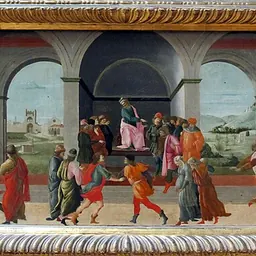
In 473 BC, the tribune Gnaeus Genucius attempted to bring the consuls of the preceding year to trial for having blocked multiple attempts to bring about agrarian reform. But on the morning of the trial he was found to have been murdered in his house, notwithstanding his sacrosanctity. Cowed by the murder of their colleague, the remaining tribunes failed to block a levy of soldiers. Tensions rose as the leaders of the patrician and plebeian factions each argued that the other side was depriving them of their liberty. Things came to a head when Volero Publilius, who had served as a centurion in the Roman army, was called to serve as a common soldier. He refused, and the consuls sent a lictor to arrest him. Publilius resisted, and a scuffle ensued in which the clothes were torn from Publilius' back; breaking free of the lictor, he appealed to the people to defend him. Niebuhr, vol. II, pp. 207–210 (Schmitz, trans.).
At this point, the fury of the mob drove the consuls and their lictors from the forum; the lictors were manhandled, and their fasces broken; the consuls took refuge in the senate house, as the senate deliberated its response. Over the objections of the hard-liners, the senior members prevailed, and took no further actions against the people. For his courage in resisting an unjust order, knowing that it might lead to his death, Publilius became a hero to the people, and was elected one of the tribunes of the plebs for the following year.
Legislation As tribune in 472 BC, Publilius surprised the aristocrats, who expected him to foment violence between the classes, by instead choosing a peaceful course of action. He proposed a law transferring the election of the tribunes of the plebs from the comitia centuriata, the oldest of the assemblies, which conferred imperium on magistrates, to the comitia tributa, considered a more democratic assembly. Voting strength in the comitia centuriata was determined by age and property, and the assembly tended to reflect the wishes of the aristocracy, a problem that only increased with the passage of time. Voting in the comitia tributa was done by tribes, with each tribe receiving an equal vote. Although neither the senate nor the consuls favoured the law, they could do nothing to block it. Nonetheless, debate over the law consumed the rest of the year, and the proposal carried over to the following year.
In the senate, Claudius harangued those who either supported Publilius' legislation, or failed to oppose it as cowards and traitors; but the senate wisely chose to accede to the will of the people, and dropped its opposition. Publilius' laws were passed, becoming the Lex Publilia of 471 BC. The election of the tribunes of the plebs passed to the comitia tributa, and three new tribunes were elected to serve alongside Publilius and Laetorius.
Footnotes
Don’t just read it —
keep it.
Full-length biographies made to live with: read them, listen on the way to work, watch them tonight.
- E-book
- Audio
- Video
Instant download · yours to keep · every purchase keeps this site free
Important facts
Related people
Same field, nearest in time
Contemporaries
People whose lives overlapped Volero Publilius's


Frequently asked questions
Who was Volero Publilius?
5th-century BC Roman tribune of the plebs
When was Volero Publilius born?
Volero Publilius was born in 550 BC.
When did Volero Publilius die?
Volero Publilius died in 500 BC.
What was Volero Publilius's occupation?
Volero Publilius was a politician and military personnel.
What nationality was Volero Publilius?
Volero Publilius was Roman.
Sources & further reading
Cite this page
APA: Biography.guide. (2026). Volero Publilius. https://biography.guide/volero-publilius/
MLA: "Volero Publilius." Biography.guide, https://biography.guide/volero-publilius/.
Chicago: "Volero Publilius." Biography.guide. https://biography.guide/volero-publilius/.
Data last updated: 2026-09-20 · Spot an error? Report a correction.
Page generated 2026-09-27 05:02 UTC