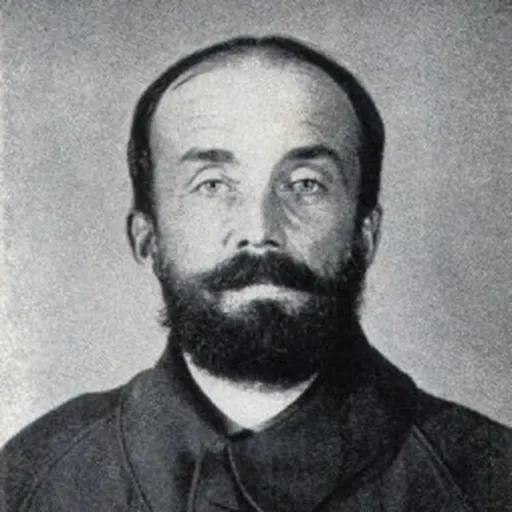
Vladimir Tchernavin
Russian scientist and political prisoner
About Vladimir Tchernavin
Lived 1887 – 1949 (aged 61–62). Vladimir Tchernavin was a Russian ichthyologist, writer, zoologist and opinion journalist.
Vladimir Vyacheslavovich Tchernavin (alternative transliteration: Chernavin) (Russian: Владимир Вячеславович Чернавин) (1887– 31 March 1949) was a Russian-born ichthyologist who became famous as one of the first and few prisoners of the Soviet Gulag system to escape abroad.
Background
Tchernavin was born in 1887 in Tsarskoye Selo, near St. Petersburg, Russian Empire, into a noble family of modest means.
Career
Food shortages were very severe in Russian cities at this time, and Tchernavin took a lecturing post at the Petrograd Agronomical Institute in order to obtain the daily issue of milk from the Institute's herd to members of staff, for his infant son. and from 1926 he moved to Murmansk as Director of Production and Research Work of the Northern Fisheries Trust, the State-owned industry, which had been set up to deal with the fishing sector in the region along the Arctic Ocean. He stepped down from his position in the management of production in 1928, in order to concentrate on research work. His main academic research to this point had been the study of skeletal development and re-development in salmon species, and its application to systematics and evolution: these publications were not available outside the USSR in his lifetime.
His family remained in Leningrad (Saint-Petersburg), where Tatiana worked as curator in the Section of Applied Arts of the Hermitage.
Life after the Gulag
Tchernavin's wife Tatiana began to write her account of their escape during her time spent in the hospital in the immediate aftermath of their escape; she was recovering from the adverse effects of the journey and life in the gulag, given the fact that she had a heart condition. The Tchernavins were still living in Finland in 1933, but in April of that year, a letter from Vladimir, entitled "Methods of the OGPU" was published in The London Times. strongly suggests that Pares had helped to bring about Vladimir's publication, and in March 1934 Pares presided at Tatiana's public lecture in London, entitled "The fate of the intellectual worker in Soviet Russia".
In 1934 Tchernavin and his family moved to England, where he continued his scientific work as an ichthyologist. He worked in the Natural History Museum in London until his death. (Tatiana became a translator in the UK Ministry of Information for the remainder of World War II and helped subtitle Noël Coward's war propaganda film In Which We Serve. Andrei became a civil engineer and designed the Bow Flyover.)
Vladimir Vyacheslavovich Chernavin was rehabilitated in the Soviet Union on October 11, 1989 by the prosecutor's office of the Murmansk region.
Legacy
Tchernavin's I Speak for the Silent: Prisoners of the Soviets (1935) In his memoir, Whittaker Chambers cited Tchernavin's I Speak for the Silent as one of the original factors in his own decision to break from the Soviet GRU during the latter 1930s.
Five Dials literary magazine reprinted an excerpt from I Speak for the Silent in its second issue.
Works
"Methods of the OGPU," The London Times (1933) I Speak for the Silent: Prisoners of the Soviets (1934) "Notes on the chondrocranium and bronchial skeleton of Salmo," Proceedings of the Zoological Society (1938)
Don’t just read it —
keep it.
Full-length biographies made to live with: read them, listen on the way to work, watch them tonight.
- E-book
- Audio
- Video
Instant download · yours to keep · every purchase keeps this site free
Important facts
Family & relationships
People in Vladimir Tchernavin's life
Named in this biography and alive at the same time


Related people
Same field, nearest in time


Contemporaries
People whose lives overlapped Vladimir Tchernavin's





Frequently asked questions
Who was Vladimir Tchernavin?
Russian scientist and political prisoner (1887–1949)
When was Vladimir Tchernavin born?
Vladimir Tchernavin was born in 1887 in Pushkin.
When did Vladimir Tchernavin die?
Vladimir Tchernavin died on 31 March 1949 in United Kingdom.
What was Vladimir Tchernavin's occupation?
Vladimir Tchernavin was an ichthyologist, writer, zoologist and opinion journalist.
What nationality was Vladimir Tchernavin?
Vladimir Tchernavin was Russian.
Sources & further reading
· Wikipedia: Vladimir Tchernavin
· DBpedia: Vladimir V. Tchernavin
Cite this page
APA: Biography.guide. (2026). Vladimir Tchernavin. https://biography.guide/vladimir-tchernavin/
MLA: "Vladimir Tchernavin." Biography.guide, https://biography.guide/vladimir-tchernavin/.
Chicago: "Vladimir Tchernavin." Biography.guide. https://biography.guide/vladimir-tchernavin/.
Data last updated: 2026-09-20 · Spot an error? Report a correction.
Portrait: Wikimedia Commons · author & licence
Page generated 2026-09-27 04:57 UTC