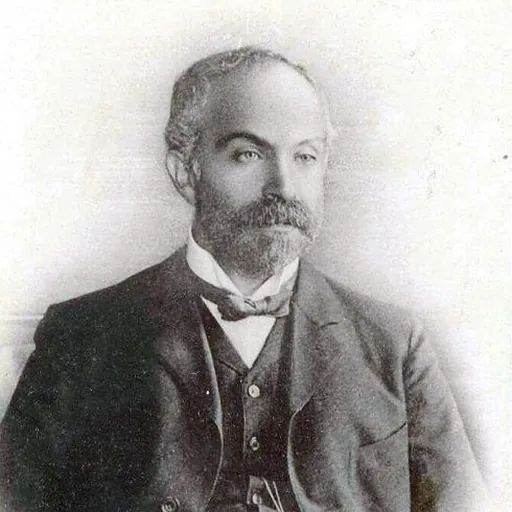
About Vladimir Bogoraz
Lived 1865 – 1936 (aged 71). Vladimir Bogoraz was a Russian anthropologist, revolutionary, writer, poet, linguist and politician, known for Ethnography and Ethnology.
Vladimir Germanovich Bogoraz , born Natan Mendelevich Bogoraz and used the literary pseudonym N. A. Tan (; – May 10, 1936), was a Russian revolutionary, writer and anthropologist, especially known for his studies of the Chukchi people in Siberia. In English, his name was often rendered as Waldemar Bogoras.
Biography Bogoraz was born in the city of Ovruch in the family of a Jewish school teacher. Bogoraz changed his birthname from Natan to Vladimir after he converted to Christianity in adulthood. After finishing Chekhov Gymnasium in 1882, he enrolled in the Faculty of Law of Saint Petersburg University, but was dismissed for revolutionary activity with Narodnaya Volya and exiled to his parents' home in Taganrog. He spent 11 months at Taganrog prison for revolutionary propaganda. In 1886, he moved to Saint Petersburg, where he was arrested and later exiled into northeastern Siberia, near Yakutsk (1889–1899), where he studied the Chukchi people, their way of life, traditions, language, and beliefs, giving him valuable material for poems and belletristic essays. Allegedly, Bogoraz attained fluency in the Chukchi language and partial fluency in the Even language. During the 1920s and 1930s he did important anthropological work creating and teaching written languages for indigenous Siberian peoples and founded the Institute of the Peoples of the North in Leningrad.
In March 1929, at the Sixth Plenum of the Committee for Assistance to the Peoples of the Northern Regions (the "Committee of the North"), Bogoraz and his fellow "northerners" (ethnographers) were viciously attacked by the "orientalists" (mostly Russian rabfak students, "veterans of many a battle and keen on participating in the nationwide search for class enemies"):At various meetings, the old revolutionary had been accused of turning the institute into a scientific laboratory; of trying to split the institute and gain personal power; of "populist culture-mongering [as opposed to Marxist socio-economic revolutionism] and of a sentimental approach to the peoples of the north"; of denying the existence of classes among the natives and, "as a result . . ., protecting them from the (supposedly harmful) influence of economic development." At the same time, Bogoraz's students and institute allies Ia. P. Koshkin (Al'kor) and E. A. Kreinovich were exposed as his spineless Communist clones and urged to "publicly and categorically disassociate themselves from [his] anti-Marxist views." More ambitiously, the "orientalists" charged the Committee of the North with not exercising proper political control and publishing "anti-Party and anti-Marxist" materials in their official organ Sovetskii Sever. But Bogoraz and his allies defended themselves stoutly, and by claiming to adhere to the new political line (defining shamans as priests, applying a strict class analysis to the tribes, and laying the groundwork for collectivization) they managed to keep their positions, though they remained under close scrutiny.
He died of natural causes on May 10, 1936, at the age of 71 and was buried in the Volkovo Cemetery.
Don’t just read it —
keep it.
Full-length biographies made to live with: read them, listen on the way to work, watch them tonight.
- E-book
- Audio
- Video
Instant download · yours to keep · every purchase keeps this site free
Important facts
Related people
Same field, nearest in time


Contemporaries
People whose lives overlapped Vladimir Bogoraz's


Frequently asked questions
Who was Vladimir Bogoraz?
Russian writer and anthropologist (1865-1936)
When was Vladimir Bogoraz born?
Vladimir Bogoraz was born on 15 April 1865 in Ovruch.
When did Vladimir Bogoraz die?
Vladimir Bogoraz died on 10 May 1936 in Rostov-on-Don.
What was Vladimir Bogoraz's occupation?
Vladimir Bogoraz was an anthropologist, revolutionary, writer, poet, linguist and politician.
What was Vladimir Bogoraz known for?
Vladimir Bogoraz was known for Ethnography and Ethnology.
What nationality was Vladimir Bogoraz?
Vladimir Bogoraz was Russian.
Sources & further reading
Cite this page
APA: Biography.guide. (2026). Vladimir Bogoraz. https://biography.guide/vladimir-bogoraz/
MLA: "Vladimir Bogoraz." Biography.guide, https://biography.guide/vladimir-bogoraz/.
Chicago: "Vladimir Bogoraz." Biography.guide. https://biography.guide/vladimir-bogoraz/.
Data last updated: 2026-09-22 · Spot an error? Report a correction.
Portrait: Wikimedia Commons · author & licence
Page generated 2026-09-27 05:03 UTC