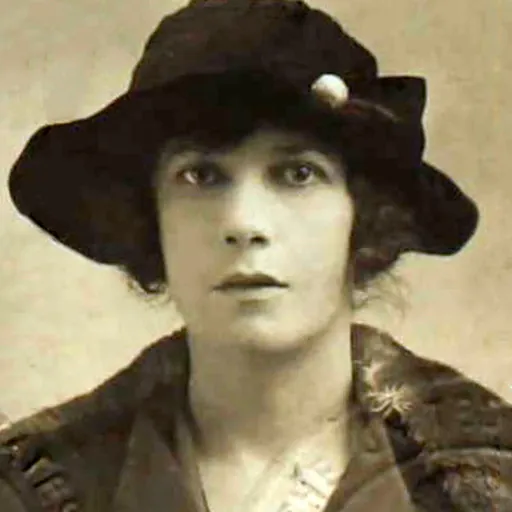
About Vivienne Haigh-Wood Eliot
Lived 1888 – 1947 (aged 58). Vivienne Haigh-Wood Eliot was an American and British poet and writer.
Vivienne Haigh-Wood Eliot (also Vivien, born Vivienne Haigh; 28 May 1888 – 22 January 1947) was the first wife of American-British poet T. S. Eliot, whom she married in 1915, less than three months after their introduction by mutual friends, when Vivienne was a governess in Cambridge and Eliot was studying at Oxford.
Vivienne had many serious health problems, beginning with tuberculosis of the arm as a child, but it was a difficult relationship. Both had mental and physical health problems, and it is often cited as the inspiration for The Waste Land, which remains Eliot's most noted work. He consulted with Vivienne, refusing to release a section of the poem until she had approved it.
Early life
Vivienne Haigh-Wood was born in Knowsley Street, Bury, Lancashire, the first child of Rose Esther (née Robinson; 1860–1941) and Charles Haigh-Wood ( Wood; 1854–1927), an artist and member of the Royal Academy of Arts. Charles was local to the area, but his wife was born in London where the couple had been living, and they had returned to Bury for an exhibition of Charles's paintings at a gentleman's club, with Rose Esther heavily pregnant. The journey may have triggered the birth earlier than expected, and Haigh-Wood was born in Lancashire rather than London.
She was registered at birth as Vivienne Haigh, though as an adult she called herself Haigh-Wood, Her paternal grandfather was Charles Wood, a gilder and picture framer from Bolton, so her father called himself Charles Haigh-Wood to distinguish himself. The "Haigh" came from his mother, Mary Haigh, originally from Dublin. Mary Haigh had inherited seven semi-detached houses in Kingstown (now Dún Laoghaire), a Dublin suburb, which gave the family financial stability, allowing Haigh-Wood's father to study at the Manchester Art College and the Royal Academy Schools in London. Vivienne's brother, Maurice, was born there in 1896; he went on to train at Sandhurst and fought during the First World War.
She was also plagued by heavy, irregular menstruation, to her great embarrassment, and severe pre-menstrual tension, which led to mood swings, fainting spells, and migraines. She would insist on washing her own bedlinen, often twice a day, and would take her sheets home with her to clean when on holiday, once leading a hotel to claim she had stolen them, to Eliot's dismay. She apparently felt unable to ask her mother for help. Eventually her mother took her to a doctor who prescribed potassium bromide to sedate her, which probably meant he had diagnosed "hysteria". Virginia Woolf described Vivienne on 8 November 1930 in her diary:
As the medical bills rose, so did her family's resentment of her. Her brother, Maurice, blamed her for what he saw as his second-rate education, because there was no money left to send him to public school. She became engaged to a schoolteacher, Charles Buckle, in 1914, but Buckle's mother was apparently unhappy about it. Vivienne's health problems persuaded Rose Haigh-Wood that her daughter had "moral insanity." She decided that Vivienne should not marry or bear children, and withdrew the family's consent to the marriage.
Relationship with T. S. Eliot First meeting
As he signed copies of the books for her, she asked him, "Will you come back with me?" and he replied, "I cannot talk to you now," then left with someone else.
Eliot's attitude toward women
Carole Seymour-Jones, one of Haigh-Wood's biographers, argues that there was a strong streak of misogyny in the way Eliot regarded Haigh-Wood. He wrote to a friend that Haigh-Wood had "an original mind, and I consider not at all a feminine one."
Louis Menand argues in The New Yorker that Eliot regarded women the way he regarded Jews, seeing both as responsible for irrationality and romanticism. He was uneasy with female sexuality – which led Seymour-Jones to suspect he was homosexual – which manifested itself both in his poetry and in his attitude toward Haigh-Wood's body. Menand writes that Eliot's work is replete with oversexed women, whom he saw as modern succubi, such as Grishkin in his "Whispers of Immortality" (1919).
Legacy Carole Seymour-Jones writes that it was out of the turmoil of the marriage that Eliot produced The Waste Land, one of the 20th century's finest poems. Eliot's sister-in-law, Theresa, said of the relationship: "Vivienne ruined Tom as a man, but she made him as a poet."
Valerie Eliot, the poet's second wife (from 1957) claimed the copyright of Haigh-Wood's writings in 1984, including her private diaries, which has complicated the research into her role in Eliot's life.
Writing Haigh-Wood wrote several stories and reviews for The Criterion, the literary magazine Eliot founded, using the pseudonyms FM, Fanny Marlow, Feiron Morris, Felise Morrison, and Irene Fassett.
Don’t just read it —
keep it.
Full-length biographies made to live with: read them, listen on the way to work, watch them tonight.
- E-book
- Audio
- Video
Instant download · yours to keep · every purchase keeps this site free
Important facts
Family & relationships
People in Vivienne Haigh-Wood Eliot's life
Named in this biography and alive at the same time


Related people
Same field, nearest in time

Contemporaries
People whose lives overlapped Vivienne Haigh-Wood Eliot's




Frequently asked questions
Who was Vivienne Haigh-Wood Eliot?
British poet (1888-1947)
When was Vivienne Haigh-Wood Eliot born?
Vivienne Haigh-Wood Eliot was born on 28 May 1888 in Bury.
When did Vivienne Haigh-Wood Eliot die?
Vivienne Haigh-Wood Eliot died on 22 January 1947 in Harringay.
What was Vivienne Haigh-Wood Eliot's occupation?
Vivienne Haigh-Wood Eliot was a poet and writer.
What nationality was Vivienne Haigh-Wood Eliot?
Vivienne Haigh-Wood Eliot was American and British.
Sources & further reading
· Wikipedia: Vivienne Haigh-Wood Eliot
· DBpedia: Vivienne Haigh-Wood Eliot
Cite this page
APA: Biography.guide. (2026). Vivienne Haigh-Wood Eliot. https://biography.guide/vivienne-haigh-wood-eliot/
MLA: "Vivienne Haigh-Wood Eliot." Biography.guide, https://biography.guide/vivienne-haigh-wood-eliot/.
Chicago: "Vivienne Haigh-Wood Eliot." Biography.guide. https://biography.guide/vivienne-haigh-wood-eliot/.
Data last updated: 2026-09-23 · Spot an error? Report a correction.
Portrait: Wikimedia Commons · author & licence
Page generated 2026-09-27 05:07 UTC