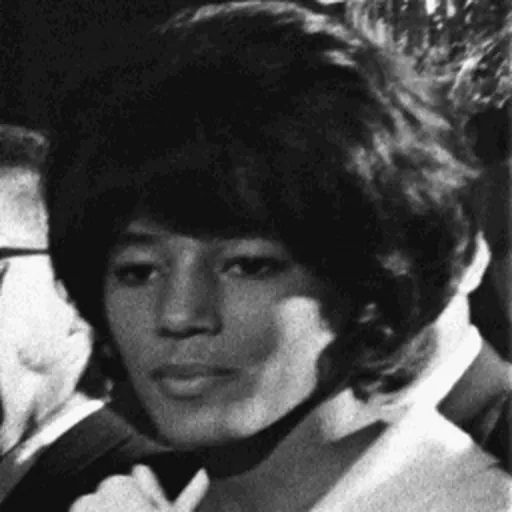
About Vivian Malone Jones
Lived 1942 – 2005 (aged 63). Vivian Malone Jones was an American activist.
Vivian Juanita Malone Jones (July 15, 1942 – October 13, 2005) was the first black student to graduate from the University of Alabama, in 1965. She and James Hood were the first black students able to enroll at the university since Autherine Lucy and Pollie Myers initially strove to desegregate the school. Malone became famous when George Wallace, the Governor of Alabama, attempted to physically block her and Hood from enrolling at the all-white university. Malone faced threats and ostracism at the university but successfully graduated in two years with a Bachelor of Arts in Business Management. Throughout her career, Malone continued to work for civil rights causes. She worked for various federal agencies like the Department of Justice and Environmental Protection Agency, and served as executive director of the Voter Education Project.
Early life Malone was born in Mobile, Mobile County, Alabama in 1942, the fourth of eight children. Her parents both worked at Brookley Air Force Base; her father served in maintenance and her mother worked as a domestic servant. Her parents emphasized the importance of receiving an education and made sure that their children attended college. Each of Malone's older brothers attended Tuskegee University. In February 1961, she enrolled in Alabama Agricultural and Mechanical University, one of the few colleges for black students in the state. She attended Alabama A&M for two years and received a bachelor's degree in business education.
Black students who applied to the university's branch campus in Mobile were investigated by the university's department of Public Safety, including Malone.
Court cases The NAACP Legal Defense and Educational Fund of Alabama organized an opportunity with Malone to enroll her in the University of Alabama's School of Commerce and Business Administration to earn her accounting degree. As Malone and Hood waited in a car, Deputy Attorney General Katzenbach and a small team of federal marshals confronted Wallace to demand that Malone and Hood be allowed entry by order of the federal court and for Wallace to step aside.
After seeing that Wallace would not step aside, Katzenbach called upon the assistance of President John F. Kennedy to force Wallace to permit the black students' entry into the university. As she and Hood entered the building, they were met with surprising applause from white supporters of integration.
Threats Two trends added worries to Malone's time at the University of Alabama: the threat of violence and the strong desire by local white politicians and community members to find excuses to expel Malone. The university spent an extra $100,000 on security for Malone and Hood, and with Wallace pledging not to allow any state-level protection, the federal government provided marshals and National Guardsmen, and the school asked for federal grants to cover their security costs. In the summer of 1963, rumors that the Ku Klux Klan wanted to burn a cross on campus resulted in a stern speech from the university's president, Frank Rose, to campus security officers. Then on September 15, there was a nearby white supremacist terrorist attack in the 16th Street Baptist Church Bombing. Considering this and the earlier Ole Miss Riot, university officials made students sign pledges to not "contribute to disorder" that fall.
With no major threats for a couple months, the guardsmen began to relax, and were soon to be demobilized. However, on November 16, a bomb went off 130 yards away from Malone's room, tearing a foot-long hole in the concrete of the street and waking Malone up in the middle of the night. She visited Stillman College the next day, when another bomb went off at the University of Alabama. Over the next four days, two more bombs followed. At the same time, calls came in threatening more violence: after the first bombing, one said that "last night the explosion was outside–the next night it will be inside." Wallace's legal advisor, Cecil Jackson, called a university official, Jeff Bennett, to argue for removing Malone from the dorms "for the safety of the other children." Bennett thought that Wallace was behind the bombings, or at least using them to remove Malone, and went to visit him in Montgomery to ask him to make them stop. Wallace responded by asking him what the university could do if four or five cars full of Alabama Highway Patrolmen tried to remove Malone by force. A member of the university's board also called Wallace after hearing the university president's complaints about the governor. The next day, President Kennedy was assassinated, and Malone considered this the most blatant reminder of how she could be killed at any time due to her position. However, she remained at the university. After this period of violence, there were no more bombings near Malone at the university. Malone was frequently assigned to seats in class that placed a conspicuous ring of empty seats around her, and she skipped school dances rather than attending to be ignored. She faced bullying, such as when someone dumped a cup of ice on her at a football game. However, Malone felt encouraged by shows of support by some other students, and she was able to make friends early on with some white women on campus. She went on dates during this time too, with black men from the nearby Stillman College. While in Washington, she attended George Washington University and pursued a master's degree in public administration. She took a job as an employee relations specialist at the central office of the United States Veteran's Administration.
Vivian Malone Jones, far right, at the signing of the Voting Rights Act of 1965.
Malone was appointed to a position as the executive director of the Voter Education Project in August 1977 and worked towards voter equality for minorities.
In October 1996, Malone was chosen by the George Wallace Family Foundation to be the first recipient of its Lurleen B. Wallace Award of Courage. George Wallace, the governor who had attempted to block her from integrating the University of Alabama, presented her with the award and praised her: "Vivian Malone Jones was at the center of the fight over states' rights and conducted herself with grace, strength and, above all, courage." They had met privately the night before, for the first time since their confrontation, where Malone said that Wallace apologized, and she had already forgiven him. Wallace had also previously taken back his defiance against progressing civil rights.
Personal life Malone was married to Mack Arthur Jones, an obstetrician, who predeceased her in 2004. served as U.S. Attorney General. Her nephew Jeff Malone was an All-American basketball student-athlete at Mississippi State University and NBA standout. The main character appeared at the event and handed Malone a book she dropped when walking into Foster Auditorium.
Historical marker and additional honors In 2017, a historical marker was installed at the Mobile County Health Department in honor of Malone. It was placed at the location of her childhood home, which is now the parking lot for the Keeler Memorial Building on the Health Department's campus.
Awards and community impact In 2018, JaVaughnae Malone and her mother, Janice, started a nonprofit called Vivian's Door in Mobile, Alabama. With a purpose of fostering minority-owned businesses, Vivian's Door has dedicated itself to providing training, resources, networking opportunities, and customers to local minority businesses in south Alabama.
The University of Alabama awards a student the Vivian Malone Jones Endowed Scholarship for Diversity each year. Each year, an individual who has demonstrated integrity and consistently contributed to social justice in the Environmental Protection Agency or in the greater community is presented with this award in memoriam of Malone and the legacy of her work.
Don’t just read it —
keep it.
Full-length biographies made to live with: read them, listen on the way to work, watch them tonight.
- E-book
- Audio
- Video
Instant download · yours to keep · every purchase keeps this site free
Important facts
People in Vivian Malone Jones's life
Named in this biography and alive at the same time





Related people
Same field, nearest in time




Contemporaries
People whose lives overlapped Vivian Malone Jones's

Frequently asked questions
Who was Vivian Malone Jones?
American activist
When was Vivian Malone Jones born?
Vivian Malone Jones was born on 15 July 1942 in Mobile.
When did Vivian Malone Jones die?
Vivian Malone Jones died on 13 October 2005 in Atlanta.
What was Vivian Malone Jones's occupation?
Vivian Malone Jones was an activist.
What nationality was Vivian Malone Jones?
Vivian Malone Jones was American.
Sources & further reading
· Wikipedia: Vivian Malone Jones
· DBpedia: Vivian Malone Jones
Cite this page
APA: Biography.guide. (2026). Vivian Malone Jones. https://biography.guide/vivian-malone-jones/
MLA: "Vivian Malone Jones." Biography.guide, https://biography.guide/vivian-malone-jones/.
Chicago: "Vivian Malone Jones." Biography.guide. https://biography.guide/vivian-malone-jones/.
Data last updated: 2026-09-23 · Spot an error? Report a correction.
Portrait: Wikimedia Commons · author & licence
Page generated 2026-09-27 05:07 UTC