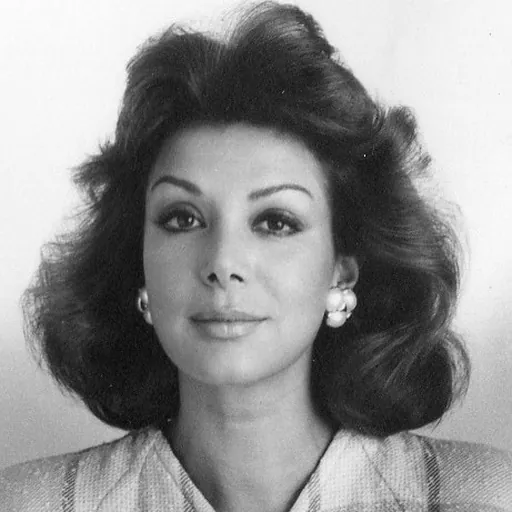
Virginia Vallejo De Escobar
Colombian writer, columnist, television and radio journalist
About Virginia Vallejo De Escobar
Born 1949. Virginia Vallejo De Escobar is a Colombian writer, journalist, television director, presenter, columnist and television presenter.
Virginia Vallejo García (born 26 August 1949) is a Colombian author, journalist, television and radio director, anchorwoman, columnist, socialite, and political asylee in the United States of America.
She is one of the most relevant media personalities of her native country, known for her interviews of presidents, politicians, international celebrities, musicians, authors and scientists. She has been international editor of television newscasts and also anchorwoman, when she won twice the prize as the best anchorperson of Colombia. Her programs for TV Impacto, her own company, obtained the highest ratings compared to her competition. She was image and model of Di Lido pantyhose, with commercials made in Venice, Rio de Janeiro, San Juan, Bogotá and Cartagena de Indias. She has been invited by foreign governments, like Israel and Taiwan, to cover historical events. and the first journalist to interview Pablo Escobar in 1983, when he was just an aspiring politician. She also presented other type of programs, like musical shows with the most famous singers and orchestras of her time. Due to her voice, education, beauty and elegance, Vallejo has become an icon of the Colombian media, and thanks to her unique story, a contemporary legend. She is now a bestseller author, translated to many languages.
On 18 July 2006, the DEA took her out of Colombia in a special flight to save her life and cooperate with the Department of Justice in high-profile cases, after she had signaled several Colombian presidents and politicians as beneficiaries or accomplices of the leading cocaine cartels.
In 2007, she published her first book, Loving Pablo, Hating Escobar, which led the Colombian Supreme Court to reopen the cases of the Palace of Justice siege in 1985, and the assassination of the presidential candidate Luis Carlos Galán in 1989. The book was translated to fifteen languages and made into a movie in 2018, with the Spanish actress Penélope Cruz in the role of the journalist.
Since 2006, Virginia Vallejo lives in Miami, Florida. In 2009, she became a columnist of a Venezuelan opposition newspaper, and, in 2019, television journalist for the international channel Actualidad RT. On May 1, 2025, she launched her new book, El alucinante País Dorado, the first of a trilogy of novels inspired in the recent history of Colombia and her personal life.
Early life Family and childhood Virginia Vallejo was born on 26 August 1949 in Cartago, Valle del Cauca, Colombia, near her family's ranch. Her parents were Juan Vallejo Jaramillo, an entrepreneur, and Mary García Rivera. Her paternal grandmother, Sofía Jaramillo Arango, was a descendant of Alonso Jaramillo de Andrade Céspedes y Guzmán, a nobleman from Extremadura, Spain. Several members of her family were ministers, writers and ambassadors, such as her paternal grandfather Eduardo Vallejo Varela, minister of finance (1930); her granduncle Alejandro Vallejo Varela, writer and close friend of Jorge Eliécer Gaitán; and his granduncle Jaime Jaramillo Arango, minister of education (1934), ambassador to several countries in Europe, and co-founder of the Anglo Colombian School.
In 1950, the young family returned to Bogotá, where her siblings, Felipe (1951), Antonio (1955–2012), and Sofía (1957) were born. She attended the Anglo Colombian School.
Early career In 1967 and 1968, she worked as an English teacher in the Centro Colombo Americano in Bogotá and, in 1969, in the presidency of Banco del Comercio. In 1972, while she was working as director of public relations of Cervecería Andina, she received an invitation to join an upcoming television program directed by Carlos Lemos Simmonds and Aníbal Fernández de Soto. This was the reason why Vallejo could work simultaneously as a news anchor and presenter of other programs.
1970s From 1972 to 1975, she was as the presenter of "¡Oiga Colombia, Revista del Sábado!", a program directed by Carlos Lemos Simmonds and Fernández de Soto.
In 1973, she began working as a reporter on TV Sucesos-A3, the newscast directed by Alberto Acosta; and, from 1975 to 1977, she became the international editor. In the early and mid seventies, she hosted other television programs, like the quiz show TV Crucigrama, a cooking show with chef Segundo Cabezas, and a program for children.
In January 1978, she became the anchorwoman of Noticiero 24 Horas, which aired at 7:00 PM, and was directed by Mauricio Gómez, Ernesto Rodríguez Medina and Sergio Arboleda. In March, the Government of Taiwan invited her to the inauguration of President Chiang Ching-kuo. The same year, she was elected as the vice-president of the board of directors of the ACL, Asociación Colombiana de Locutores (Association of Colombian Speakers). In 1978, 1979 and 1980, she won the award as the Best Television Anchor of the APE, Asociación de Periodistas del Espectáculo (Association of Entertainment Journalists).
In 1979, she co-starred in the movie Colombia Connection by Gustavo Nieto Roa. In November, she appeared in Town & Country, opening the section The Beautiful Women of El Dorado. In 1979 and 1980, she presented ¡Cuidado con las Mujeres!, a program by RTI Producciones, directed by David Stivel.
1980s In 1981, she founded her own programadora, TV Impacto, with the journalist Margot Ricci. In 1983 and 1984, she presented the musical El Show de las Estrellas, directed by Jorge Barón.
In 1985, she appeared on the covers of Harper's Bazaar and Cosmopolitan. Also, in Elenco, a magazine of El Tiempo that presented her as "the symbol of an era". In 1988, she won a scholarship from the German Government, and she studied economic journalism in Berlin at the Internationales Institut für Journalismus.
1990s In 1991, she returned to Colombia to co-star in the soap opera Sombra de tu Sombra of Caracol Televisión. In 1992, she presented ¡Indiscretísimo!, directed by Manuel Prado. From 1992 to 1994, she worked at Todelar radio. In October 1994, she ended her career in the Colombian media to open the South American operation of a multilevel company based in the United States.
2000s Between 2009 and 2010, she worked as a columnist for the Venezuelan newspaper 6to Poder, directed by the opposition journalist Leocenis García; but, President Hugo Chávez closed the newspaper and jailed the director.
2019 In 2019, Vallejo returned to her work as a television journalist for the international channel RT en Español or Actualidad RT. The twelve episodes, titled as "Sueños y Pesadillas" – "Dreams and Nightmares" in English – were inspired by the "American dream", and describe problems like the huge gap between wealth and poverty, violence and guns, LGBTQ and discrimination of gender, and the high cost of healthcare, among others.
Exile and asylum in the U.S. Departure from Colombia In early July 2006, Vallejo offered her testimony in the case against Alberto Santofimio, a former Justice Minister and associate of Pablo Escobar, head of the Medellín cartel and lover of the journalist from 1983 to 1987. The politician was on trial for conspiracy in the assassination of Luis Carlos Galán, a presidential candidate killed by Pablo Escobar on August 18, 1989. The following week, the Prosecutor Edgardo José Maya Villazón closed the case "for lack of evidence". All of Escobar's hitmen in the crime and several key witnesses against Santofimio had been killed, so Vallejo contacted the American Embassy in Bogotá and asked the US Government to help save her life in exchange for information on the associates of Pablo Escobar and Gilberto and Miguel Rodriguez Orejuela of the Cali cartel, Pablo Escobar's nemesis. The brothers had been extradited by President Álvaro Uribe, and the trial was due to begin in Miami in a few weeks.
Vallejo's flight made news worldwide, and a home video that Vallejo had taped before her departure to protect her life was aired by Canal RCN of Colombia; according to the channel, it was watched by 14 million people, with higher rates of audience than the Football World Cup final of 2006 on 9 July. Six weeks later, Miguel and Gilberto Rodriguez Orejuela pleaded guilty; they were sentenced to 30 years in prison, and the United States Department of Justice collected $2.1 billion ($ billion today) in assets without going to trial.
Loving Pablo, Hating Escobar In 2007, Vallejo published Amando a Pablo, odiando a Escobar (In English: Loving Pablo, Hating Escobar), in which she describes, among other topics, her romantic relationship with Pablo Escobar, head of the Medellín Cartel, from 1982 to 1987; the origins of the rebel organizations in Colombia; the reasons for the explosive growth of the cocaine industry; the birth of MAS (Muerte a Secuestradores) (Death to Kidnappers), The Extraditables, and the United Self-Defense Forces of Colombia; the links of the Medellin and Cali cartels with Caribbean dictators and the Colombian presidents Alfonso López Michelsen, Ernesto Samper, and Álvaro Uribe; the siege of the Palace of Justice in 1985; Escobar's relationship with the extreme left and extreme right rebel groups; the horrors during the era of narcoterrorism from 1988 to 1993; and the hunt and death of her former lover on December 2, 1993. Vallejo's memoir became the number one bestselling Spanish-language book in both Colombia and the United States.
The memoir was translated to English and fifteen languages, in 2018. where the Spanish actress Penélope Cruz played the role of Vallejo, while Javier Bardem played Escobar. Many of the elements and characters were fictional, like the DEA agent. The film was launched during the 74th Venice International Film Festival, and the two leading actors were nominated for the Goya Awards of 2018.
Political asylum
Upon her arrival to the United States, on July 18, 2006, Vallejo requested political asylum. She knew that if returned to Colombia, she would be killed, like several witnesses in the cases vs. Alberto Santofimio and the bosses of the Cali cartel. To grant her political asylum, the State Department and the Immigration Court of Miami examined Vallejo's life and could not find any investigation against her; only hundreds of threats from members of the Colombian government, media outlets owned or directed by the family of vice president Francisco Santos Calderón and defense minister Juan Manuel Santos, and the paramilitary squads Águilas Negras (Black Eagles).
On 3 May 2010, the United States of America granted Virginia Vallejo political asylum under the United Nations Convention against Torture. She received it due to her political opinion about powerful politicians, her testimony in high-profile criminal cases, a brutal car crash she had suffered on her way to testify in the Colombian Miami consulate, and thousands of threats against her life and integrity posted under her name in the Internet. Though most of them were withdrawn from the search engines in the following two weeks, they remain in Vallejo's case in the Miami immigration court.
Testimonies Siege of the Palace of Justice In July 2008, the Colombian Government ordered Vallejo to testify in the reopened case of the Palace of Justice siege ( 6 and 7 November 1985), a massacre that killed more than 100 people, including 11 Supreme Court Justices, rebels of the M-19, government agents, and dozens of unarmed civilians. In the Colombian Consulate in Miami, a prosecutor sent by the Colombian Attorney General asked Vallejo to confirm the events described in her memoir, in the chapter "That Palace in Flames" (Aquel Palacio en Llamas). So, during the next five hours, she explained the roles of all the actors involved in the attack: "Though the M-19 and the Medellín cartel were responsible for the siege, the military were responsible for the massacre". The journalist signaled also the lack of action of President Belisario Betancur: "The rebel commanders of the M-19 took the Justices as hostages, to force the government to listen to their claims, including the elimination of the extradition treaty with the United States. But, President Betancur refused to take the calls of the President of the Supreme Court, Magistrate Alfonso Reyes Echandia, pleading to save their lives, and instead he allowed the army and the police to bomb a building with 400 people inside". In her testimony under oath, she described what Pablo Escobar had told her the following year, after 10 months of separation: "The people detained after the fire, many with third degree burns, were sent to military garrisons where they were tortured – and the women gang-raped – to find the hiding places of other rebel commanders, and the money that I had paid them to steal my files before the Court ruled on our extradition; At the end of that chapter, Vallejo summarized the tragic events: "That conflagration was the holocaust of the Colombian justice system, with the triumph of the establishment, the traditional parties, and "Los Extraditables" with Escobar at the head".
Case of Luis Carlos Galán In July 2009, Vallejo testified in the reopened case of the assassination of presidential candidate Luis Carlos Galán which occurred on 18 August 1989, and signaled Alberto Santofimio as the main instigator of the candidate's assassination. She described how, in 1984 and 1985 and in her presence, Alberto Santofimio had repeatedly asked Pablo Escobar to "...eliminate Senator Galan before he could become the next president and extradite him".
Verdicts Twenty-five years after the Palace of Justice massacre, on 9 June 2010 judge Maria Stella Jara sentenced Colonel Alfonso Plazas of the army to 30 years in prison for forced disappearance of the detained. President Uribe attacked the verdict on television and offered his protection to the military. The following week, with the help of a European human rights organization, Judge Jara fled Colombia and went into exile.
After 18 years of delays and appeals, in 2007 Alberto Santofimio was sentenced to 24 years in prison for conspiracy with Pablo Escobar in the assassination of Luis Carlos Galán.
Personal life
Virginia Vallejo has been married twice to prominent and older men, the architect Fernando Borrero, a widower, and David Stivel, head of the Clan Stivel that grouped the leading Argentinean actors of his time. Virginia has often said that she would never have children.
After her divorce from Borrero in 1971, she dated the future Colombian billionaires, Carlos Haime, Julio Mario Santo Domingo, Carlos Ardila Lülle, and Luis Carlos Sarmiento Angulo, heads of the four Colombian conglomerates.
Vallejo divorced Stivel in 1981. The following year, she became engaged to Aníbal Turbay, the nephew of President Julio César Turbay Ayala. In mid 1982, she, her fiancé and his children - now Carlos Ardila Lülle’s stepchildren - were invited to see the zoo of Hacienda Nápoles, owned by the young congressman Pablo Escobar. Six months later, Virginia ended her relationship with Aníbal and began a romance with the head of the Medellín Cartel. It lasted almost five years, but was marked by long separations in 1984, 1985 and 1986. She spent most of year 1986 in Cartagena with Rafael Vieira, director of the Oceanarium of the Rosario Islands. Upon her return to Bogotá in 1987, she ended forever her relationship with Escobar. She did it after he told her that, “very soon, would begin a war against both the Colombian State and the Cali Cartel. To crush the Government, he would use dynamite; and to finance his wars, he would use Cuba as a trampoline to send cocaine to the Florida Keys”. grandson of Lord Curzon, Viceroy of India, and godson of Edward VIII, the Duke of Windsor. Her last romantic relationship was with a German count that she has described as “the great love of her life”.
List of works Loving Pablo, Hating Escobar (2007) El alucinante País Dorado (2025)
Don’t just read it —
keep it.
Full-length biographies made to live with: read them, listen on the way to work, watch them tonight.
- E-book
- Audio
- Video
Instant download · yours to keep · every purchase keeps this site free
Important facts
People in Virginia Vallejo De Escobar's life
Named in this biography and alive at the same time



Related people
Same field, nearest in time

Contemporaries
People whose lives overlapped Virginia Vallejo De Escobar's


Frequently asked questions
Who is Virginia Vallejo De Escobar?
Colombian writer, columnist, television and radio journalist
When was Virginia Vallejo De Escobar born?
Virginia Vallejo De Escobar was born on 26 August 1949 in Cartago Municipality.
What is Virginia Vallejo De Escobar's occupation?
Virginia Vallejo De Escobar is a writer, journalist, television director, presenter, columnist and television presenter.
What nationality is Virginia Vallejo De Escobar?
Virginia Vallejo De Escobar is Colombian.
Sources & further reading
· Wikipedia: Virginia Vallejo De Escobar
Cite this page
APA: Biography.guide. (2026). Virginia Vallejo De Escobar. https://biography.guide/virginia-vallejo-de-escobar/
MLA: "Virginia Vallejo De Escobar." Biography.guide, https://biography.guide/virginia-vallejo-de-escobar/.
Chicago: "Virginia Vallejo De Escobar." Biography.guide. https://biography.guide/virginia-vallejo-de-escobar/.
Data last updated: 2026-09-21 · Spot an error? Report a correction.
Portrait: Wikimedia Commons · author & licence
Page generated 2026-09-27 04:59 UTC