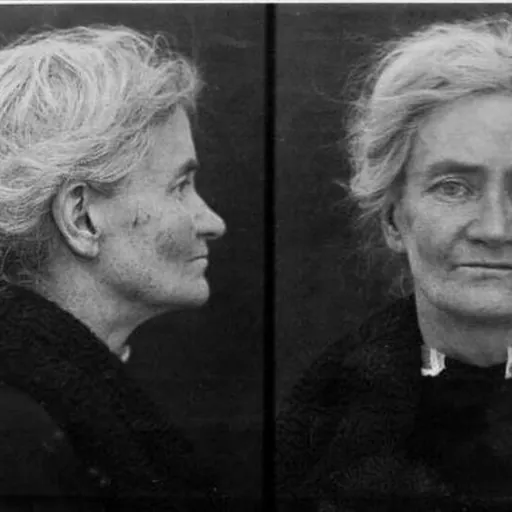
Violet Gibson
Irish aristocrat noted for shooting Mussolini
About Violet Gibson
Lived 1876 – 1956 (aged 79). Violet Gibson was an Irish and British.
Violet Albina Gibson (31 August 1876 – 2 May 1956) was an Irish woman who attempted to assassinate Benito Mussolini in 1926. She was released without charge but spent the rest of her life in a psychiatric hospital in England.
She was the daughter of Lord Ashbourne, Lord Chancellor of Ireland.
Early life Violet Gibson was born in Dublin, Ireland, on 31 August 1876. Her father was an Irish lawyer and politician, Edward Gibson, who was created Baron Ashbourne in 1885. Her mother, Frances, was a Christian Scientist. Violet experimented with Theosophy, then became a Roman Catholic in 1902, and adopted socialism, both to the displeasure of her family. She was presented as a debutante at court during the reign of Queen Victoria. Gibson suffered severe ill health throughout her life. She had a nervous breakdown in 1922 due to her fiancé's sudden death; She attempted suicide in Rome in early 1925.
Shooting of Mussolini
On 7 April 1926, Gibson shot Mussolini, the Prime Minister of Italy and leader of the National Fascist Party, as he walked among the crowd in the Piazza del Campidoglio in Rome after leaving an assembly of the International Congress of Surgeons, to whom he had delivered a speech on the wonders of modern medicine. Gibson had armed herself with a rock to break Mussolini's car window if necessary, and a Modèle 1892 revolver disguised in a black shawl. She fired once, but Mussolini moved his head at that moment, and the shot hit his nose; she tried again, but the gun misfired. She died on 2 May 1956 and was buried in Kingsthorpe Cemetery, Northampton.
Legacy
A radio documentary titled The Irishwoman Who Shot Mussolini was made for RTÉ Radio 1 by Siobhán Lynam. A film drama-documentary with a similar name, Violet Gibson, The Irish Woman Who Shot Mussolini, was commissioned by TG4 and produced by Barrie Dowdall and Siobhán Lynam. Many of these productions and films aim to delve into the possible reasons and motivations behind Gibson's attempt at Mussolini.
Lisa O'Neill's song "Violet Gibson" celebrates her. It is featured on O'Neill's album Heard a Long Gone Song. Evelyn Conlon's short story "Dear You" provides an epistolary account of events from Gibson's point of view. The story first appeared in both Italian and English in Tratti Review (Numero Novantatre, Italy, May 2013), and subsequently in Accenti: The Magazine with an Italian Accent (Canada). It also appears in Conlon's Moving About the Place Collection (Blackstaff, 2021).
In March 2021, Dublin City Council approved the placement of a plaque on her childhood home in Merrion Square to commemorate Gibson as "a committed anti-fascist".
Don’t just read it —
keep it.
Full-length biographies made to live with: read them, listen on the way to work, watch them tonight.
- E-book
- Audio
- Video
Instant download · yours to keep · every purchase keeps this site free
Important facts
Family & relationships
People in Violet Gibson's life
Named in this biography and alive at the same time



Contemporaries
People whose lives overlapped Violet Gibson's

Frequently asked questions
Who was Violet Gibson?
Irish aristocrat noted for shooting Mussolini (1876–1956)
When was Violet Gibson born?
Violet Gibson was born on 31 August 1876 in Dublin.
When did Violet Gibson die?
Violet Gibson died on 2 May 1956 in Northampton.
What nationality was Violet Gibson?
Violet Gibson was Irish and British.
Sources & further reading
Cite this page
APA: Biography.guide. (2026). Violet Gibson. https://biography.guide/violet-gibson/
MLA: "Violet Gibson." Biography.guide, https://biography.guide/violet-gibson/.
Chicago: "Violet Gibson." Biography.guide. https://biography.guide/violet-gibson/.
Data last updated: 2026-09-22 · Spot an error? Report a correction.
Portrait: Wikimedia Commons · author & licence
Page generated 2026-09-27 05:02 UTC