
About Vincenzo Foppa
Lived 1427 – 1515 (aged 87–88). Vincenzo Foppa was an Italian painter.
Vincenzo Foppa (Brescia, – Brescia, ) was an Italian painter from the Renaissance period. While few of his works survive, he was an esteemed and influential painter during his time and is considered the preeminent leader of the Early Lombard School. He spent his career working for the Sforza family, Dukes of Milan, in Pavia, as well as various other patrons throughout Lombardy and Liguria. He lived and worked in his native Brescia during his later years.
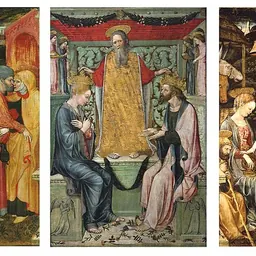
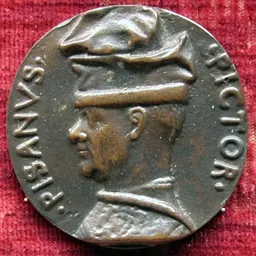
Early life Very little is known about the early life and training of Foppa. He was born in Brescia. At the time, there were few esteemed painters in the region, and the art scene in Brescia was lacking. It is therefore likely that Foppa had to seek artistic training elsewhere. Some of his earliest exposures to art were likely frescoes painted by Gentile da Fabriano in the Broletto Chapel in Brescia and the woven Annunciation by Jacopo Bellini. The latter artist was one of the strongest influences on him, and it is possible that Foppa was directly apprenticed to Bellini. He also may have been apprenticed to Bonifacio Bembo. Some historians suggest that Foppa may have had early training in Padua with Francesco Squarcione, though his earliest works are more stylistically reminiscent of Pisanello and Gentile da Fabriano. It is most likely that Foppa went to Verona for his training.
Career
Early works
The earliest known work attributed to Foppa is The Madonna and Child with Angels. Compositionally, this painting is reminiscent of the Veronese style due to its Gothic appearance, contributing to speculation that Foppa was trained in Verona, possibly by Stefano or Michelino da Besozzo. However, the piece also has unique aspects indicative of the artist's personal touch, such as the greyish skin tone, which would become a defining aspect of the Lombard school. However, the figures in The Madonna and Child with Angels are not nearly as lifelike as those featured in the painter's later works. The next work known to be by Foppa's hand is his Crucifixion, painted at Bergamo in 1456. This work marked a significant step forward for Vincenzo, as his representation of humans matured considerably between the completion of the Madonna and the Crucifixion. The painting is exceedingly similar to a Jacopo Bellini work of the same name, lending credibility to the notion that Foppa may have spent time training with Bellini in Venice. The work also uses elements associated with the Veronese school, such as the hilly landscape and fictional city featured in the background. While the composition is nearly identical to the earlier Bellini work, Foppa's delicate colouring and advanced naturalist depiction of the three crucified men indicate his considerable talent, even at such an early stage of his career.
In 1468, Foppa was again commissioned by Pigello Portinari to decorate the Portinari Chapel at Saint Eustorgio in Milan. The Chapel holds the remains of Saint Peter Martyr of Verona, and for a time held those of Portinari himself. While it is not certain that Foppa painted the Chapel himself, the fresco cycle Life of St. Peter Martyr is commonly attributed to him. His work in the Chapel also includes a Doctors of the Church cycle, busts of saints, and an Annunciation. The rainbow decoration of the ribbed dome likely represents a "Beatific Vision" of arrival in paradise, with the rainbow signifying God and implying Portinari's piety. The frescoes in the Chapel display an advanced and creative use of perspective by Foppa, featuring vanishing points outside of the composition. Combined with his use of light and placement of the scenes in everyday settings, this "Lombard perspective" makes the scenes come to life.
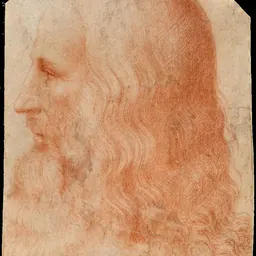
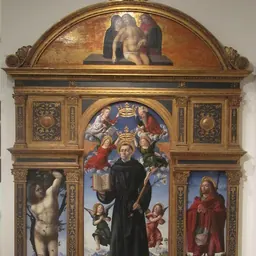
Pavia In 1474, Foppa collaborated with Zanetto Bugatto and Bonifacio Bembo on an ambitious altarpiece for the Castello of Pavia, but work on the project was halted when Galeazzo Sforza was murdered in 1476. Some surviving panels have been speculated to be part of this Castello project. The trio also worked on various other commissions in Pavia. Foppa completed several ecclesiastical works during the latter part of the decade, including a number of works featuring the Virgin and Child. Foppa became renowned for these Virgin and Child works, which he continued to produce in the 1480s and for the rest of his career. Many of these pieces are nearly identically composed: Mary holding the baby Jesus in front of a curtain, landscape, or other similar background. Vincenzo did a number of works for Santa Maria di Brera in Milan, including a polyptych titled Virgin and Child with Saints finished around 1476 and a fresco titled Virgin and Child with Saints John the Baptist and John the Evangelist dated 1485. At Santa Maria di Brera he also completed a fresco of Saint Sebastian, a subject whom Foppa painted several times during the decade. By 1486, Foppa had completed the Bottigella Altarpiece in Pavia Civic Museums, which depicted Silvestro Bottigella and his wife genuflect in front of the Virgin Mary. The vast majority of Foppa's known works are religious in subject, with a particular focus on paintings of the Virgin with Child. He did not venture far into other subject matters, although due to his dependence on commissions, this may not have been a personal choice. However, this limited scope is likely biased due to which works have survived the centuries, as many of his fresco cycles have been lost to history, and most surviving works are small devotional pieces or altarpiece panels. There are multiple artists who exhibit significant influence by Foppa, including Vincenzo Civerchio, Ambrogio Bergognone, and Girolamo Romanino. His long-term influence was somewhat diminished due to the arrival of Leonardo da Vinci in Milan in 1482. Leonardo's massive persona and artistic influence diluted the importance of Foppa's style. His perception in modern times is also damaged by the sheer volume of his work that has been lost. While he was a prolific painter during his career, relatively few pieces painted by Foppa have survived into the modern era.
Notable works
Madonna and Child with Angels, c.1450, Florence, Berenson Collection Crucifixion, 1456, Bergamo, Accademia Carrara St. Jerome Penitent, c.1460, Bergamo, Accademia Carrara Madonna of the Book, 1460–1468, Milan, Pinacoteca del Castello Sforzesco Madonna and Child, 1460–1470, Berlin, Staatliche Museen Boy Reading Cicero, , London, Wallace Collection Frescoes of the Portinari Chapel, 1464–1468, Milan, Basilica of Sant'Eustorgio Four Doctors of the Church Eight Busts of Saints Four Scenes from the Life of St. Peter Martyr : Cloud Miracle Miracle of the False Madonna Miracle of Narni Martyrdom of Saint Peter of Verona Annunciation Assumption of the Virgin St. Augustine, 1465–1470, Milan, Pinacoteca del Castello Sforzesco St. Theodore, 1465–1470, Milan, Pinacoteca del Castello Sforzesco St. Christopher, c.1470, Denver, Denver Art Museum Evangelists, 1477, Brescia, Carmelite Church of Santa Maria, Averoldi chapel Madonna and Child with an Angel, 1479–1480, Florence, Uffizi Bottigella Altarpiece, c.1486, Pavia, Civic Museums St. Francis receiving the stigmata and St. Giovanni Battista, 1488–1489, Milan, Pinacoteca del Castello Sforzesco Saint Sebastian, c.1489, Milan, Pinacoteca di Brera Madonna and Child in a Landscape, c.1490, Philadelphia, Philadelphia Museum of Art Altarpiece, c.1490, Oratory of Our Lady of the Castle, Savona, with Ludovico Brea Madonna and Child, 1490–1495, Milan, Museo Poldi Pezzoli Madonna and Child, 1492, Brescia, Chiesa di Santa Maria Assunta di Chiesanuova Martyrdom of St. Sebastian, c.1485, Milan, Pinacoteca del Castello Sforzesco Portrait of Giovanni Francesco Brivio, 1495, Milan, Museo Poldi Pezzoli Portrait of an Old Gentleman, 1495–1500, Philadelphia, Philadelphia Museum of Art St. Anthony of Padua, 1495–1500, Washington, National Gallery of Art San Bernardino of Siena, 1495–1500, Washington, National Gallery of Art Altarpiece of Santa Maria delle Grazie, 1500–1510, Milan, Pinacoteca di Brera Adoration of the Magi, c.1500, London, National Gallery
Don’t just read it —
keep it.
Full-length biographies made to live with: read them, listen on the way to work, watch them tonight.
- E-book
- Audio
- Video
Instant download · yours to keep · every purchase keeps this site free
Important facts
People in Vincenzo Foppa's life
Named in this biography and alive at the same time



Related people
Same field, nearest in time

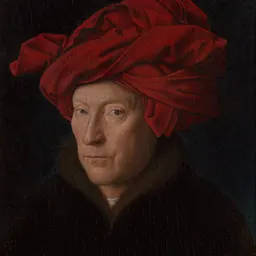
Contemporaries
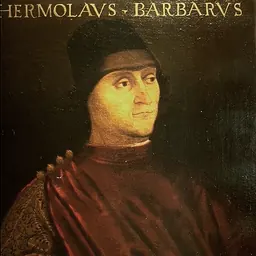
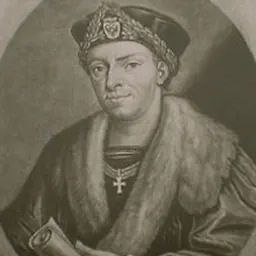
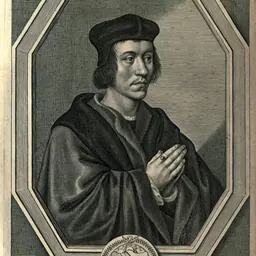
People whose lives overlapped Vincenzo Foppa's
Frequently asked questions
Who was Vincenzo Foppa?
Northern-Italian Renaissance painter (1427-1515)
When was Vincenzo Foppa born?
Vincenzo Foppa was born in 1427 in Bagnolo Mella, Brescia.
When did Vincenzo Foppa die?
Vincenzo Foppa died in 1515 in Brescia.
What was Vincenzo Foppa's occupation?
Vincenzo Foppa was a painter.
What nationality was Vincenzo Foppa?
Vincenzo Foppa was Italian.
Sources & further reading
Cite this page
APA: Biography.guide. (2026). Vincenzo Foppa. https://biography.guide/vincenzo-foppa/
MLA: "Vincenzo Foppa." Biography.guide, https://biography.guide/vincenzo-foppa/.
Chicago: "Vincenzo Foppa." Biography.guide. https://biography.guide/vincenzo-foppa/.
Data last updated: 2026-09-20 · Spot an error? Report a correction.
Page generated 2026-09-27 05:24 UTC