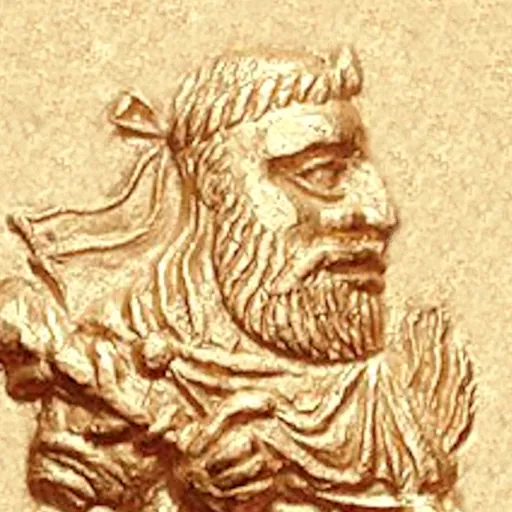
About Vima Kadphises
Born 100. Vima Kadphises was a monarch.
Vima Kadphises (Greek: Οοημο Καδφιϲηϲ Ooēmo Kadphisēs (epigraphic); Kharosthi: 𐨬𐨁𐨨 𐨐𐨫𐨿𐨤𐨁𐨭 , ) was a Kushan emperor from approximately 113 to 127 CE. According to the Rabatak inscription, he was the son of Vima Takto and the father of Kanishka.
Rule
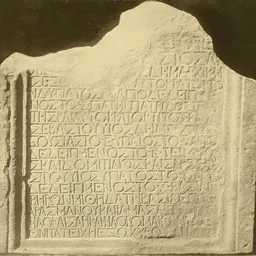
The connection of Vima Kadphises with other Kushan rulers is described in the Rabatak inscription, which Kanishka wrote. Kanishka makes the list of the kings who ruled up to his time: Kujula Kadphises as his great-grandfather, Vima Taktu as his grandfather, Vima Kadphises as his father, and himself Kanishka:
Emperor Vima Kadphises expanded the Kushan territory in Afghanistan and north-west India, where he may have replaced the Indo-Scythian ruler Sodasa in Mathura. The Kushans were able to maintain and protect the Silk Road, allowing silk, spices, textiles or medicine to move between China, India and the West. In particular, sea trade occurred with the Roman Empire, creating a return flow of gold coins, Greek wine and slaves. Works of arts were also imported as indicated by the artefacts found in the so-called Treasure of Begram. An artistic syncretism was observed in the empire, as indicated by the Greco-Buddhist art of Gandhara.
Roman historians relates the visit of ambassadors from the kings of Bactria and India to the court of Trajan (98–117 CE), bearing presents and letters in Greek, which may have been sent either by Vima Kadphises or his son Kanishka.
Coinage
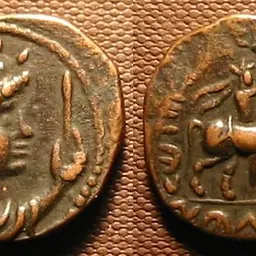
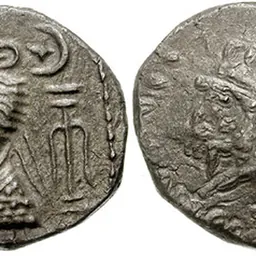
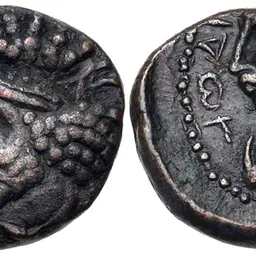
He was the Kushan emperor to first introduce gold coinage, in addition to the existing copper and silver coinage. Most of the gold seems to have been obtained through trade with the Roman Empire. The gold weight standard of approximately eight grams corresponds to that of Roman coins of the 1st century, into three denominations: the double stater, the stater, and the quarter starter (or dinara).
The usage of gold testifies to the prosperity of the Kushan Empire from the time of Vima, being the center of trade between the Han dynasty of China (where Vima was known as 阎膏珍), Central Asia and Alexandria and Antioch in the West.
Most of Vima's coins feature the Buddhist symbol of the Triratana on the reverse (or possibly Shiva's symbol for Nandi, the Nandipada), together with Hindu representations of Shiva, with or without his bull. Often time, a Trishul is depicted along with Shiva.
Coin types
Footnotes
Don’t just read it —
keep it.
Full-length biographies made to live with: read them, listen on the way to work, watch them tonight.
- E-book
- Audio
- Video
Instant download · yours to keep · every purchase keeps this site free
Important facts
Related people
Same field, nearest in time

Frequently asked questions
Who was Vima Kadphises?
the third Kushan emperor (113–127)
When was Vima Kadphises born?
Vima Kadphises was born in 100.
What was Vima Kadphises's occupation?
Vima Kadphises was a monarch.
What nationality was Vima Kadphises?
Vima Kadphises's recorded nationality: Kushan Empire.
Sources & further reading
Cite this page
APA: Biography.guide. (2026). Vima Kadphises. https://biography.guide/vima-kadphises/
MLA: "Vima Kadphises." Biography.guide, https://biography.guide/vima-kadphises/.
Chicago: "Vima Kadphises." Biography.guide. https://biography.guide/vima-kadphises/.
Data last updated: 2026-09-20 · Spot an error? Report a correction.
Portrait: Wikimedia Commons · author & licence
Page generated 2026-09-27 04:58 UTC