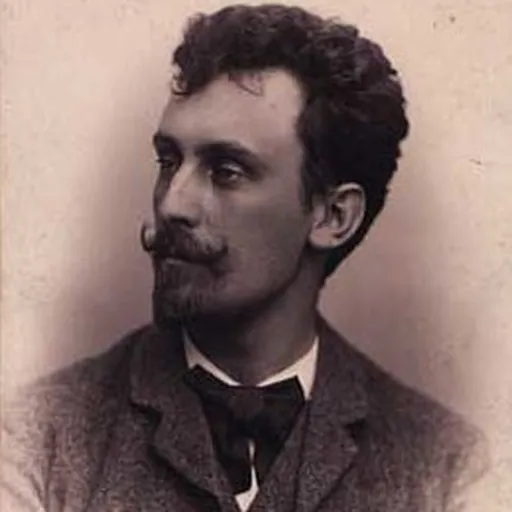
About Viggo Stuckenberg
Lived 1863 – 1905 (aged 42). Viggo Stuckenberg was a Danish poet and writer.
Viggo Henrik Fog Stuckenberg (17 September 1863 – 6 December 1905) was a Danish poet, notable for his lyrical and emotional poems. His work varied from faithful representation of nature in his early career to Expressionism and Realism. He befriended Sophus Claussen, Johannes Jørgensen and J. P. Jacobsen.
Personal life Stuckenberg was born in Vridsløselille where his father, Frederick Henry Stuckenberg (1832–1899), was a teacher at the state prison. His mother was Johanne Georgine Fog (1833–1895). There were three younger siblings, Borge, a painter, Tyge, and Else. In 1872, his father found employment in central Copenhagen, and the family moved to Nørrebro. Stuckenberg matriculated from the Von Westenske Institute in 1884. At the University of Copenhagen, he first studied theology, then science. In 1887, he married Ingeborg Pamperin (1866–1904). The couple had two sons, Henry (born May 1890) and Niels Holger (born December 1891). But the marriage ended with Ingeborg leaving her husband and children in 1903 to emigrate to New Zealand with the gardener Hans Madsen. When the new life quickly became a disappointment, Madsen returned to Denmark, and Pamperin took her own life in 1904. Stuckenberg married Madsen's ex-wife, Clara Holbøll (1868–1940), in 1904 and died in Copenhagen the following year of kidney inflammation. He was buried at Assistens Cemetery.
Career After leaving the university, Stuckenberg was employed as a teacher at Slomanns School in Frederiksberg where he remained for the rest of his life. His debut as a poet was in 1886 with the publication of a work titled Digte (poems). Other works included: I Gennembrud (The Breakthrough, short story) in 1887; Messias (Messiah, short story) in 1889; Den vilde Jæger (The Wild Hunter, fairytale poem) in 1894; Fagre Ord (Fair Words, novel) in 1895; Valravn (novel) in 1896; Sol (Sun, novel) in 1897, Flyvende Sommer (Flying Summer, poems) in 1898; Vejbred (fairy tales and legends) and Asmadæus in 1899; Sne (Snow, containing a number of his finest and best-known poems) in 1901; and Aarsens Tid (Aarsen's Time, Twelve Poems) in 1905. His Sidste Digte (Last Poems) were published posthumously in 1906. His own life drama was a lasting source of inspiration for his poetry, where the main themes were marriage, luck, and accident. His best-known poems, all set to music, are: To som elsker hinanden (music: Emil Reesen), Forårsregn (music: Jens Bjerg) and Åliv (music: Svend S. Schultz).
After his marriage to Pamperin, he was highly regarded by the circle of poets whom he befriended. Stuckenberg and his wife often hosted artists who published in the literary journal Taarnet.
Don’t just read it —
keep it.
Full-length biographies made to live with: read them, listen on the way to work, watch them tonight.
- E-book
- Audio
- Video
Instant download · yours to keep · every purchase keeps this site free
Important facts
People in Viggo Stuckenberg's life
Named in this biography and alive at the same time


Related people
Same field, nearest in time

Contemporaries
People whose lives overlapped Viggo Stuckenberg's


Frequently asked questions
Who was Viggo Stuckenberg?
Danish poet and novelist (1863-1905)
When was Viggo Stuckenberg born?
Viggo Stuckenberg was born on 17 September 1863 in Albertslund Municipality.
When did Viggo Stuckenberg die?
Viggo Stuckenberg died on 6 December 1905 in Copenhagen.
What was Viggo Stuckenberg's occupation?
Viggo Stuckenberg was a poet and writer.
What nationality was Viggo Stuckenberg?
Viggo Stuckenberg was Danish.
Sources & further reading
· Wikipedia: Viggo Stuckenberg
Cite this page
APA: Biography.guide. (2026). Viggo Stuckenberg. https://biography.guide/viggo-stuckenberg/
MLA: "Viggo Stuckenberg." Biography.guide, https://biography.guide/viggo-stuckenberg/.
Chicago: "Viggo Stuckenberg." Biography.guide. https://biography.guide/viggo-stuckenberg/.
Data last updated: 2026-09-21 · Spot an error? Report a correction.
Portrait: Wikimedia Commons · author & licence
Page generated 2026-09-27 04:59 UTC