
About Victor Djorbenadze
Lived 1924 – 1999 (aged 74–75). Victor Djorbenadze was a Russian and Georgian architect.
Victor Djorbenadze (1925–1999) was a Georgian architect, best known for the Wedding Palace in Tbilisi.
Early life and education Djorbenadze, known as widely as "Butza" to his friends, was born July 28, 1925, in Kharkiv while his father, Nikoloz Jorbenadze, served in the Red Army. In 1928 he moved to Samtredia, where his mother, Lubov Sanadze, worked as one of the country's leading obstetricians. Due to his mother's status, Djorbenadze enjoyed a privileged childhood with private tutors in music and foreign languages.
He avoided the draft while studying architecture at the Georgian Polytechnic Institute in Tbilisi from 1940-1946. Upon graduation, he worked for the design and construction branch of Samtredia Ministry of Agriculture (1946-1952) before enrolling in the Giprogor Russian Institute of Urban and Investment Development in Moscow from 1952-1956 and apprenticing with Stalinist architect Mikhail Parusnikov.
Career Djorbenadze returned to Tbilisi in 1957, working first as chief architect of Tbilisi's Kalinin district (covering parts of present-day Mtatsminda, Sololaki, and Rustaveli Avenue neighborhoods), and then at the design and cost-estimation bureau of the Tbilisi executive committee. From 1959 he began work for the municipal planning and design workshop TbilQalaqProekt (Tbilisi City Project), where he spent the rest of his career. He also published essays on architecture, including a 1958 review of Mtskheta as an "architectural ensemble" and thus model of planning cities. His designs for the ensemble (including an office, memorial space, water tower, and monument workshop) drew on Le Corbusier's Notre Dame du Haut at Ronchamp, earning him the nickname "Jorbusier" in the local architecture community. The cemetery was completed in 1974.
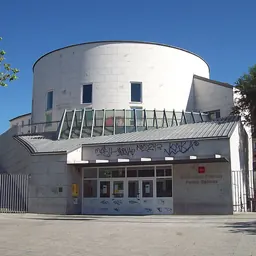
Working with TbilQalaqProekt colleague Keto Kobakhidze, Djorbenadze continued refining his style in his next project, a small museum at the birthplace of Georgian poet Ilia Chavchavadze. Completed in 1979, the building exemplifies Djorbenadze's clean, sculptural exteriors and flowing interiors illuminated by stained glass. At the same time, Djorbenadze was developing plans for a masterpiece: Tbilisi's Wedding Palace. Like the cemetery complex, the wedding palace was intended to bring life milestones in line with secular Soviet dogma while still making concessions to the public taste for ritual. In the 1960s and 70s, Tbilisi had several wedding houses, usually located in repurposed historic buildings or occupying the first floor of newer residential buildings. Although they included decorative elements, these institutions were primarily registration offices and offered little in the way of festive ambience – especially when compared to traditional Georgian church weddings. Djorbenadze proposed a grand wedding palace design that incorporated elements of Georgian church architecture: frescoes, a bell tower, soaring interior spaces. These elements raised objections from municipal authorities, appalled by the inclusion of ecclesiastical iconography in the very building intended to supplant religious ceremonies. Eduard Shevardnadze, however, defended Djorbenadze's design to the state committees, and his design was approved. The Wedding Palace was completed in 1984, with a grand opening on Tbilisoba, a municipal holiday instituted by Shevardnadze in 1979. The exuberantly phallic building, drawing on influences as diverse as 1920s expressionism and medieval Georgian church architecture, met with mixed critical reviews.
After Georgia declared independence from the Soviet Union, the Georgian Orthodox Church opened a competition for a new national cathedral in Tbilisi in 1990. Djorbenadze and colleague Shota Kavlashvili submitted a radical, postmodern design, including spires and glass domes. The memorial volume to his life issued in 2013 carries a collection of his works, various photographs, and also photographs from his private apartment.
Don’t just read it —
keep it.
Full-length biographies made to live with: read them, listen on the way to work, watch them tonight.
- E-book
- Audio
- Video
Instant download · yours to keep · every purchase keeps this site free
Important facts
People in Victor Djorbenadze's life
Named in this biography and alive at the same time


Related people
Same field, nearest in time


Contemporaries
People whose lives overlapped Victor Djorbenadze's




Frequently asked questions
Who was Victor Djorbenadze?
Georgian architect
When was Victor Djorbenadze born?
Victor Djorbenadze was born on 28 July 1924 in Tbilisi.
When did Victor Djorbenadze die?
Victor Djorbenadze died in 1999 in Tbilisi.
What was Victor Djorbenadze's occupation?
Victor Djorbenadze was an architect.
What nationality was Victor Djorbenadze?
Victor Djorbenadze was Russian and Georgian.
Sources & further reading
· Wikipedia: Victor Djorbenadze
Cite this page
APA: Biography.guide. (2026). Victor Djorbenadze. https://biography.guide/victor-djorbenadze/
MLA: "Victor Djorbenadze." Biography.guide, https://biography.guide/victor-djorbenadze/.
Chicago: "Victor Djorbenadze." Biography.guide. https://biography.guide/victor-djorbenadze/.
Data last updated: 2026-09-20 · Spot an error? Report a correction.
Page generated 2026-09-27 05:25 UTC