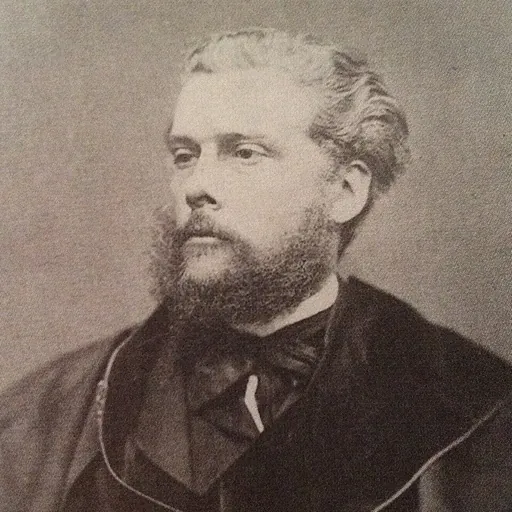
About Víctor Balaguer i Cirera
Lived 1824 – 1901 (aged 76). Víctor Balaguer i Cirera was a Spanish politician, writer, historian, poet, playwright and journalist.
Víctor Balaguer i Cirera (; 11 December 1824 – 14 January 1901) was a Spanish politician and author. A native of Barcelona, Catalonia, he was educated at the university there.
Biography His first dramatic essay, Pepín el jorobado, was staged in Barcelona when he was fourteen, and at 19 he was publicly "crowned" after the production of his second play, Don Enrique el Dadivoso. From 1843 to 1868 he was the chief of the Liberal Party in Barcelona, and as proprietor and editor of El Conseller did much to promote the growth of Catalan nationalism. But it was not until 1857 that he wrote his first poem in Catalan – a copy of verses to the Virgin of Montserrat. He was the author of Historia de Cataluña y de la Corona de Aragón in 5 volumes (Barcelona: Salvador Manero, 1860–63).
Henceforward, he frequently adopted the pseudonym of "Lo Trovador de Montserrat"; in 1859 he helped to restore the "Jocs Florals", and in 1861 was proclaimed mestre en gay saber. He went to Madrid, took a prominent part in political life, and in 1867 emigrated to Provence.
With the 1868 Glorious Revolution and overthrow of Queen Isabella II of Spain, he returned to Spain and represented Manresa in the Cortes, and in 1871—1872 was successively Overseas Minister and Finance Minister. He resigned during the Restoration, but finally followed his party in rallying behind the Bourbon monarchy; he was appointed vice-president of the Congress, and subsequently was a senator. He died in Madrid on 14 January 1901.
Works
Press A Freemason, liberal and of romantic ideas, he contributed to several liberal newspapers such as El Constitucional, El Laurel, El Genio. Semanario de Literatura, Artes, Teatros y Modas, and La Lira. In 1846 he moved to Madrid, where he met major literary and political figures of the time. In Barcelona, he founded the liberal newspaper La Corona de Aragón, promoting both a proud Catalan past and decentralisation for the former Crown of Aragon territories. From 1893 to 1895 he issued the monthly Pro Patria to spread his political views.
Theatre Tragedies: La mort d'Aníbal – Saffo – La tragèdia de Llivia, by Víctor Balaguer. 1913 edition, Lectura Popular collection
In Spanish:* Pepín el Jorobado o el hijo de Carlomagno (1838) Enrique el Dadivoso (1844) Juan de Padilla (1847) Vifredo el Velloso (1848) Los cuatro palos de sangre (second part of Vifredo el Velloso) In Catalan:* Don Joan de Serrallonga (1868) Tragedies: *La mort d'Aníbal*, *Coriolà*, *L'ómbra de Cessar*, *Lo festí de Tibullus*, *La mort de Neró*, *Saffo* New tragedies: *La tragèdia de Llívia*, *L'última hora de Colon*, *Lo guant del degollat*, *Les esposalles de la morta* Los Pirineus (1893), used as the libretto for the opera by Felip Pedrell: El Comte de Foix Raig de Lluna La Jornada de Pannissars
Poetry Llibre de l'Amor*, *Llibre de la Fe*, *Llibre de la Pàtria* – embodying the Floral Games motto "Pàtria, fe i amor." Los trobadors moderns (1859) Lo trobador de Montserrat (1861) Esperances i records (1866) Lo romiatge de l'ànima (1891)
Novels Don Joan de Serrallonga (1858) La bandera de la mort (1859)
Studies and Essays in Spanish Bellezas de la historia de Cataluña (1853) Historia de Cataluña y de la Corona de Aragón (1860–63) Las calles de Barcelona (1865) Historia política y literaria de los trovadores (1878–79) Instituciones y reyes de Aragón (1896) La libertad constitucional (1857) Memorias de un constituyente (1868) El Regionalismo y los Juegos Florales (1897)
History
In his historical work, he did not uncover archival discoveries and was not strictly critical, often merging legend with fact, a trait of his romantic‑liberal style that drew criticism from rivals. He positioned himself as an effective populariser of Catalan history from a liberal viewpoint, resisting strict scholarly examination.
Don’t just read it —
keep it.
Full-length biographies made to live with: read them, listen on the way to work, watch them tonight.
- E-book
- Audio
- Video
Instant download · yours to keep · every purchase keeps this site free
Important facts
more
Victor Balaguer i CireraPeople in Víctor Balaguer i Cirera's life
Named in this biography and alive at the same time
Related people
Same field, nearest in time





Contemporaries
People whose lives overlapped Víctor Balaguer i Cirera's





Frequently asked questions
Who was Víctor Balaguer i Cirera?
Spanish author and politician (1824-1901)
When was Víctor Balaguer i Cirera born?
Víctor Balaguer i Cirera was born on 11 December 1824 in Barcelona.
When did Víctor Balaguer i Cirera die?
Víctor Balaguer i Cirera died on 14 January 1901 in Madrid.
What was Víctor Balaguer i Cirera's occupation?
Víctor Balaguer i Cirera was a politician, writer, historian, poet, playwright and journalist.
What nationality was Víctor Balaguer i Cirera?
Víctor Balaguer i Cirera was Spanish.
Sources & further reading
· Wikipedia: Víctor Balaguer i Cirera
· DBpedia: Víctor Balaguer i Cirera
Cite this page
APA: Biography.guide. (2026). Víctor Balaguer i Cirera. https://biography.guide/victor-balaguer-i-cirera/
MLA: "Víctor Balaguer i Cirera." Biography.guide, https://biography.guide/victor-balaguer-i-cirera/.
Chicago: "Víctor Balaguer i Cirera." Biography.guide. https://biography.guide/victor-balaguer-i-cirera/.
Data last updated: 2026-09-22 · Spot an error? Report a correction.
Portrait: Wikimedia Commons · author & licence
Page generated 2026-09-27 05:04 UTC