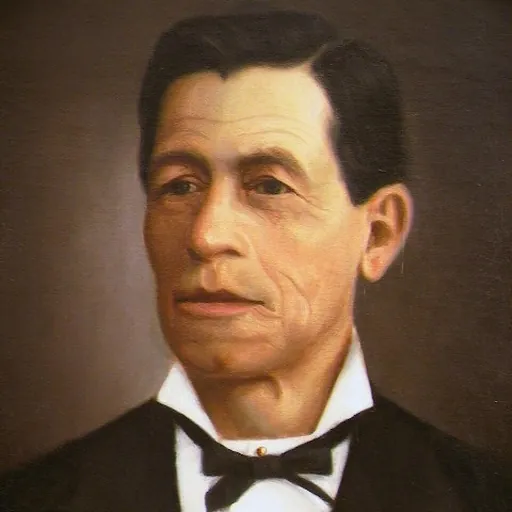
About Vicente Herrera Zeledón
Lived 1821 – 1888 (aged 67). Vicente Herrera Zeledón was a Costa Rican politician, lawyer and judge.
Vicente de las Mercedes Herrera Zeledón (20 January 1821 – 10 November 1888) was a Costa Rican jurist, academic and politician who served as the 10th President of Costa Rica from 1876 to 1877. He assumed the presidency following the overthrow of Aniceto Esquivel Sáenz and resigned the following year, after which Tomás Guardia Gutiérrez returned to office.
Early life and education Herrera was born in San José on 20 January 1821, the son of José Cleto Herrera Salazar and Antonia Zeledón Masís. He completed his studies in philosophy at the Casa de Enseñanza de Santo Tomás in 1839 before moving to Guatemala in 1846. In 1849, he earned a doctorate in law from the University of San Carlos of Guatemala and was admitted to the Costa Rican bar on 20 May 1850.
On 18 December 1853, he married Guadalupe Gutiérrez García, daughter of Atanasio Gutiérrez y Lizaurzábal, who had served as President of the Supreme Court from 1832 to 1833, and María del Pilar García Ramírez. The couple had three children: Angélica, Vicente, and Mercedes Herrera Gutiérrez.
Academic and legal career Herrera taught Castilian and Latin grammar at the Casa de Enseñanza de Santo Tomás until 1845. After the institution became the University of Santo Tomás, he served as professor of canon law and public law, university secretary, and member of its Academic Board. In 1870, he briefly served as rector of the university.
He also held several positions within the Catholic Church's administration, including President of the Board of Charity of San José, Notary Major of the Ecclesiastical Curia, and Secretary of the Cathedral Chapter of the Diocese of Costa Rica. His political views were generally associated with the conservative current of Costa Rican politics and reflected the influence of Catholic social and educational thought.
Public career Herrera served as secretary to President Juan Rafael Mora Porras during the Filibuster War of 1856. He also held office as a deputy in Congress, Governor of San José Province, and Minister Plenipotentiary to Guatemala and Nicaragua.
In 1851, Congress elected him as a magistrate of the Supreme Court of Justice. He became Prosecutor of the Supreme Court in 1852 and was re-elected in 1855. On 17 October 1856, he was elected President (Regent) of the Supreme Court, serving until 29 April 1860 after being re-elected in 1858. He was elected to the Chamber of Senators at a later point, and was serving as its secretary between 1864 and 1865.
During the administration of Tomás Guardia Gutiérrez, Herrera occupied several senior government positions. He was a member of the Council of State (1870–1872), Secretary of the Interior (1873–1876), Acting Secretary of Foreign Affairs on several occasions between 1873 and 1876, and Second Designate to the Presidency from 1874 to 1875.
Following the inauguration of President Aniceto Esquivel Sáenz in May 1876, Herrera was elected Second Designate to the Presidency by the Constitutional Congress. Two days later, however, he resigned from the office, stating that he expected to be absent from the country for an extended period and that it would therefore be preferable for Congress to appoint another officeholder in his place.
Presidency (1876–1877) Following the military coup of 30 July 1876, Herrera was proclaimed Provisional President of the Republic. The coup suspended the Constitution of 1871 and vested the provisional government with extraordinary powers. Although Herrera served as head of state, political and military authority remained concentrated in the hands of General Tomás Guardia Gutiérrez, Commander-in-Chief of the Army and First Designate to the Presidency.
Herrera appointed Guardia, Manuel Antonio Bonilla Nava, and Saturnino Lizano Gutiérrez as First, Second, and Third Designates to the Presidency, respectively. His cabinet included as Secretary of Foreign Affairs, Lizano as Secretary of the Interior and Police, Joaquín Lizano Gutiérrez and later Tomás Guardia Gutiérrez as Secretary of Finance and Commerce, and as Secretary of Public Works. Responsibility for the Ministry of War and Navy was initially assigned to the Secretary of the Interior and later transferred to the Secretary of Finance. A five-member Council of State, chaired by Manuel Antonio Bonilla Nava, was also established to advise the executive.
During Herrera's administration, the government granted financial support to the San Luis Gonzaga School in Cartago, adopted measures to strengthen public education, introduced reforms aimed at reducing smuggling, restored municipal governments in the cantonal capitals after their abolition in 1859, and implemented measures to reduce public expenditure. During an official visit to Guanacaste in May 1877, the town of Guardia was founded and the canton of Carrillo was created. The administration also imposed restrictions on the press and adopted other security measures, particularly following an attempted uprising in 1877.
On 11 September 1877, Herrera temporarily transferred executive authority to Tomás Guardia, citing health reasons. Twelve days later, on 23 September, a meeting of prominent political and military figures convened by Guardia proclaimed him President of the Republic, effectively ending Herrera's administration.
Later life Following his removal from office, Herrera went into exile in El Salvador. In 1879, he joined a group of Costa Rican political exiles opposed to the Guardia government. After returning to Costa Rica, he withdrew from public life and took no further part in politics.
Herrera died on 10 November 1888 at the age of 67. His funeral was conducted with military honors by order of the government of President Bernardo Soto Alfaro.
Don’t just read it —
keep it.
Full-length biographies made to live with: read them, listen on the way to work, watch them tonight.
- E-book
- Audio
- Video
Instant download · yours to keep · every purchase keeps this site free
Important facts
People in Vicente Herrera Zeledón's life
Named in this biography and alive at the same time


Related people
Same field, nearest in time



Contemporaries
People whose lives overlapped Vicente Herrera Zeledón's




Frequently asked questions
Who was Vicente Herrera Zeledón?
Costa rican politician (1821-1888)
When was Vicente Herrera Zeledón born?
Vicente Herrera Zeledón was born on 20 January 1821 in San José.
When did Vicente Herrera Zeledón die?
Vicente Herrera Zeledón died on 10 November 1888 in San José.
What was Vicente Herrera Zeledón's occupation?
Vicente Herrera Zeledón was a politician, lawyer and judge.
What nationality was Vicente Herrera Zeledón?
Vicente Herrera Zeledón was Costa Rican.
Sources & further reading
· Wikipedia: Vicente Herrera Zeledón
· DBpedia: Vicente Herrera Zeledón
Cite this page
APA: Biography.guide. (2026). Vicente Herrera Zeledón. https://biography.guide/vicente-herrera-zeledon/
MLA: "Vicente Herrera Zeledón." Biography.guide, https://biography.guide/vicente-herrera-zeledon/.
Chicago: "Vicente Herrera Zeledón." Biography.guide. https://biography.guide/vicente-herrera-zeledon/.
Data last updated: 2026-09-22 · Spot an error? Report a correction.
Portrait: Wikimedia Commons · author & licence
Page generated 2026-09-27 05:04 UTC