
About Venetia Kotta
Lived 1901 – 1945 (aged 43–44). Venetia Kotta was a Greek archaeologist and byzantinist.
Venetia Kotta (; 1897 or 1901 – 1945) was a Pontic Greek archaeologist, museum curator, and Byzantine historian from Sampsunta in the former Ottoman Empire.
Early life and education Venetia Kotta was born in 1897 or 1901 in Sampsunta, then part of the Ottoman Empire. Her parents belonged to the Pontus region's Greek-speaking minority.
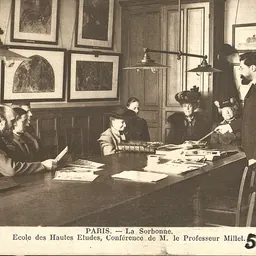
Kotta completed her high school education in Russia. Later, she ran a girls' school for Romanian Greeks in Bucharest. During the 1920s, she went to universities in Athens and Paris. She studied the Byzantines under Gabriel Millet and earned a PhD while attending school in Paris.
Career In 1933, Kotta applied for a job at the University of Thessaloniki, aiming to teach a course about the people's public and private lives in Byzantine times. Her application was rejected, possibly on the basis of her gender.
In the 1930s, Kotta became involved with Greece's archaeological community. She wrote for the Archaiologiki Ephimeris, one of Greece's prominent archaeological journals. In the journal's 1937 edition, Kotta published a piece about a rare icon of Mary. That same year, she was a member of the Archaeological Society of Athens.
During the early 1900s, though the sciences in Greece were male-dominated, some women entered careers as archaeologists. In the decades between WWI and WWII, two women were appointed to the state-run Greek Archaeological Service: Semni Karouzou and Eirene Varoucha-Christodoulopoulou, who worked as excavators. Contemporary activist Avra Theodoropoulou called their promotion a "feminist victory".
After the authoritarian Prime Minister Ioannis Metaxas came to power in 1936, a law was passed which forbade women from joining the Archaeological Service. Women already employed there could continue to work, but they couldn't become the directors of museums or archaeological programs. No women joined the Service until the law was abolished in 1955, with two exceptions.
Venetia Kotta was one such exception. She joined the Archaeological Service under the special circumstance of WWII. She worked in the Byzantine Museum for over a decade. She became a curator of the Byzantine Museum in 1943, specializing in Byzantine textiles and other handmade artifacts.
Kotta worked at the Byzantine Museum until her death in 1945.
Writing Venetia Kotta wrote about Byzantine art and philology.
Don’t just read it —
keep it.
Full-length biographies made to live with: read them, listen on the way to work, watch them tonight.
- E-book
- Audio
- Video
Instant download · yours to keep · every purchase keeps this site free
Important facts
People in Venetia Kotta's life
Named in this biography and alive at the same time

Related people
Same field, nearest in time

Contemporaries
People whose lives overlapped Venetia Kotta's



Frequently asked questions
Who was Venetia Kotta?
Greek archaeologist
When was Venetia Kotta born?
Venetia Kotta was born in 1901 in Samsun.
When did Venetia Kotta die?
Venetia Kotta died in 1945.
What was Venetia Kotta's occupation?
Venetia Kotta was an archaeologist and byzantinist.
What nationality was Venetia Kotta?
Venetia Kotta was Greek.
Sources & further reading
Cite this page
APA: Biography.guide. (2026). Venetia Kotta. https://biography.guide/venetia-kotta/
MLA: "Venetia Kotta." Biography.guide, https://biography.guide/venetia-kotta/.
Chicago: "Venetia Kotta." Biography.guide. https://biography.guide/venetia-kotta/.
Data last updated: 2026-09-20 · Spot an error? Report a correction.
Page generated 2026-09-27 05:27 UTC