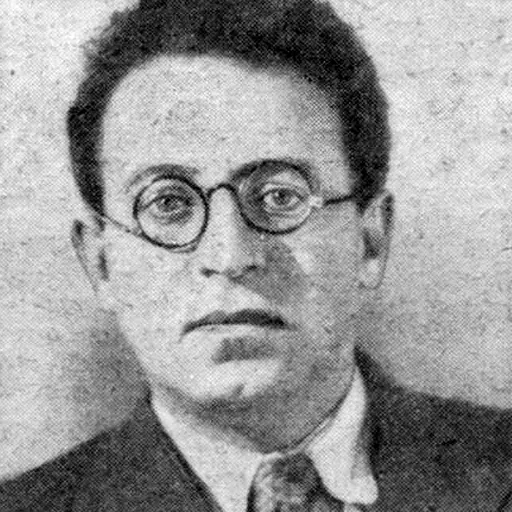
About Vasily Grossman
Lived 1905 – 1964 (aged 58). Vasily Grossman was a Russian and Ukrainian war correspondent, writer, novelist, prose writer, engineer and reporter.
Vasily Semyonovich Grossman (; 12 December [ O.S. 29 November] 1905 – 14 September 1964) was a Soviet writer and journalist. Born to a Jewish family in Ukraine, then part of the Russian Empire, Grossman trained as a chemical engineer at Moscow State University, earning the nickname Vasya-khimik ("Vasya the Chemist") because of his diligence as a student. Upon graduation, he took a job in Stalino (now Donetsk) in the Donets Basin. In the 1930s he changed careers and began writing full-time, publishing a number of short stories and several novels.
At the outbreak of the Second World War, Grossman was engaged as a war correspondent by the Red Army newspaper Krasnaya Zvezda; he wrote first-hand accounts of the battles of Moscow, Stalingrad, Kursk, and Berlin. Grossman's eyewitness reports of a Nazi extermination camp, following the discovery of Treblinka, were among the earliest accounts of a Nazi death camp by a reporter.
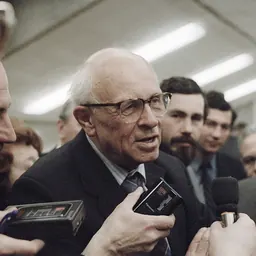
There is some dispute over the extent of the state repression Grossman endured after the war. While he was never arrested, his two major literary works (Life and Fate and ) were censored by Nikita Khrushchev's government as anti-Soviet. At the time of Grossman's death from kidney cancer in 1964, these books remained unreleased. Copies were eventually smuggled out of the Soviet Union by a network of dissidents, including Andrei Sakharov and Vladimir Voinovich, and first published in the West in 1980, before appearing in the Soviet Union in 1988.
Early life and career
Born Iosif Solomonovich Grossman in Berdychiv, Ukraine, Russian Empire, into a Jewish family, he did not receive a traditional Jewish education. His father Semyon Osipovich Grossman was a chemical engineer, and his mother Yekaterina Savelievna was a teacher of French. From 1910 to 1912, he lived with his mother in Geneva after his parents had separated. One of his first short stories, "In the Town of Berdichev" (В городе Бердичеве), drew favourable attention and encouragement from Maxim Gorky and Mikhail Bulgakov. The film Commissar (director Aleksandr Askoldov), made in 1967, suppressed by the KGB and released only in 1988, is based on this four-page story.
In the mid-1930s Grossman left his job and committed himself fully to writing. By 1936 he had published two collections of stories and the novel Glyukauf, and in 1937 was accepted into the privileged Union of Writers. His novel Stepan Kol'chugin (published 1937-40) was nominated for a Stalin prize, but deleted from the list by Stalin himself for alleged Menshevik sympathies.
Grossman's first marriage ended in 1933, and in the summer of 1935 he began an affair with Olga Mikhailovna Guber, the wife of his friend, the writer Boris Guber. Grossman and Olga began living together in October 1935, and they married in May 1936, a few days after Olga and Boris Guber divorced. In 1937 during the Great Purge Boris Guber was arrested, and later Olga was also arrested for failing to denounce her previous husband as an "enemy of the people". Grossman quickly had himself registered as the official guardian of Olga's two sons by Boris Guber, thus saving them from being sent to orphanages. He then wrote to Nikolay Yezhov, the head of the NKVD, pointing out that Olga was now his wife, not Guber's, and that she should not be held responsible for a man from whom she had separated long before his arrest. Grossman's friend, Semyon Lipkin, commented, "In 1937 only a very brave man would have dared to write a letter like this to the State's chief executioner." Astonishingly, Olga Guber was released.
War reporter
When Nazi Germany invaded the Soviet Union in 1941, Grossman's mother was trapped in Berdychiv by the invading German Army, and eventually murdered together with 20,000 to 30,000 other Jews who had not evacuated. Grossman was exempt from military service, but volunteered for the front, where he spent more than 1,000 days. He became a war correspondent for the popular Red Army newspaper Krasnaya Zvezda (Red Star). As the war raged on, he covered its major events, including the Battle of Moscow, the Battle of Stalingrad, the Battle of Kursk and the Battle of Berlin. In addition to war journalism, his novels (such as The People Immortal) were published in newspapers and he came to be regarded as a legendary war hero. The novel Stalingrad was begun during the war and finished in 1952. After a struggle with censors over the book's content, the novel was published in the journal Znamya. It was later renamed For a Just Cause (За правое дело) and heavily edited in republications released after Joseph Stalin's death. A new English translation, with added material from Grossman's politically risky early drafts, was published in 2019 under the original title, Stalingrad. In December 2019 the book was the subject of the series Stalingrad: Destiny of a Novel in BBC Radio 4's Book of the Week.
Grossman described Nazi ethnic cleansing in German-occupied Ukraine and Poland and the liberation by the Red Army of the German Nazi Treblinka and Majdanek extermination camps. He collected some of the first eyewitness accounts—as early as 1943—of what later became known as the Holocaust. His article The Hell of Treblinka (1944) was disseminated at the Nuremberg Trials as evidence for the prosecution.
The Hell of Treblinka Grossman interviewed former Sonderkommando inmates who escaped from Treblinka and wrote his manuscript without revealing their identities. He had access to materials already published. Grossman described Treblinka's operation in the first person. Of Josef Hirtreiter, the SS man who served at the reception zone of the Treblinka extermination camp during the arrival of transports, Grossman wrote: In his article, Grossman claimed that 3 million people had been killed at Treblinka, the highest estimate ever proposed, rather than the now widely accepted 750,000 to 880,000; this was because of an error made by Grossman when he calculated the number of trains that could arrive at the extermination camp each day.
Conflict with the Soviet government Grossman participated in the compiling of the Black Book, a project of the Jewish Anti-Fascist Committee to document the crimes of the Holocaust. The post-war suppression of the Black Book by the Soviet state shook him to the core, and he began to question his own loyal support of the Soviet government. First the censors ordered changes in the text to conceal the specifically anti-Jewish character of the atrocities and to downplay the role of Ukrainians who worked with the Nazis as police. Then, in 1948, the Soviet edition of the book was scrapped completely. Semyon Lipkin wrote:
Grossman also criticized collectivization and political repression of peasants that led to the Holodomor tragedy. He wrote that "The decree about grain procurement required that the peasants of Ukraine, the Don and the Kuban be put to death by starvation, put to death along with their little children."
Because of state persecution, only a few of Grossman's post-war works were published during his lifetime. After he submitted for publication his magnum opus, the novel Life and Fate (Жизнь и судьба, 1959), the KGB raided his flat. The manuscripts, carbon copies, notebooks, as well as the typists' copies and even the typewriter ribbons were seized. It has been said by many, including Grossman's translator, Robert Chandler (see, for example his introduction to Life and Fate that the Politburo ideology chief Mikhail Suslov told Grossman that his book could not be published for two or three hundred years. However, Chandler and Yury Bit-Yunan, in Vasily Grossman: Myths and Counter-Myths, say that their research into the notes about that meeting of both Grossman and Suslov show that this was not the case, and in note 2 of that article, Chandler expresses regret for having made the claim.
Grossman wrote to Nikita Khrushchev: "What is the point of me being physically free when the book I dedicated my life to is arrested... I am not renouncing it... I am requesting freedom for my book." However, Life and Fate and his last major novel, Everything Flows (Все течет, 1961) were considered a threat to the Soviet power and remained unpublished. Grossman died in 1964, not knowing whether his greatest work would ever be read by the public.
Death Grossman died of kidney cancer on 14 September 1964. He was buried at the Troyekurovskoye Cemetery on the edge of Moscow.
Legacy Memorial plaque in Donetsk where Grossman worked in the early 1930s.
Life and Fate was first published in Russian in 1980
Publications Kolchugin's Youth: A Novel, translated by Rosemary Edmonds (1946). Hutchinsons International Authors Ltd. The People Immortal, translated by Elizabeth Donnelly (1943), Moscow, Foreign Languages Publishing House (published in U.S. as No Beautiful Nights, New York, J. Messner (1944) and in U.K. as The People Immortal, London: Hutchinson International Authors (1945)). A new translation by Robert and Elizabeth Chandler, including previously censored passages reinstated by Julia Volohova from Grossman's original typescript, was published in 2022 by NYRB Classics (US edition) and the MacLehose Press (UK edition). The Black Book: The Ruthless Murder of Jews by German-Fascist Invaders Throughout the Temporarily-Occupied Regions of the Soviet Union and in the Death Camps of Poland during the War 1941–1945. (originally 1944), by Vasily Grossman and Ilya Ehrenburg For a Just Cause (1956), originally titled Stalingrad. Published in the Soviet Union in Russian in 1952. English translation with additional material from Grossman's unpublished manuscripts by Robert and Elizabeth Chandler published under original name Stalingrad by New York Review Books, June 2019. The Road: Stories, Journalism, and Essays, translated by Robert and Elizabeth Chandler with Olga Mukovnikova, commentary and notes by Robert Chandler with Yury Bit-Yunan, afterword by Fyodor Guber. New York Review Books, 2010, A Writer at War: Vasily Grossman with the Red Army, 1941-1945, edited and translated by Antony Beevor and Luba Vinogradova from Grossman's wartime notebooks. New York: Pantheon Books, 2005. . Also published as A Writer at War: A Soviet Journalist with the Red Army, 1941-1945. Vintage Canada. . From the Front Line: Stalingrad–Treblinka–Berlin, 1941–45. New York Review Books, 2026. An Armenian Sketchbook (written in 1962). Translated by Robert Chandler. New York Review Books Classics, 2013. "In The War" and Other Stories. Translated by Andrew Glikin-Gusinsky. Sovlit.net Grossman's publications at lib.ru
Don’t just read it —
keep it.
Full-length biographies made to live with: read them, listen on the way to work, watch them tonight.
- E-book
- Audio
- Video
Instant download · yours to keep · every purchase keeps this site free
Important facts
People in Vasily Grossman's life
Named in this biography and alive at the same time






Related people
Same field, nearest in time

Contemporaries
People whose lives overlapped Vasily Grossman's



Frequently asked questions
Who was Vasily Grossman?
Russian Soviet writer and journalist (1905-1964)
When was Vasily Grossman born?
Vasily Grossman was born on 29 November 1905 in Berdychiv.
When did Vasily Grossman die?
Vasily Grossman died on 14 September 1964 in Moscow.
What was Vasily Grossman's occupation?
Vasily Grossman was a war correspondent, writer, novelist, prose writer, engineer and reporter.
What nationality was Vasily Grossman?
Vasily Grossman was Russian and Ukrainian.
Sources & further reading
Cite this page
APA: Biography.guide. (2026). Vasily Grossman. https://biography.guide/vasily-grossman/
MLA: "Vasily Grossman." Biography.guide, https://biography.guide/vasily-grossman/.
Chicago: "Vasily Grossman." Biography.guide. https://biography.guide/vasily-grossman/.
Data last updated: 2026-09-21 · Spot an error? Report a correction.
Portrait: Wikimedia Commons · author & licence
Page generated 2026-09-27 05:00 UTC