
About Vasili Byros
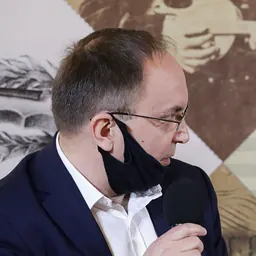
Vasili Byros was a musicologist and music theorist.
Vasili Byros (born 1976) is a Greek-American music theorist, musicologist and pianist. He is best known for his contributions to the field of music schemata theory and partimento.
Education Byros is an alumnus of the Aaron Copland School of Music, receiving his B.A. in music composition in 2001 and M.A. in music history and music theory in 2003. Byros received his PhD in Music Theory from Yale Graduate School of Arts and Sciences' Department of Music in 2009. He is currently a tenured associate professor of Music Theory and Cognition at Northwestern University since 2010, after spending a year at the Jacobs School of Music of Indiana University as a Post-Doctoral Resident Scholar. In 2017, Byros received the Charles Deering McCormick Professor of Teaching Excellence.
Research related to Music Schemata Theory Le Sol Fi Sol One of Byros' notable contributions to Music Schemata Theory is his study of the Le-Sol-Fi-Sol Schema in Ludwig van Beethoven's Eroica Symphony.
The le-sol-fi-sol is a 4-stage pattern, based on a b6-5-#4–5 bass line. Its most common harmonization is VI–i6/4–#ivo7–V(7), frequently with a cadential 6/4 over the dominant. The function of the pattern's first three stages is equivalent to that of an augmented sixth chord.
Fonte-Romanesca Byros is also noted for identifying and naming a common music schema popularized by Arcangelo Corelli and still used a century later by Wolfgang Amadeus Mozart known as the Fonte-Romanesca, which shares the characteristics of a Fonte and a Romanesca.
The Fonte-Romanesca is a chromatic and modulating variant of the so-called Pachelbel sequence. Its main element is a bass 6-7-1 (la-ti-do) progression, which is equivalent to the last three stages of the ascending Rule of Octave. This 6-7-1 progression is successively transposed down a third, each time to a new key, for example Bb major to G minor. Extended versions contain as many as three transpositions: e.g., Bb major–G minor–Eb major–C minor.
Awards Outstanding Publication Award (2017) – Prelude on a Partimento: Invention in the Compositional Pedagogy of the German States in the Time of J. S. Bach – Society for Music Theory.
Don’t just read it —
keep it.
Full-length biographies made to live with: read them, listen on the way to work, watch them tonight.
- E-book
- Audio
- Video
Instant download · yours to keep · every purchase keeps this site free
Important facts
Related people
Same field, nearest in time




Frequently asked questions
Who was Vasili Byros?
Greek-American music theorist, musicologist and pianist
What was Vasili Byros's occupation?
Vasili Byros was a musicologist and music theorist.
Sources & further reading
Cite this page
APA: Biography.guide. (2026). Vasili Byros. https://biography.guide/vasili-byros/
MLA: "Vasili Byros." Biography.guide, https://biography.guide/vasili-byros/.
Chicago: "Vasili Byros." Biography.guide. https://biography.guide/vasili-byros/.
Data last updated: 2026-09-20 · Spot an error? Report a correction.
Page generated 2026-09-27 04:58 UTC