
About Valentin Bouché
Lived 1490 – 1541 (aged 50–51). Valentin Bouché was a French painter, engineer, stained-glass artist, glass artist, glass painter and artist.
″The Deluge″ by Valentin Bousch, 1531. Glass, painted and stained. 11 ft. 10 1/4 in. x 5 ft. 7 in. Metropolitan Museum of Art.Valentin Bousch (circa 1490 – August 1541) was a Renaissance stained glass glazier and painter from Strasbourg, active in the Duchy of Lorraine and the Republic of Metz. A rarity among stained glass artists, Bousch is seen as one who actively sought to express new ideas in his art, often before they were widely used in the area, revising his method even from one window to the next, to create striking Renaissance effects and a personal style.
Life Bousch was born in Strasbourg. The earliest mention of his work is at Saint-Nicolas-de-Port, near Nancy in 1514. Bousch was active there from 1514 to 1520, developed a large glass studio and made many windows for the Saint Nicolas basilica. In 1518 he also made windows for the priory church of Varangéville on a command of the Bishop of Metz, John IV of Lorraine. On 25 September 1518, Valentin Bousch became the master glazier of the cathedral of Metz, where most work was done in the years 1520-1528, and 1534-1539. In between, he made a cycle of biblical scenes for the Saint-Firmin priory church in Flavigny-sur-Moselle. A number of documents relating to Bousch, including his will are at the Bibliothèque municipale de Nancy.
Saint-Nicolas-de-Port In Saint-Nicolas-de-Port, much of the glass had not survived the Thirty Years' War and later events, and other parts are rearranged. Yet Bousch is attributed with the great rose window, and some windows, in full or part, in the small chapels. The repetitions, as well as some uncertain attributions, are explained by the fact that works were mostly commissioned by donors, and were no part of an overall design of the church.
In the Chapelle Notre Dame des Victoires: The Dormition of Mary, her funeral and her Assumption; and in another window, the Presentation of Mary, the Visitation and the Presentation of Jesus at the Temple. In the Chapelle Saint Anne: possibly a window with the Annunciation and Saint Barbara, and another with church donors, coats of arms and Adrian of Nicomedia.
Two greater windows, are dedicated one to Saint Sebastian and other characters, the other mostly to the Transfiguration of Jesus, witnessed by a circle with Moses, Elijah, Saint Peter and others.
Metz
In Metz Bousch made most of the stained glasses of the choir and south transept.
Flavigny-sur-Moselle The windows from Flavigny-sur-Moselle show Bousch's mature style. Out of a cycle of seven, three were lost by 1850, and four were sold in 1904 by the priory and are dispersed in North America. Two are in the Metropolitan Museum of Art (along with four smaller pieces), one in St. Joseph church, Stockbridge, Massachusetts and one in a private collection in Canada.
Technique As a glazier, Bousch produced large cuts of glass that were technically difficult to make, and allowed greater freedom in painting. Bousch's glasses were designed to keep each window's net of lead reinforcement lines along the picture's painted contours, so they will not interrupt the scene. At times, obvious lead lines were incorporated to emphasize an object, The more traditional method of placing lead lines in a way that help define panels, or spotlight a person's head, was used as a second choice in Bousch's work.
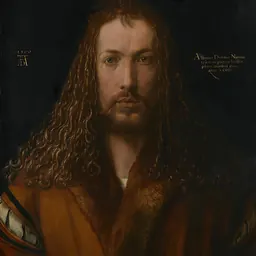
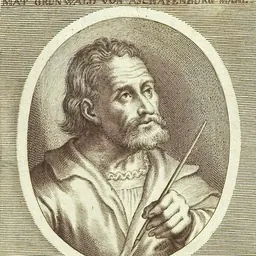
As a painter, Bousch utilized the large glass cuts to present rich arrays of shadows and background details, applying Grisaille color washes in modulation. The luminosity and color of his support medium came into play, as he left the brightest areas in the painting, the least matted surfaces in a glass. Illusionistic details were added to distract a viewer away from lead lines. and Albrecht Dürer, but also Matthias Grünewald 's Isenheim Altarpiece and the elder Cranach's 1503 Crucifixion, have been paired each with a parallel detail from Bousch. He most likely studied their works from prints, but probably also knew Baldung Grien, a citizen of Strasbourg, in person. Bousch had his own experience in panel painting.
In Bousch's later work, particularly the windows of Flavigny-sur-Moselle, in addition to using these artists' works as models, Bousch introduced many novelties. Gothic decorations like foliage and damask backgrounds were minimized, replaced by neoclassical architectural frames; Generic glass panels gave way to Bousch's more advanced cutting and leading; Halos, to naturalistic light beams. Perspective was nuanced for different emotive ends, objects placed strategically in space and persons arranged in dramatic, purposeful postures, These are all signs of another layer of influences on Bousch work, that of Italian Renaissance and Mannerism. However, no direct sources of this phase are known.
On a religious dimension, his Flavigny-sur-Moselle work has also been connected with a Catholic prior's relatively sympathetic response to Protestant humanist thought; the cycle is interpreted as identifying a history of predestination within the bible.
Don’t just read it —
keep it.
Full-length biographies made to live with: read them, listen on the way to work, watch them tonight.
- E-book
- Audio
- Video
Instant download · yours to keep · every purchase keeps this site free
Important facts
People in Valentin Bouché's life
Named in this biography and alive at the same time
Related people
Same field, nearest in time




Contemporaries
People whose lives overlapped Valentin Bouché's

Frequently asked questions
Who was Valentin Bouché?
Glass artisian (c.1490-1541)
When was Valentin Bouché born?
Valentin Bouché was born in 1490 in Strasbourg.
When did Valentin Bouché die?
Valentin Bouché died in 1541 in Metz.
What was Valentin Bouché's occupation?
Valentin Bouché was a painter, engineer, stained-glass artist, glass artist, glass painter and artist.
What nationality was Valentin Bouché?
Valentin Bouché was French.
Sources & further reading
Cite this page
APA: Biography.guide. (2026). Valentin Bouché. https://biography.guide/valentin-bouche/
MLA: "Valentin Bouché." Biography.guide, https://biography.guide/valentin-bouche/.
Chicago: "Valentin Bouché." Biography.guide. https://biography.guide/valentin-bouche/.
Data last updated: 2026-09-26 · Spot an error? Report a correction.
Page generated 2026-09-27 05:14 UTC