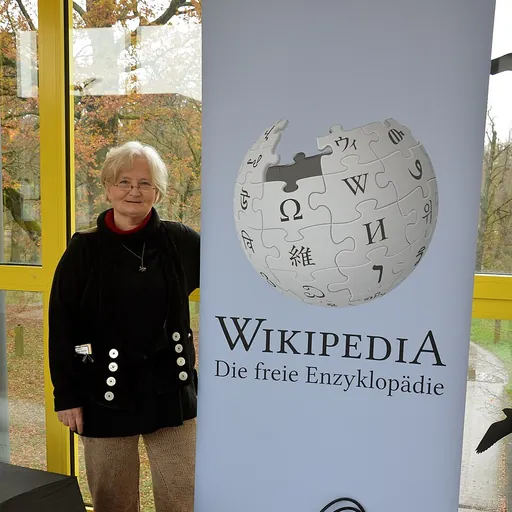
About Ute Erb
Born 1940. Ute Erb is a German writer, translator, proofreader, publisher, kommune 1 and poet.
Ute Erb (born 25 December 1940) is a German writer, poet and translator. She grew up in the German Democratic Republic (East Germany); but when she was 16 she escaped illegally to the west, without telling her parents, and ended up living in Cologne "with friends". She was driven to it, as she later explained, "by a homesickness for a Germany that simply did not exist". It would not be the last time she would display a well-honed rebellious streak.
Family provenance and early years Ute Erb was born at Scherbach (subsequently subsumed into Rheinbach) in the hills south of Bonn. Her parents had moved there with her uncle Otto and his family in 1937 in order, as her father put it, to "overwinter National Socialism". (1903–1978), her father, worked at the local tax office, having lost his academic post as a Marxist literary historian at the University of Bonn in 1933 on account of suspected "Communist activities". Her mother Elisabeth worked on the land. Ute was the youngest of her parents' three daughters, all born in Scherbach between 1938 and 1941, when her father was conscripted for military service. "Die Kette an deinem Hals" nevertheless enjoyed significant commercial success, despite being the author's first published novel. In due course a film version was produced (1965) and the book was translated into several languages.
First marriage By 1962 she was back in Germany, where she settled in Charlottenburg (West Berlin) and married Michael Pampuch, a professional simultaneous interpreter and singer. The couple's sons were born in 1961 and 1963. Erb and Pampuch also teamed up to produce a German language translation of Booth Mooney's then topical biography of President Lyndon Johnson. The marriage ended in divorce in 1966.
Party memberships After her youthful escape to West Germany, the homeland security services of East Germany continued to keep an eye on Ute Erb's activities. In May 1961 "IM Hermann" reported back to his handlers at the "Ministry for State Security in East Berlin, "she has a very idiosyncratic character, and insists on her own opinions". Without the muscular state backing available in the Soviet sponsored German Democratic Republic, however, the Socialist Unity Party and its Berlin proxy never acquired significant traction in West Berlin or in West Germany, where after 1949 it was widely perceived as a proxy for Moscow's all-too traditional imperialist ambitions. Despite her party memberships, even though she was clearly involved in her own varieties of political activism, Ute Erb never became a significant figure in Berlin's party political scene.
Activist Ute Erb became part of the "Kommune 1" movement which grew out of the 1968 student protests. She was a co-founder and "lead tenant" of "Kommune 99" and active in the "Kinderladen" movement, dedicated to an alternative template for Kindergarten organisation, their objectives summarized in the slogan, "More parents for each child". She became involved in the executive committee of the West Berlin German Authors' Association, the West German "Writers' Working Circle", the Standing Committee for Culture Days at "Progressive Kunst West-Berlin e. V." and with the Lebanon aid charity, "Libanon-Hilfe". Reflecting the Austrian connections acquired through her marriage with Hermann Schürrer she is also a member of the Grazer Autorenversammlung (based, since 1975, not in Graz but in Vienna).
In 1982 she founded "Schriftstellerei Ute Erb & Kollektiv", a short-lived and somewhat niche co-operatively organised and structured publishing operation.
Third marriage 1982 was also the year in which Ute Erb married Omar Saad: the marriage ended in divorce four years later. It was the longest of Ute Erb's (three) marriages to date. Omar Saad was described at the time as a Palestinian letter writer and asylum seeker.
Output (selection) Die Kette an deinem Hals. Europäische Verlagsanstalt, Frankfurt 1960 (Bertelsmann Lesering: Gütersloh 1962) as translator into German, together with Michael Pampuch: Booth Mooney: Lyndon B. Johnson. Colloquium, Berlin 1964
Das Wochenende einer Gastarbeiterin. Westdeutscher Rundfunk, Köln 1968 (Fernsehskizze) Hütet euren Kopf. Gedichte. Sender Freies Berlin, 1972 Nie kommen wir ins Paradies. Gedichte. Sender Freies Berlin, 1973 Schindluder treiben. Gedichte. Sender Freies Berlin, 1975
as translator into German: Tahsin İncirci: Lieder für den Frieden und Lieder aus der Fremde. with Sümeyra and Türkischer Arbeiterchor Westberlin. Verlag „pläne", Dortmund 1979 (LP, Übertragung ins Deutsche) Ich habe einen Mann in Süddeutschland. Lyrik bei SFB1, 18. Oktober 1982. 23:00–23:10 Uhr (not an interview but a talk) Berliner Künstler. Feature in SFB3 (Journal), 7. Juni 1983, 17:05–18:10 Uhr Ende einer Versammlung. In: Radio Bremen am 20. April 1984, 22:50–23:00 Uhr Frauenleiden. In: Schreibwerkstatt – Texte von Frauen. Hessischer Rundfunk am 6. Januar 1985, 16:15–16:30 Uhr (as part of a 2 Minute contribution by von Anna Rheinsberg) Lyrik und Interview (17 Minuten) in Deutschland – Deutschland (2) Die Töchter der Verlierer. In: WDR3 (Fernsehen) ab 22:20 Uhr (overall length 69 Minuten) Alternative – Gebrauchsanthologie. 1. Zwanzig Einfälle auf zehn Streichholzschachteln. Amerikanischer Sektor. Berlin 1988 Gebühreneinheit. In: Lyrik um zehn vor elf. RBII am 8. Januar 1989, 22:50–23:00 Uhr with Regina Nössler: So können wir uns nicht trennen. In: Neue literarische Texte. SFB3 (Hörfunk), 16. April 1989, 18:30–19:00 (Textanteil 12,5 Minuten) with Petra Ganglbauer in Jazz und Lyrik. Es las Judith Kelle. Es dankten fürs Zuhören Gerald Bisinger und Friederike Raderer auf ORF 2 1995.
Don’t just read it —
keep it.
Full-length biographies made to live with: read them, listen on the way to work, watch them tonight.
- E-book
- Audio
- Video
Instant download · yours to keep · every purchase keeps this site free
Important facts
People in Ute Erb's life
Named in this biography and alive at the same time

Related people
Same field, nearest in time


Contemporaries
People whose lives overlapped Ute Erb's



Frequently asked questions
Who is Ute Erb?
German writer
When was Ute Erb born?
Ute Erb was born on 25 December 1940 in Rheinbach.
What is Ute Erb's occupation?
Ute Erb is a writer, translator, proofreader, publisher, kommune 1 and poet.
What nationality is Ute Erb?
Ute Erb is German.
Sources & further reading
Cite this page
APA: Biography.guide. (2026). Ute Erb. https://biography.guide/ute-erb/
MLA: "Ute Erb." Biography.guide, https://biography.guide/ute-erb/.
Chicago: "Ute Erb." Biography.guide. https://biography.guide/ute-erb/.
Data last updated: 2026-09-21 · Spot an error? Report a correction.
Portrait: Wikimedia Commons · author & licence
Page generated 2026-09-27 04:58 UTC