Urith
Anglo-Saxon saint
About Urith
Urith (also known in Welsh as Iwerydd) was a Christian woman from the Westcountry of Great Britain who was alleged to have been martyred in the 8th century, and subsequently revered as a saint. The name was not uncommon in the English county of Devon. Her feast day is 8 July and her shrine is located in the North Devon village of Chittlehampton. Her name is also known in Latin as Hieritha and occasionally corrupted to Erth.
History
Urith is a fairly obscure figure. John Leland makes no mention of her, nor does Capgrave's Nova Legenda Angliae, and Nicholas Roscarock knew little of her apart from the fact of her existence. A book of her life, containing a record of her miracles, was at one time present in her shrine, and appears to be the basis of a rhyming poem in Latin now held by Trinity College, Cambridge. According to both this and William Camden, her legend was as follows:
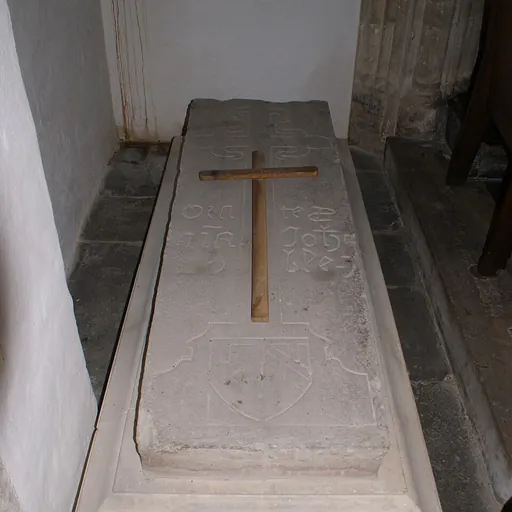
Legend Legend says Saint Urith was born at East Stowford in Swimbridge parish, in the English county of Devon, to an Anglo-Saxon father and unknown mother. She was converted to Christianity by St Kea, lived as a hermit in nearby Chittlehampton, where she founded a church. At the urging of an allegedly jealous, and perhaps pagan, stepmother, some female haymakers beheaded the girl with a scythe, sprang forth wherever a drop of her blood was sprinkled. These last elements of her legend are the same as those found in the Lives of Sidwell and Juthwara. Urith was buried near the site of her martyrdom and a church was later built above her grave.
Veneration drawing of window in St Mary's Church, South Walsham, Norfolk England depicting Saint Urith.Saint Urith's holy well still stands at the east end of Chittlehampton, now called by the corrupt name of Taddy Well or Saint Teara's Well. and later suffragan Bishop of Crediton. She became known to local parishioners as "Miss Urith". Urith Pole, a daughter of Sir John Pole, 3rd Baronet (1649–1708), of Shute, Devon, and wife of Sir John Trevelyan, 2nd Baronet (1670–1755), of Nettlecombe Court in Somerset. A stained-glass figure of St Urith survives in an early 16th-century window in Nettlecombe Church, with the Latin inscription Sancta Uritha. Urith Shapcott (born 1617), wife of Sir Courtenay Pole, 2nd Baronet (1618–1695). She was the daughter of the lawyer Thomas Shapcott (1587–1670) of Shapcott in the parish of Knowstone, Devon, by his wife Urith Sotherin (d. 1661) of Cheshire. Urith Chichester, a daughter of Sir John Chichester (1519/20 – 1569) of Raleigh in Devon, who in 1591 married John Trevelyan of Nettlecombe Court in Somerset. It may have been in memory of this marriage that the existing stained-glass figure of a female saint (possibly St Sidwell) in a window of Nettlecombe Church was given the inscription Sancta Uritha.
Don’t just read it —
keep it.
Full-length biographies made to live with: read them, listen on the way to work, watch them tonight.
- E-book
- Audio
- Video
Instant download · yours to keep · every purchase keeps this site free
Important facts
Frequently asked questions
Who was Urith?
Anglo-Saxon saint
When was Urith born?
Urith was born in Devon, Swimbridge.
When did Urith die?
Urith died in Chittlehampton, Devon.
Sources & further reading
Cite this page
APA: Biography.guide. (2026). Urith. https://biography.guide/urith/
MLA: "Urith." Biography.guide, https://biography.guide/urith/.
Chicago: "Urith." Biography.guide. https://biography.guide/urith/.
Data last updated: 2026-09-22 · Spot an error? Report a correction.
Portrait: Wikimedia Commons · author & licence
Page generated 2026-09-27 05:03 UTC