About Ur-Nanshe
Ur-Nanshe was a sovereign.
Ur-Nanshe (, ; ) also Ur-Nina, was the first king of the First Dynasty of Lagash in the Sumerian Early Dynastic Period III. He is known through inscriptions to have commissioned many building projects, including canals and temples, in the state of Lagash, and defending Lagash from its rival state Umma, whose ensi Pabilgagaltuku he recorded capturing. He was probably not from royal lineage, being the son of Gunidu who was recorded without an accompanying royal title. He was the father of Akurgal, who succeeded him, and grandfather of Eannatum.
He ascended after Lugalshaengur (lugal-ša-engur), who was the ensi, or high priest of Lagash, and is only known from the macehead inscription of Mesilim.
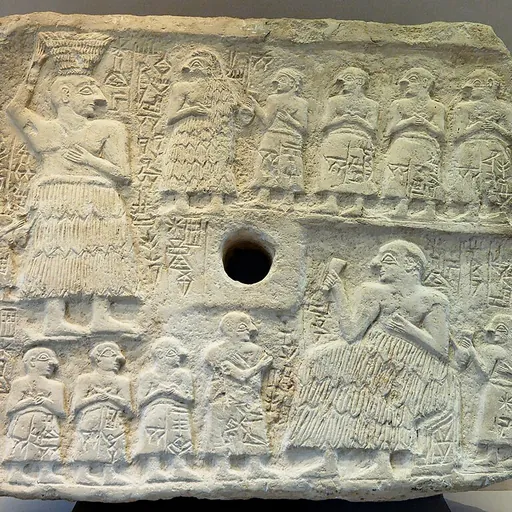
Temples According to the Perforated Relief of King Ur-Nanshe, temples attributed to Ur-Nanshe include Ningirsu's temple in Girsu, Nanshe's temple in Nina, and Apsubanda. Louvre Museum.
The Perforated Relief of King Ur-Nanshe is on display at the Louvre. The king is portrayed as a builder of temples and canals, thus a preserver of order perceived to be bestowed upon them by the gods.
The carved illustration is in two registers, top and bottom, both depicting Ur-Nanshe in different roles as king. In the top register he is dressed in a kaunakes (tufted wool skirt), carrying a basket of bricks on his head while surrounded by other Lagash elite, his wife, and four of his sons ). Inscriptions on their respective garments identify each person. On the bottom register, Ur-Nanshe is at a banquet, which is to celebrate the building of the temple. He is seated on a throne wearing the same outfit as the top register, with two officials either side of him, along with three more of his sons. In both registers Ur-Nanshe is shown using hierarchical proportion in which he is considerably larger than everyone surrounding him.
Door socket Ur-Nanshe door socket with inscription: "Ur-Nanshe, King of Lagash, son of Gunidu, the son of Gurmu..." and a list of the temples he built. Louvre Museum. An inscribed door socket from Ur-Nanshe is also known, now in the Louvre Museum. The full inscription of the door socket has been translated as:
The Plaque of Ur Nanshe
The Plaque of Ur Nanshe is a limestone plaque currently located at the Louvre Museum that honors Ur Nanshe. The figures displayed are the king and his court standing rigid and wide eyed, paying homage to the god Nanshe. They are dressed in kaunakes with their hands clasped together over their chest. Hierarchical scale of the king and the use of cuneiform on the figures to identify them are employed as in the Perforated Relief.
Additional inscriptions
There are many other inscriptions found by or mentioning Ur-Nanshe. Some of them include a listing of rulers of Lagash and a hymn to Nanshe.
Excerpt from A Hymn to Nanshe:
“There is perfection in the presence of the lady. Lagaš thrives in abundance in the presence of Nanše. She chose the šennu in her holy heart and seated Ur-Nanše, the beloved lord of Lagaš, on the throne. She gave the lofty scepter to the shepherd.”
Don’t just read it —
keep it.
Full-length biographies made to live with: read them, listen on the way to work, watch them tonight.
- E-book
- Audio
- Video
Instant download · yours to keep · every purchase keeps this site free
Important facts
Family & relationships
Related people
Same field, nearest in time



Frequently asked questions
Who was Ur-Nanshe?
king of Lagash
What was Ur-Nanshe's occupation?
Ur-Nanshe was a sovereign.
Sources & further reading
Cite this page
APA: Biography.guide. (2026). Ur-Nanshe. https://biography.guide/ur-nanshe/
MLA: "Ur-Nanshe." Biography.guide, https://biography.guide/ur-nanshe/.
Chicago: "Ur-Nanshe." Biography.guide. https://biography.guide/ur-nanshe/.
Data last updated: 2026-09-23 · Spot an error? Report a correction.
Portrait: Wikimedia Commons · author & licence
Page generated 2026-09-27 05:04 UTC