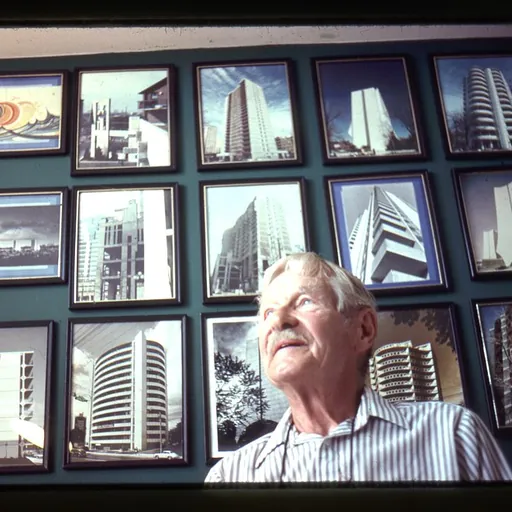
About Uno Prii
Lived 1924 – 2000 (aged 76). Uno Prii was an Estonian and Canadian architect.
alt=Uno Prii in his home picture gallery; "my work is original, and originality is the hardest thing to come by." Uno Prii in his Bloor St. E. condominium with a picture gallery of his works.
Uno Prii (February 28, 1924 – November 27, 2000) was an Estonian-born Canadian architect. He designed approximately 250 buildings, many in Toronto, but also around southern Ontario and the United States.
Some of his best-known works are apartment buildings in The Annex neighbourhood of Toronto, featuring outlines that make sweeping curves. These include The Vincennes at 35 Walmer Road (built 1966), Prince Arthur Towers at 20 Prince Arthur Avenue (1968), Brazil Towers at 485 Huron Street, and 44 Walmer Road (1969).
Early years
Uno Prii was born Tallinn and grew up in Estonia, where his father was an architect and builder. In 1943, Prii left for Finland, and in 1944, he moved to Stockholm, Sweden. He trained and worked as a civil engineer in Stockholm but left for Canada in 1950. He came to Toronto so that he could study architecture, and in 1955 he graduated cum laude from the University of Toronto School of Architecture, where he had studied under Eric Arthur. Every summer he worked with Eric Arthur's Fleury & Arthur firm until graduation.
Career
Prii created his own architectural firm in 1957. Having his own firm allowed him to explore his architectural vision, which diverged from the straight lines and simple forms emphasized by Modernism, the dominant style at the time. In the 1960s, apartment living was quickly growing in popularity as thousands of immigrants arrived in Toronto. Baby boomers also entered the work force and sought convenient living spaces.
The sides are blank concrete walls with a smooth texture and white finish, save for a black vertical stripe running the length of the walls, opening up to a massive arch at ground level. A rectangular section of the façade behind the arch is painted black for contrast. The white walls are contrasted with opaque blue balcony railings on the main façade facing the street, as well as on the opposite side of the building. The minimalism of the side walls furthers the sculptural aesthetic of the tower.
In 1969, Uno Prii would also see the completion of the Jane-Exbury Towers in suburban North York, a series of five towers staggered one after the other. These white towers share a similar sculptural design that references both The Vincennes and the Prince Arthur Towers. The roofline and side walls with an arch at ground level recall the Prince Arthur Towers, and an outward flare in the façade just above the lowest floors is similar to the Vincennes. The staggered arrangement of the towers on a large suburban site, surrounded by open green spaces, gives the towers an impressive presence, taking advantage of the more open suburban context.
44 Walmer Road 44 Walmer Road tower and fountain (1969) seen from Walmer Circle in 2011. Prii worked with Hiller again, and in 1969, his design for 44 Walmer Road was completed. The white façade is light and thoroughly rounded. The 12-storey apartment building is characterized by circular and linear motifs, with a semi-circular canopy over the driveway in front, perforated with large holes around the edges. Prii also designed a complementary fountain located in front of the building with two intersecting parabolic arches over a circular pool, connecting with the canopy. The water sprays upwards out of a large, concrete element shaped like a champagne glass, and spills out into a pool.
The building featured curvilinear, circle-patterned balcony railings designed in an artful pattern as its most distinctive feature. They were removed for balcony repairs to be made, but then owner Gaetano D'Addario decided not to reinstall them, choosing unremarkable clear glass railings in July 2001 as the replacement, in spite of protests from tenants, neighbours, the architect's family, and individuals in the architecture community like Larry Richards of the University of Toronto Faculty of Architecture.
Critics considered the buildings strange. Like Morris Lapidus in the United States, Uno Prii found himself popular, but not acclaimed, receiving no awards or recognition from his fellow architects. He noted in a 1999 interview in Taddle Creek that “they thought my work just looked funny...they didn’t like me...they didn’t like my work at all", though he remained proud of his original compositions, observing that "originality is the hardest thing to come by."
However, by the late 1980s and early 1990s, a new generation of architects and architectural enthusiasts had rediscovered the work of Uno Prii. Architects such as Michael McClelland of E.R.A. Architects, John Shnier of Kohn Shnier Architects, the University of Toronto's Larry Richards, past chairman of the Toronto Society of Architects Joe Lobko, and heritage architect Catherine Nasmith, have spoken of the importance of his work. As of 2007, 16 buildings designed by Prii have been listed in Toronto's Inventory of Heritage Properties.
Works
11 Walmer Road, Toronto, 1963 Americana, 141 Erskine Avenue, Toronto, 1963 300 Eglinton East, Toronto, 1964 425 Avenue Road, Toronto, 1965 The Vincennes, 35 Walmer Road, Toronto, 1966 90 Warren Road, Toronto, 1968 Brazil Towers, 485 Huron Street, Toronto, 1968 Gallery Towers, 50 Stephanie Street, Toronto, 1968 Prince Arthur Towers, 20 Price Arthur Avenue, Toronto, 1968 44 Walmer Road, Toronto, 1969 Jane-Exbury Towers, Toronto, 1969 100 Spadina Road, Toronto, 1969 Spadina Towers, 666 Spadina Avenue, Toronto, 1972 Weston Towers, 3400 Weston Road, Toronto, 1972 Alan Brown Building, 77 Elm Street, Toronto, 1983 22 Walmer Road (now substantially renovated)
Don’t just read it —
keep it.
Full-length biographies made to live with: read them, listen on the way to work, watch them tonight.
- E-book
- Audio
- Video
Instant download · yours to keep · every purchase keeps this site free
Important facts
People in Uno Prii's life
Named in this biography and alive at the same time





Related people
Same field, nearest in time


Contemporaries
People whose lives overlapped Uno Prii's


Frequently asked questions
Who was Uno Prii?
Estonian-Canadian architect (1924-2000)
When was Uno Prii born?
Uno Prii was born on 28 February 1924 in Tallinn.
When did Uno Prii die?
Uno Prii died on 27 November 2000 in Toronto.
What was Uno Prii's occupation?
Uno Prii was an architect.
What nationality was Uno Prii?
Uno Prii was Estonian and Canadian.
Sources & further reading
Cite this page
APA: Biography.guide. (2026). Uno Prii. https://biography.guide/uno-prii/
MLA: "Uno Prii." Biography.guide, https://biography.guide/uno-prii/.
Chicago: "Uno Prii." Biography.guide. https://biography.guide/uno-prii/.
Data last updated: 2026-09-22 · Spot an error? Report a correction.
Portrait: Wikimedia Commons · author & licence
Page generated 2026-09-27 05:03 UTC