
About Undine Smith Moore
Lived 1904 – 1989 (aged 84). Undine Smith Moore was an American composer and music educator.
Undine Eliza Anna Smith Moore (25 August 1904 – 6 February 1989), the "Dean of Black Women Composers", was an American composer and professor of music in the twentieth century. Moore was originally trained as a classical pianist, but developed a compositional output of mostly vocal music—her preferred genre. Much of her work was inspired by black spirituals and folk music. Undine Smith Moore was a renowned teacher, and once stated that she experienced "teaching itself as an art". Towards the end of her life, she received many awards for her accomplishments as a music educator.
Biography Early life Undine Eliza Anna Smith was born the youngest of three children to James William Smith and Hardie Turnbull Smith. Undine was the granddaughter of slaves. Her hometown of Jarratt, Virginia, consisted of a large African-American population, and she would later recall memories of the community singing and praying at the Morningstar Baptist Church. Of her childhood, she said that "above all else, music reigned." She was also a member of Alpha Kappa Alpha sorority.
Education At age seven, Undine Smith began taking piano lessons under Lillian Allen Darden, who later encouraged her to attend Fisk University, where she studied piano and organ with Alice M. Grass and theory with Sara Leight Laubenstein. Smith turned down a scholarship to Petersburg's Virginia Normal Institute in order to enroll at Fisk, a historically black college. From 1952–53, Moore studied composition with Howard Murphy at the Manhattan School of Music, and would often attend composition workshops at the Eastman School of Music. In 1927, Moore was hired to teach piano and organ at Virginia State College (now Virginia State University) in Petersburg, where she was also assigned with teaching classes in counterpoint and theory, for which she was "particularly renowned". The couple often performed together in recitals, as James Moore was a trained vocalist. On January 4, 1941, Moore gave birth to her only child, a daughter, Mary Hardie Moore. Aside from teaching, Moore considered the Center to be her "most significant accomplishment. In 1972, the Black Music Center closed after Smith Moore retired from Virginia State College. She traveled widely as a professor and lectured on black composers and also conducted workshops. Moore was a visiting professor at Carleton College and the College of Saint Benedict, and an adjunct professor at Virginia Union University during the 1970s.
She continued her teaching career as a distinguished professor at Virginia Union University until 1976, meanwhile teaching at multiple colleges in Minnesota. She taught various musicians including Camilla Williams, Billy Taylor, and Phil Medley.
Honors In 1973, Smith Moore was presented with the Humanitarian award from Fisk University. Smith Moore's contributions to music were recognized by the National Black Caucus, and, in 1981, Moore was invited to deliver the keynote address at the first National Congress on Women in Music at New York University. She was given the Virginia Governor's Award in the Arts in 1985. A historical marker was approved in 2010 for installation in Petersburg. Moore was named one of the Virginia Women in History for 2017.
Music Style Looking back at her years at Fisk University, Undine Smith Moore described her early compositions, especially her piano music, as having a general similarity to the music of Leopold Godowsky. Her compositional style did not "include any African American elements", and Moore did not produce much music until 1953 (during her studies with Howard Murphy), when a "marked change in style took place". Moore would transcribe melodies that her mother sang, which gradually inspired her use of African-American spirituals in her music.
In 1953, Moore composed the "powerful and dissonant" piano solo Before I'd be a Slave, "characterized by tone clusters, bitonality, and quartal harmonies" Moore acknowledged that there was "almost always strong contrapuntal influence" in her music, which began leaning towards a more dissonant counterpoint after 1953. Helen Walker-Hill, author of From Spirituals to Symphonies, writes that Moore's compositional style was "freely tonal… sometimes strongly modal, often using twentieth-century techniques…, frequently using recitative… style, almost always strongly contrapuntal, and dominated by the black idiom." Moore herself, however, only acknowledged "black folk music and Bach as true influences". Of the philosophy of her music, Smith Moore stated:
Compositions Smith Moore's works range "from arrangements of spirituals, to solo art songs, instrumental chamber music, and multimovement works for chorus, soloists, and instruments." Although she composed more than one hundred pieces between 1925 and 1987, only twenty-six were published during her lifetime. Moore wrote over 50 choral works, 21 compositions for solo voice and accompaniment, and 18 instrumental pieces. The 16-part oratorio is based on the life of the Reverend Dr. Martin Luther King Jr. and written for chorus, orchestra, solo voices and narrator.
Moore was a strong advocate for the promotion of black music and art: in her opinion, art could be used as "a powerful agent for social change". Moore was careful to point out that because of the social issues surrounding African-Americans, their music and art could be stereotyped:
Selected works
Piano solo Valse Caprice (1930) Before I'd Be a Slave (1953) Organ solo Organ Variations on Nettleton (1976)
Chamber ensemble Introduction, March and Allegro, for piano and clarinet (1958) Three Pieces for Flute and Piano (1958) Afro-American Suite, for two flutes, cello, and piano (1969) Soweto (1987)
Voice(s) and piano Source: Watch and Pray (1972) To be Baptized (1973) Lyric for TrueLove (1975) Come Down Angels and Trouble the Water (1978) Is There Anybody Here That Loves My Jesus (1981)
Chorus Daniel, Daniel, Servant of the Lord, SATB divisi (1953) Long Fare You Well, SATB divisi (1960) Tambourines to Glory, SATB (1973) Lord, We Give Thanks to Thee, SATB (1973) I Believe This Is Jesus, SATB (1977) Oh, That Bleeding Lamb, SATB divisi (1977) Walk through the Streets of the City SSATB (1977) We Shall Walk through the Valley, SATB (1977) I'm Going Home, SATB divisi, opt. soprano solo (1978) Lord, Have Mercy, SATB (1978) I Would Be True, SAB (1979) I Will Trust in the Lord, SATB divisi with solos (1989)
Chorus and orchestra Sir Olaf and the Erl King's Daughter (1925) Glory to God (1979) Scenes from the Life of a Martyr (1981)
Recordings "Daniel, Daniel, Servant of the Lord", on Steal Away: The African American Concert Spiritual (2016). Suite for Flute, Cello, and Piano on Songs for the Soul: Chamber Music by African American Composers (2010). "Before I'd be a Slave" on Soulscapes (2007). "Mother to Son" (1955), "We Shall Walk Through the Valley" (1977), "Tambourines to Glory" (1973), on Vocalessence Witness – Dance Like the Wind (2004). "To Be Baptised" (1973), "Set Down!" (1951), "I Want To Die While You Love Me" (1975), "Come Down Angels" (1978), on Ah! Love, But a Day – Songs and Spirituals of American Women (2000). "To be Baptized" and "Watch and Pray". On The Angels Bowed Down: African American Spirituals. "Come Down Angels and Trouble the Water" (1978), "I am in Doubt" (1981), "Watch and Pray" (1973), "Love Let the Wind Cry How I Adore Thee" (1961), on Watch and Pray (1994). "Tambourines to Glory" and "We Shall Walk through the Valley". On Dance like the Wind: Music of Today's Black Composers.
Don’t just read it —
keep it.
Full-length biographies made to live with: read them, listen on the way to work, watch them tonight.
- E-book
- Audio
- Video
Instant download · yours to keep · every purchase keeps this site free
Important facts
People in Undine Smith Moore's life
Named in this biography and alive at the same time



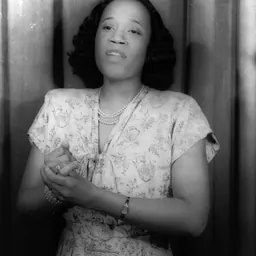


Related people
Same field, nearest in time




Contemporaries
People whose lives overlapped Undine Smith Moore's

Frequently asked questions
Who was Undine Smith Moore?
American composer (1904-1989)
When was Undine Smith Moore born?
Undine Smith Moore was born on 25 August 1904 in Jarratt.
When did Undine Smith Moore die?
Undine Smith Moore died on 6 February 1989 in Petersburg.
What was Undine Smith Moore's occupation?
Undine Smith Moore was a composer and music educator.
What nationality was Undine Smith Moore?
Undine Smith Moore was American.
Sources & further reading
· Wikipedia: Undine Smith Moore
Cite this page
APA: Biography.guide. (2026). Undine Smith Moore. https://biography.guide/undine-smith-moore/
MLA: "Undine Smith Moore." Biography.guide, https://biography.guide/undine-smith-moore/.
Chicago: "Undine Smith Moore." Biography.guide. https://biography.guide/undine-smith-moore/.
Data last updated: 2026-09-22 · Spot an error? Report a correction.
Page generated 2026-09-27 05:27 UTC