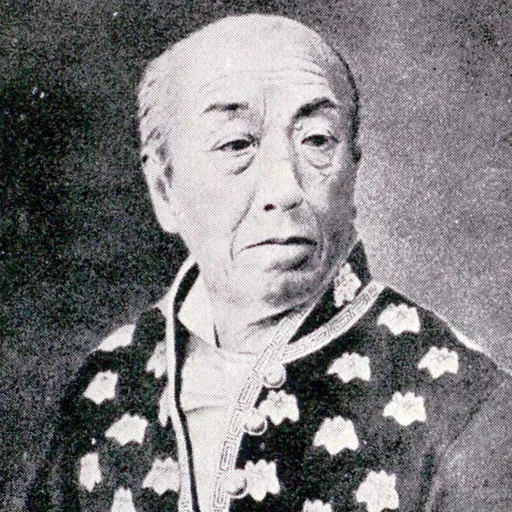
About Uesugi Narinori
Lived 1820 – 1889 (aged 68). Uesugi Narinori was a Japanese samurai.
was the 12th daimyō of Yonezawa Domain in Dewa Province, Japan (modern-day Yamagata Prefecture), under the Edo period Tokugawa shogunate of Japan.
Biography Uesugi Narinori was the eldest son of Uesugi Narisada and received the kanji of "nari" from Shogun Tokugawa Ienari as a special mark of favor. In 1836, he was awarded the courtesy titles of Shikibu-no-daiyu and Jiju, and Court rank of Junior Fourth Rank, Lower Grade. This title was raised to Danjōitaihitsu in 1839 when he became daimyō. Early in his tenure, he revived the practice of borrowing money from his retainers, which he used to fund the military modernization of the domain in response to ever increasing demands from the shogunate to contribute to Japan's coastal defenses. In 1859, the domain suffered from a severe epidemic of smallpox. In 1863, he was ordered to accompany Shogun Tokugawa Iemochi to Kyoto and was placed in charge of security at Nijō Castle during the visit. His courtesy title was also raised to Sakonoe-gon-chūjō and in 1864 his court rank was increased to Junior Fourth Rank, Upper Grade. In 1866, in recognition of the efforts he had made to modernize the domain's military and the expenses which had been incurred, the shogunate decided to raise the kokudaka of the domain by 30,000 koku. This was the first increase in territory which the domain had received in over 200 years.
Politically Uesugi Narinori was a reformer, and supported ending Japan's national isolation policy. With the start of the Boshin War, Uesugi Narinori was initially inclined to support the new Meiji government; however Yonezawa Domain was targeted for destruction by the Satchō Alliance along with Aizu Domain and his letters to the new government were rebuffed with exceeding rude responses. Outraged by the response, he joined with Sendai Domain in forming the Ōuetsu Reppan Dōmei. Initially the domain had a string of military victories even seizing the Port of Niigata. However, with the defection of Shibata Domain, the tide turned and the Uesugi forces were pushed back. Narinori approached the Meiji government again, offering to surrender. His offer was accepted only under the condition that the Uesugi army fight against their former allies of Kubota Domain and Aizu Domain (in the Battle of Aizu). Afterwards, the Meiji government still punished the domain by a reduction in its kokudaka of 140,000 koku. Furthermore, in 1868, he was forced into retirement. In 1869, his court rank was demoted to Junior Fifth Rank. He died in Tokyo in 1889.
Don’t just read it —
keep it.
Full-length biographies made to live with: read them, listen on the way to work, watch them tonight.
- E-book
- Audio
- Video
Instant download · yours to keep · every purchase keeps this site free
Important facts
Family & relationships
People in Uesugi Narinori's life
Named in this biography and alive at the same time

Related people
Same field, nearest in time




Contemporaries
People whose lives overlapped Uesugi Narinori's




Frequently asked questions
Who was Uesugi Narinori?
Saimyo of the Edo period, who ruled the Yonezawa Domain (1820–1889)
When was Uesugi Narinori born?
Uesugi Narinori was born on 20 June 1820 in Japan.
When did Uesugi Narinori die?
Uesugi Narinori died on 20 May 1889 in Tokyo.
What was Uesugi Narinori's occupation?
Uesugi Narinori was a samurai.
What nationality was Uesugi Narinori?
Uesugi Narinori was Japanese.
Sources & further reading
Cite this page
APA: Biography.guide. (2026). Uesugi Narinori. https://biography.guide/uesugi-narinori/
MLA: "Uesugi Narinori." Biography.guide, https://biography.guide/uesugi-narinori/.
Chicago: "Uesugi Narinori." Biography.guide. https://biography.guide/uesugi-narinori/.
Data last updated: 2026-09-23 · Spot an error? Report a correction.
Portrait: Wikimedia Commons · author & licence
Page generated 2026-09-27 05:07 UTC