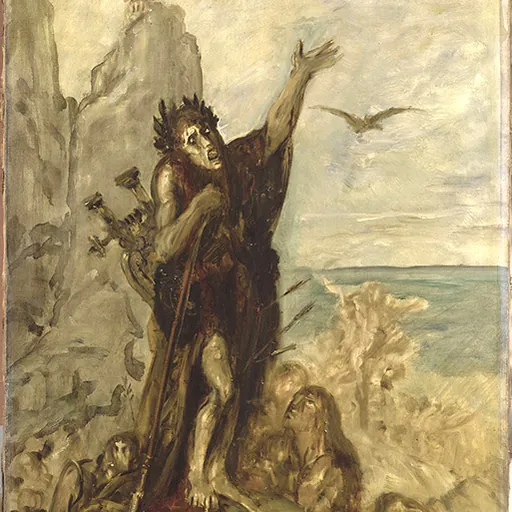
About Tyrtaeus
Tyrtaeus was a poet, writer and elegist.
Tyrtaeus (; Tyrtaios; fl. mid-7th century BC) was a Greek elegiac poet from Sparta whose works were speculated to fill five books. His works survive from quotations and papyri, and include 250 lines or parts of lines. He wrote at a time of two crises affecting the city: a civic unrest threatening the authority of kings and elders, later recalled in a poem named Eunomia ("Law and Order"), where he reminded citizens to respect the divine and constitutional roles of kings, council, and demos; and the Second Messenian War, during which he served as a sort of "state poet", exhorting Spartans to fight to the death for their city. In the 4th century BC, when Tyrtaeus was an established classic, Spartan armies on campaign were made to listen to his poetry. The Suda states that he wrote martial songs; these were important in Spartan festivals and were done through anapaestic and iambic chants that accompanied armed dances and processions.
Life
Birth and place of origin The floruit given in the first entry of Suda is perhaps too early since Jerome offers a date of 633–632 BC. Modern scholars are less specific and provide instead date ranges for the Second Messenian War (and thus for Tyrtaeus' life) such as "the latter part of the 7th century", or "any time between the sixties and the thirties" of the 7th century.
The confusion about his place of origin, which emerged by the 5th century BC, may have had several causes. It has been suggested that the depictions of Tyrtaeus as a lame schoolmaster from Athens were invented to denigrate Sparta, which in the views of Athenians could not have had a talented poet of its own. According to Pausanias, the Athenians sent the lame, mentally defective teacher-poet to Sparta as a compromise, wishing to obey the oracle which had demanded an Athenian, but unwilling to help the Spartans in their war with a more capable individual. Yet, Tyrtaeus was not listed by Herodotus among the two foreigners ever to have been awarded Spartan citizenship. One ancient source even listed Aphidnae as his supposed Athenian deme, but there was also a place of that name in Laconia.
Ancient Athenian propaganda might indeed have played a role, although even Plato, who could hardly have intended any denigration as an admirer of Sparta, gave credence to the poet's Athenian origin. According to scholar N. R. E. Fisher, "he story was surely an invention by Athenians, designed in the first instance for a predominantly Athenian market. It must have been aimed at making co-operation between Sparta and Athens more acceptable". It has also been noted that Tyrtaeus did not compose in the vernacular Laconian Doric dialect of Sparta, as could be expected of a native Spartan like his near contemporary Alcman. However, Greek elegists used the Ionic dialect of Homer regardless of their city of origin or their audience.
Scholars generally agree that Tyrtaeus was a native of Laconia for several reasons: the use of the first personal plural to include himself among the Heraclidae whom Zeus had given to Sparta in fragment 2; the presence of occasional Doric words in his vocabulary; and his tone of authority when addressing Spartan warriors, which would have been tolerated only if delivered by a Spartan-born poet.
Don’t just read it —
keep it.
Full-length biographies made to live with: read them, listen on the way to work, watch them tonight.
- E-book
- Audio
- Video
Instant download · yours to keep · every purchase keeps this site free
Important facts
Related people
Same field, nearest in time


Frequently asked questions
Who was Tyrtaeus?
Greek lyric poet
When was Tyrtaeus born?
Tyrtaeus was born in Athens, Sparta.
When did Tyrtaeus die?
Tyrtaeus died in Sparta.
What was Tyrtaeus's occupation?
Tyrtaeus was a poet, writer and elegist.
What nationality was Tyrtaeus?
Tyrtaeus's recorded nationality: Sparta.
Sources & further reading
Cite this page
APA: Biography.guide. (2026). Tyrtaeus. https://biography.guide/tyrtaeus/
MLA: "Tyrtaeus." Biography.guide, https://biography.guide/tyrtaeus/.
Chicago: "Tyrtaeus." Biography.guide. https://biography.guide/tyrtaeus/.
Data last updated: 2026-09-23 · Spot an error? Report a correction.
Portrait: Wikimedia Commons · author & licence
Page generated 2026-09-27 05:07 UTC