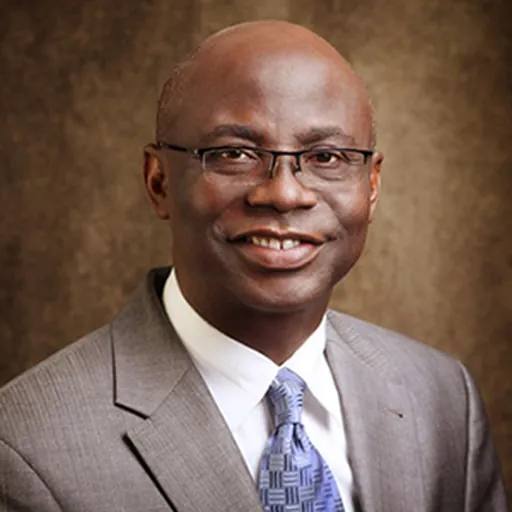
About Tunde Bakare
Born 1954. Tunde Bakare is a Nigerian televangelist, lawyer, teacher and activist.
Tunde Bakare (born 11 November 1954) is a Nigerian prophetic-apostolic pastor, corporate lawyer, author, and politician. He studied law at the University of Lagos and practiced with prominent legal firms before transitioning to full-time Christian ministry. He served as a legal adviser at the Deeper Life Bible Church, later moving to the Redeemed Christian Church of God where he pioneered its first Model Parish. In 1989, he founded The Latter Rain Assembly, later renamed The Citadel Global Community Church (CGCC).
Bakare entered active politics as the vice-presidential running mate to Muhammadu Buhari in the 2011 Nigerian presidential election under the Congress for Progressive Change (CPC) platform. He has been a fixture in Nigerian civil advocacy, convening the Save Nigeria Group (SNG) in 2010. Bakare has also maintained public commentary on governance in Nigeria and participated as a primary contestant in the 2022 All Progressives Congress (APC) presidential primaries.
Early life and education Bakare was born into a Muslim family in Abeokuta, Ogun State, on 11 November 1954. He completed his early education at All Saints Primary School, Kemta, Abeokuta, between 1961 and 1966, and attended Lisabi Grammar School, Abeokuta, from 1969 to 1973. He completed his secondary education at Zumratul Islamiyyah Grammar School in Yaba, Lagos, in 1974. He converted to Christianity on 24 September 1974.
Following a brief period working at First Bank, he studied law at the University of Lagos between 1977 and 1980, where he served as a member of the University of Lagos Students' Union (ULSU). He graduated in 1980, was called to the Nigerian Bar in 1981, and completed his mandatory National Youth Service Corps (NYSC) primary assignment at the Lagos State Ministry of Justice.
Ministry and leadership In May 1988, Bakare left private legal practice to enter full-time Christian ministry. He helped establish the first Model Parish of the Redeemed Christian Church of God (RCCG). On 1 April 1989, he founded The Latter Rain Assembly (now known as The Citadel Global Community Church), where he serves as the Serving Overseer.
Bakare presides over the Global Apostolic Impact Network (GAIN) and serves as President of Latter Rain Ministries, Inc. in Atlanta, Georgia. He hosts the globally syndicated television ministry program, Moment of Truth. In 1996, he was awarded a Doctor of Ministry degree by Indiana Christian University.
During the political alignments preceding the 2015 general elections, Bakare played an internal role in the 2013 merger that formed the All Progressives Congress (APC), moving the formal motion for merger at Eagle Square, Abuja, on behalf of the Congress for Progressive Change (CPC). In 2014, he served as a South West delegate to Nigeria's National Conference, where he proposed The Nigerian Charter for National Reconciliation and Integration, a policy document adopted into the conference's final report. Bakare is the Founder and Chairman of the Board of Directors of Citadel School of Government (CSG), a practitioner-based governance institution which signed a Memoransum of Agreement with the University of Lagos Business School (ULBS) in 2025 to jointly offer academic programmes such as the Advanced Diploma in Public Leadership and Statecraft.
Political candidacy In 2011, Bakare formally contested in Nigeria's general election as the vice-presidential running mate to Gen. Muhammadu Buhari on the Congress for Progressive Change (CPC) ticket.
In 2019, Bakare announced his intention to contest for the presidency of Nigeria after the expiration of Buhari's second term in 2023. He declared his candidacy on the platform of the All Progressives Congress (APC) in May 2022, running on a four-pillar manifesto focused on "Peace, Progress, Prosperity, and Possibilities." He participated in the party's primary election in June 2022.
Education development and philanthropy Bakare established the Family Heritage Foundation, a charitable initiative that provides academic scholarships to underprivileged students within Nigeria and abroad.
In October 2024, Bakare was awarded an honorary Doctor of Laws (LLD, Honoris Causa) by Afe Babalola University, Ado Ekiti (ABUAD), in recognition of his contributions to public sector institutional reform and nation-building.
Views and controversies Bakare has historically maintained a critical posture towards administrative leadership in Nigeria. He was arrested in March 2002 after delivering sermons critical of then-president Olusegun Obasanjo.
On Leadership and Nation Building
Pastor Tunde Bakare has consistently maintained that Nigeria's future depends on the emergence of leaders who combine competence, character, courage, and a deep sense of public purpose. Throughout his public ministry and civic engagement, he has argued that national transformation cannot be achieved by personalities alone but through the deliberate strengthening of institutions, the cultivation of responsible citizenship, and the preparation of principled leaders capable of responding to the complexities of governance in a rapidly changing world. He has repeatedly challenged both leaders and citizens to embrace responsibility over rhetoric, service above self-interest, and long-term nation-building over short-term political expediency. His interventions have consistently emphasised that leadership is not merely the exercise of authority but the disciplined pursuit of justice, accountability, innovation, and the common good. In his view, the measure of leadership lies not in the offices occupied, but in the enduring institutions built, the people empowered, and the positive legacy left for future generations.
On Governance and National Renewal
A defining feature of Pastor Bakare's public interventions has been his willingness to challenge the status quo while proposing practical pathways for national renewal. He has consistently advocated constitutional and institutional reforms—including restructuring as a means of strengthening Nigeria's federal system—arguing that such reforms are intended to enhance national unity, security, accountability, and shared prosperity rather than weaken the Nigerian state. His interventions have emphasised that enduring progress requires courageous leadership, informed civic participation, and institutions capable of adapting to the demands of the twenty-first century. He has also argued that the strength of a nation is ultimately determined by the quality of its institutions and the integrity of those entrusted with public office. Across successive administrations, he has called for leadership that is visionary rather than reactive, principled rather than expedient, and committed to justice, inclusion, and the rule of law. While often candid in his assessment of national affairs, his public engagements have consistently reflected an abiding optimism that Nigeria possesses the human capital, resilience, and strategic potential to emerge as a leading force on the African continent and in the global community if it embraces the necessary reforms.
On Controversies
Pastor Bakare's public interventions have at times generated significant debate and controversy, particularly because of his forthright engagement with political, economic, and ecclesiastical issues. Rather than avoid difficult conversations, he has often argued that truth is not always comfortable and that prophetic ministry carries a responsibility to confront societal failings. In explaining reactions to some of his messages, he has on several occasions alluded to the biblical declaration that "the Lord has a controversy with His people" (cf. Book of Hosea 4:1 and Book of Micah 6:2), maintaining that where God's standards are at stake, controversy is often a consequence of faithfully proclaiming His word rather than an end in itself. Whether praised or criticised for his positions, he has consistently maintained that his responsibility is to speak according to his convictions and leave the judgment of history to posterity.
Personal life Bakare is married to Olayide Bakare, and the marriage has produced five children.
Don’t just read it —
keep it.
Full-length biographies made to live with: read them, listen on the way to work, watch them tonight.
- E-book
- Audio
- Video
Instant download · yours to keep · every purchase keeps this site free
Important facts
People in Tunde Bakare's life
Named in this biography and alive at the same time




Related people
Same field, nearest in time



Contemporaries
People whose lives overlapped Tunde Bakare's



Frequently asked questions
Who is Tunde Bakare?
Nigerian clergyman
When was Tunde Bakare born?
Tunde Bakare was born on 11 November 1954 in Abeokuta.
What is Tunde Bakare's occupation?
Tunde Bakare is a televangelist, lawyer, teacher and activist.
What nationality is Tunde Bakare?
Tunde Bakare is Nigerian.
Sources & further reading
Cite this page
APA: Biography.guide. (2026). Tunde Bakare. https://biography.guide/tunde-bakare/
MLA: "Tunde Bakare." Biography.guide, https://biography.guide/tunde-bakare/.
Chicago: "Tunde Bakare." Biography.guide. https://biography.guide/tunde-bakare/.
Data last updated: 2026-09-21 · Spot an error? Report a correction.
Portrait: Wikimedia Commons · author & licence
Page generated 2026-09-27 05:01 UTC