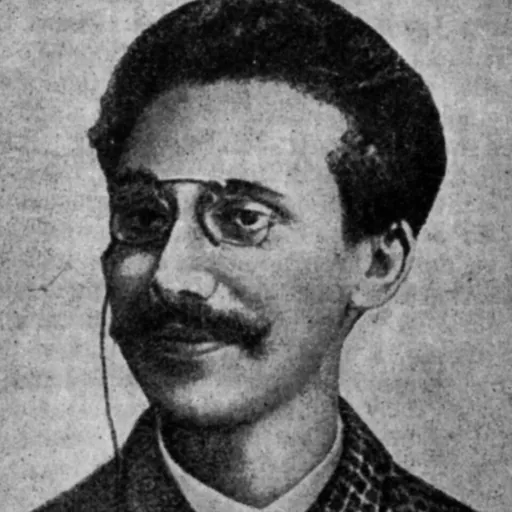
About Traian Demetrescu
Lived 1866 – 1896 (aged 29). Traian Demetrescu was a Romanian linguist, literary critic, translator, poet and writer.
Traian Rafael Radu Demetrescu (; also known under his pen name Tradem or, occasionally, as Traian Demetrescu-Tradem; December 5, 1866 – April 17, 1896) was a Romanian poet, novelist and literary critic, considered one of the first symbolist authors in local literature. Influenced by French writers such as François Coppée and the Decadent Maurice Rollinat, as well as by the local poet Mihai Eminescu, he was made popular by his poems, many of which served as the basis of popular romanzas. Receptive to impressionism and naturalism, he wrote a number of psychological novels and several short stories, some of which are remembered for their melancholic and occasionally macabre themes.
Also noted for his socialist convictions and his contributions as a journalist, Demetrescu advocated an original view of literature, which, despite placing emphasis on progressivism, was distinct from the Marxist views of his contemporaries Constantin Dobrogeanu-Gherea and Constantin Mille. A friend and associate of the influential poet Alexandru Macedonski, he played a minor part in a lengthy polemic with the conservative literary society Junimea, and authored a series of essays and memoirs documenting the Romanian intellectual environment.
Tradem was affected by the infectious disease, tuberculosis, which his contemporaries said was to be found in the depressive or exuberant tones in his writings. His original take on poetry served to inspire the Romanian symbolist groups. He is seen as a predecessor to Ştefan Petică, N. Davidescu and George Bacovia, while his prose was an influence on Caton Theodorian.
Biography Born in Craiova, Traian Demetrescu was the son of a pub owner known by the name of Gherbea; he had a sister, Victoria, and two brothers. One of them, Radu Demetrescu, graduated from the Theatrical Conservatory in Bucharest, where he befriended actor and future avant-garde dramatist George Ciprian, together with whom he was later employed by the National Theater Craiova.
Tradem kept memories of the house where he grew up, and especially of the fact that it was situated "among trees". Four years later, the latter recalled being gripped by "tremors of emotion" upon receiving his mentor's visit. Tradem recalled having spent an entire summer in Macedonski's Bucharest house. However, they came to disagree and eventually grew estranged—answering to claims that Macedonski was a vain and vindicative man, Tudor Vianu, his friend and biographer, indicated that this and other splits occurred "without coldness and the heart's versatility".
In March 1888, together with the lawyer G. D. Pencioiu, Tradem founded Revista Olteană, a magazine dedicated to literary and social criticism. In one of his articles, Demetrescu justified the new enterprise, arguing that Craiova displayed "a kind of snoozing, a sickly indifference in respect to intellectual life." In 1890–1892, he was also a collaborator for Constantin Mille's leftist newspaper Adevărul, one of his notable contributions being a study on the works of poet Théodore de Banville. During spring 1893, he became a member of the short-lived Romanian Social-Democratic Workers' Party, and helped organize it at a grassroots level, together with, among others, Alexandru Radovici and George Diamandy (Demetrescu ran the Craiova base, Radovici was active in Galaţi, and Diamandy represented the Romanian diaspora). Traian Demetrescu defended Constantin Dobrogeanu-Gherea in his polemic with Junimist leader Titu Maiorescu, and, after 1893, was among a group of younger socialists to mount a press campaign against Junimea (other people in the group included Dimitrie Anghel, Anton Bacalbaşa, Emil Fagure, Garabet Ibrăileanu, Raicu Ionescu-Rion, Sofia Nădejde, Henri Sanielevici, Constantin Stere, and Avram Steuerman-Rodion). One other socialist writer with whom Demetrescu came to associate at the time was the future Orthodox priest Gala Galaction.
Over the early 1890s, Demetrescu's condition worsened, and he sought treatment for tuberculosis in the Alpine climate regions of German Empire and in Austria-Hungary. In 1894, he was in Munich and later at the Rheyer Villa in Bad Reichenhall. According to Călinescu, Tradem was "alternatively exuberant and silent", with "unhealthy dumbnesses", and described by his acquaintances as having "a monstrous mixture of virginal purity and horrifying mental ruin".
George Călinescu indicated that Demetrescu was a read man, who was well-acquainted with works by some major figures of Medieval literature (François Villon), Renaissance literature and Humanism (Dante Alighieri, Petrarch, Torquato Tasso), the Age of Enlightenment (Jean-Jacques Rousseau, Antoine François Prévost), and Romanticism (Giacomo Leopardi, Edgar Allan Poe, Alfred de Vigny, William Wordsworth).
Early in its existence, Revista Olteană published many critical studies by Demetrescu and others, in which they discussed the literary works of the 19th century. Among the figures analyzed by him were Coppée, Louise-Victorine Ackermann, Paul Bourget, Alfred de Musset, as well as the Romanian Romantics Vasile Alecsandri, Dimitrie Bolintineanu, Mihai Eminescu, Veronica Micle, Nicolae Nicoleanu, and Mihail Zamphirescu. Tradem defined his style of literary criticism as "Impressionist", taking for his model Anatole France—in this assessment of France's style, he focused on one of the latter's statements ("The good critic is one who recounts his soul's adventures among the masterpieces"). Discussing this latter aspect, literary critic Paul Cernat notes that Demetrescu stood alongside Mihail Cruceanu, Alexandru Toma and Andrei Naum, all of whom merged a socialist discourse into their poetic vision, thus contrasting with Macedonski's post-Parnassian school, as well as with the balladesque literature produced by Ștefan Octavian Iosif. Researcher Lidia Bote proposed that Macedonski and Demetrescu were both eclectic figures representing a period when Symbolism was one of the many competing influences, and argued that a "pure" Symbolism only imposed itself in Romania after 1902, when Ştefan Petică published his earliest poems.
Demetrescu was one of Romania's earliest socialist poets, in the same generation as Constantin Mille and Ion Păun-Pincio, and a versifier of socialist battle hymns. According to his own words, Demetrescu had studied "the works of great socialist writers". Jean-Marie Guyau, and Hippolyte Taine. He believed Maiorescu was valuable, but no longer relevant. He also recorded that the theistic Macedonski answered "positive science" with "the grin of skepticism". Nevertheless, according to Tradem, Alexandru Macedonski flirted with Naturalism during the early part of his career, and admired the works of Gustave Flaubert and Émile Zola. His memoirs also provided detail on Macedonski's interest in visual arts, indicating that the older poet had always wished to become a painter, and that his determination had instead shaped the artistic career of his son Alexis.
At times, Demetrescu was contradicting himself. Călinescu noted that Tradem initially described Florile Bosforului ("The Flowers of the Bosphorus"), a book of poems by the Bolintineanu, with enthusiasm, but later considered them "banalities [and] light-hearted fantasies". This was notably present in a poem depicting the landscape of winter:
In analyzing Tradem's contributions, George Călinescu also indicated that, especially in interior scenes, the poet focused on images of "boredom", which "immerses [his] soul in the color black". while others survive as romanzas. Among the latter was a stanza many believe to be anonymous: Radu D. Rosetti, N. Davidescu, and especially George Bacovia. Călinescu noted that Tradem and Bacovia shared important traits: "proletarian sentimentalism, a fracticious attitude, morbid nostalgia, sad «philosophies» and most of all the tone of a heartbreaking romanza".
Both Tudor Vianu and Davidescu focused on Traian Demetrescu's place of origin as a staple of his style, and spoke of Demetrescu, Macedonski, Ion Minulescu and others as representatives of "Wallachian Symbolism", in contrast with Moldavians such as Bacovia, Petică, and Benjamin Fondane. In their view, Demetrescu and his fellow Wallachians was less focused on depicting obscurity and melancholy, and more precise in approach.
Tradem's legacy notably comprises his presence in the memoirs of Nicolae Condiescu, a fellow Craiova citizen,
In Craiova, Demetrescu is honored with a bust in his likeness, which was erected some ten years after his death, following intense campaigning by Adevărul journal. In 1978, the local authorities in that city have instituted the Traian Demetrescu-Tradem National Poetry Contest, which takes place annually. The festivities are occasionally hosted by the descendants of Tradem's relatives. There is a Traian Demetrescu Street in Craiova, and others of the same name in Braşov, Sibiu and Timișoara.
Published works Poezii (poetry, 1885) Freamăte (poetry, 1887) Amurg (poetry, 1888) Cartea unei inimi (poetry, 1890) Săracii (poetry, 1890) Profile literare (essay, 1891) Intim (poetry, 1892) Sensitive (poetry, 1894) Iubita (novel, 1895) Privelişti din viaţă (1895) Aquarele (poetry, 1896) Cum iubim (novel, 1896) Simplu (1896)
Don’t just read it —
keep it.
Full-length biographies made to live with: read them, listen on the way to work, watch them tonight.
- E-book
- Audio
- Video
Instant download · yours to keep · every purchase keeps this site free
Important facts
People in Traian Demetrescu's life
Named in this biography and alive at the same time





Related people
Same field, nearest in time
Contemporaries
People whose lives overlapped Traian Demetrescu's

Frequently asked questions
Who was Traian Demetrescu?
Romanian writer (1866-1896)
When was Traian Demetrescu born?
Traian Demetrescu was born on 5 December 1866 in Craiova.
When did Traian Demetrescu die?
Traian Demetrescu died on 17 April 1896 in Solca.
What was Traian Demetrescu's occupation?
Traian Demetrescu was a linguist, literary critic, translator, poet and writer.
What nationality was Traian Demetrescu?
Traian Demetrescu was Romanian.
Sources & further reading
· Wikipedia: Traian Demetrescu
Cite this page
APA: Biography.guide. (2026). Traian Demetrescu. https://biography.guide/traian-demetrescu/
MLA: "Traian Demetrescu." Biography.guide, https://biography.guide/traian-demetrescu/.
Chicago: "Traian Demetrescu." Biography.guide. https://biography.guide/traian-demetrescu/.
Data last updated: 2026-09-21 · Spot an error? Report a correction.
Portrait: Wikimedia Commons · author & licence
Page generated 2026-09-27 05:00 UTC